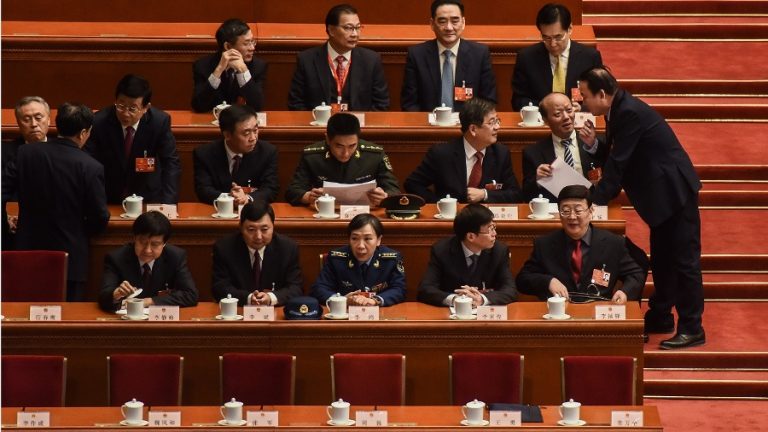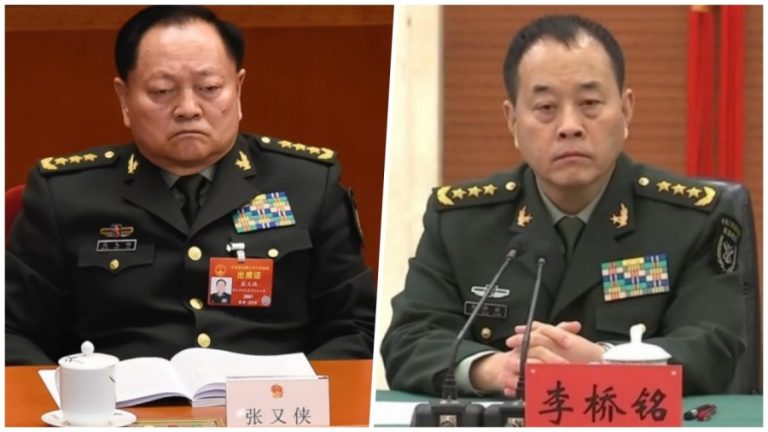
China’s rubber-stamp legislature announced on Feb. 26, 2026, that it had revoked the credentials of 19 delegates, including nine military officers, five of them holding the rank of full general. Among the purged: Li Qiaoming, the former commander of China’s ground forces, who once wrote a passionate defense of absolute Party loyalty in the military. His downfall is the latest in a cascade of military purges under Xi Jinping, China’s top leader, and it carries an irony so precise it reads like a parable.
In 2013, Li Qiaoming was a chief of staff in one of the Guangzhou Military Region’s group armies. Xi Jinping had just taken power. Li published an article in Red Flag Manuscript, a CCP theoretical journal, titled “The Historical Tragedy of the Soviet Military’s De-Partification.” The essay attacked Yevgeny Shaposhnikov, the Soviet air force commander who publicly quit the Communist Party during the August 1991 coup attempt, and other Soviet officers who broke with the Party in its final years.
The article was a loyalty signal. Xi was consolidating control over a military riddled with corruption under his predecessors, and ambitious officers were competing to demonstrate ideological devotion. Li’s argument was straightforward: the Soviet military’s willingness to abandon the Party led to the collapse of the Soviet Union, and Chinese officers must never follow that path.
Li, like countless other CCP military leaders, had no idea that over the next 13 years, the very Party he pledged to defend would destroy them one by one.
The photograph that changed a Soviet general’s mind
Much of Li’s 2013 essay drew on the book “How the Soviet Military Collapsed.” But there is a scene in that book that Li chose not to include in his article. It is a scene now playing out inside China’s own armed forces.
Success
You are now signed up for our newsletter
Success
Check your email to complete sign up
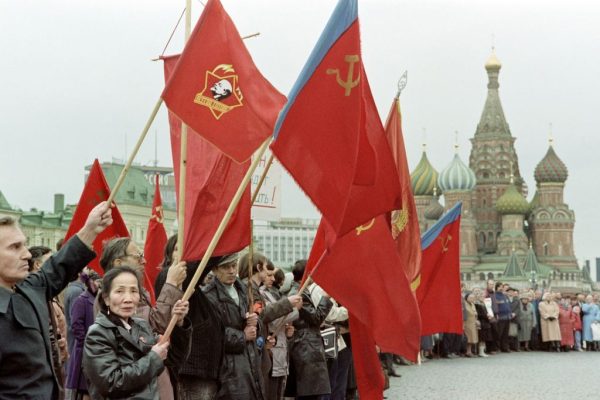
During the Aug. 19, 1991, coup, Shaposhnikov returned to his headquarters and his gaze caught a large photograph hanging on the wall. It showed his predecessors, the former commanders of the Soviet air force. Nine of them had served before World War II. Six had been arrested, declared “enemies of the people,” and shot. Two had died in unexplained aviation accidents. One had been tormented until he died of broken health. A postwar commander had been stripped of his rank and persecuted.
More than half of the men in that photograph had been executed or hounded to death by the very Party they served.
A journalist called Shaposhnikov shortly after and asked what he thought would happen next. Shaposhnikov replied that the emergency committee was not worth shedding blood for, “not even a single drop.” He agreed to let the journalist publish the conversation, asking only that his name be withheld.
The next morning, Aug. 20, Shaposhnikov sat down with his three deputies and said what he had been holding inside: the military must separate itself from Party control. “Regardless of the consequences,” he told them, “I am leaving the Party immediately.”
He then sent a subordinate, Barkov, to deliver a message to Boris Yeltsin. The message read: “The air force will not betray the people.” Barkov, overjoyed, rushed off to deliver it.
The Soviet military’s wave of party defections made the 1991 breakthrough possible
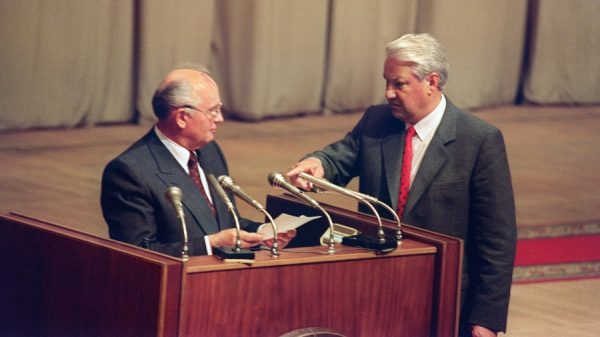
Shaposhnikov’s decision did not happen in isolation. A wave of Party resignations had already been sweeping through the Soviet armed forces.
In July 1990, Yeltsin announced his resignation from the Communist Party at the 28th Party Congress. The effect on military officers was profound. What began as a trickle of individual resignations swelled into a flood.
Throughout 1989 and 1990, growing numbers of officers quit the Party. The punishments were harsh. Lieutenant Colonel Alexander Rogin, stationed at a missile range on the Kamchatka Peninsula, resigned citing his hatred of corruption. He was confined to a psychiatric hospital and only released after he threatened to mobilize public protest. As the numbers grew, air force pilots became the service branch with the highest rate of Party defections.
Shaposhnikov later recounted that Defense Minister Dmitry Yazov confronted him almost daily, demanding to know what measures he was taking against the mass resignations. The exchange eventually became a running joke throughout the military:
“Yazov asks: What measures have you taken about the pilots leaving the Party?”
“Answer: None.”
“Why not?”
“It’s too late. They’ve all already left.”
“And what about you?”
“I’ve left too. Only you’re still in the Party, and maybe our General Secretary.”
By the time the August 1991 coup began, the groundwork had been laid. Officers in the Soviet Defense Ministry and General Staff “demonstratively tore up their Party cards and loudly told their colleagues that their grandfathers had been members of the self-defense forces, or that their grandfathers had set fire to Soviet collective farms.”
The navy commander, the air force commander, the strategic rocket forces commander, and the Leningrad Military District commander all questioned or opposed the coup committee’s orders from the start. The airborne forces commander, Grachev, led the paratroopers who had been ordered into Moscow to fulfill his promise to Yeltsin instead.

The purge Li Qiaoming never saw coming is now consuming China’s military
The Feb. 26 announcement stripped credentials from five full generals in a single day. Li Qiaoming, the former ground forces commander. Shen Jinlong, the former navy commander. Qin Shengxiang, the former navy political commissar. Yu Zhongfu, the former air force political commissar. Li Wei, the former political commissar of the Information Support Force, a branch Xi created in 2024 to oversee cyber and electronic warfare.
These five join an extraordinary procession of senior officers who have been swallowed by Xi’s purge machine. Former defense ministers Li Shangfu and Wei Fenghe were expelled from the Party in 2024. The former commander of China’s Rocket Force, the branch controlling the country’s nuclear and ballistic missile arsenal, was removed along with most of his senior staff. Dozens of generals have been investigated, dismissed, or disappeared from public view.
Two conspicuous names were absent from the Feb. 26 list: Zhang Youxia, the former vice chairman of the Central Military Commission, China’s top military command body, and Liu Zhenli, the former chief of the Joint Staff Department. Their omission has sparked intense speculation. Whether they face a different fate or have cut separate deals with Xi’s inner circle, no one outside the regime knows.
The history in that photograph on Shaposhnikov’s wall, the executed commanders, the fabricated charges, the comrades destroyed by the institution they served, is repeating itself inside the Chinese military. “Protecting the Party” or “abandoning the Party” has become a life-and-death choice for CCP officers and officials.

Chinese officers who want to survive the purge cycle have one option the Soviets already tested
Li Qiaoming cited the Soviet military’s history to argue that officers must never waver in their loyalty to the Party. But the history he cited proves the opposite. The Soviet officers who stayed loyal were the ones the Party consumed. The ones who broke away survived to see a different future.
It was precisely because a wave of resignations swept through the Soviet armed forces that the military refused to fire on the people during the August 1991 coup. The officers who tore up their Party cards, who told Yeltsin the air force would not betray the people, who turned their paratroopers against the coup plotters, were the ones who ended up on the right side of history.
Li Qiaoming read this history. He wrote about it at length. He drew exactly the wrong lesson. And the Party rewarded his loyalty by making him the next name on the wall.
For Chinese military officers now watching their colleagues vanish into the same machinery, the path the Soviets carved is still open. Quitting the Party is not the tragedy Li Qiaoming warned about. It is the exit he never took.