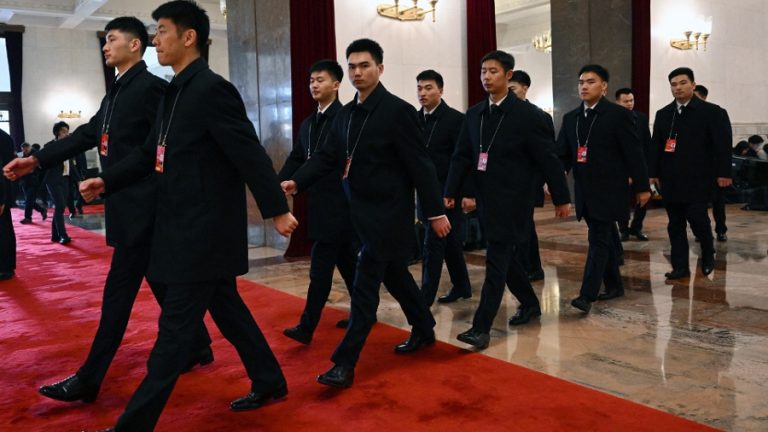
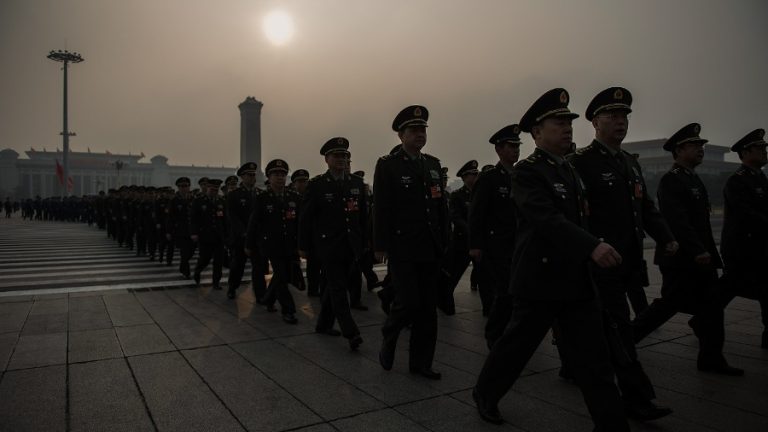
The closing session of Communist China’s National People’s Congress (NPC) was held on the afternoon of March 12, during which the “Law on the Promotion of Ethnic Unity and Progress” was passed.
Taiwan’s Mainland Affairs Council (MAC) warned that the law uses vague language and has a very broad scope. Depending on how the CCP interprets it, authorities can arbitrarily assign criminal charges. Individuals and organizations outside of China who violate its provisions could also be sanctioned. The law may provide a legal basis for the CCP to handle cross-strait issues in the future and exercise long-arm jurisdiction over so-called “Taiwan independence activists.” Human rights advocates worry that the new law could restrict language education and religious freedom for China’s ethnic minorities.
The CCP can arbitrarily assign guilt
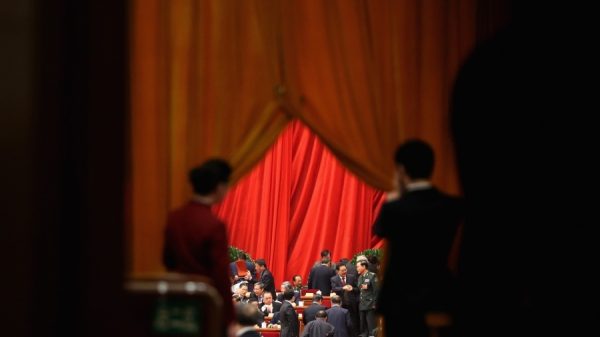
On March 12, the NPC held its closing session at the Great Hall of the People in Beijing. During the session, it passed resolutions on the “15th Five-Year Plan for National Economic and Social Development,” the “Civil Code of the People’s Republic of China on Ecological Environment”, the “Law on the Promotion of Ethnic Unity and Progress”, the “National Development Planning Law”, as well as reports from the Supreme People’s Court and Supreme People’s Procuratorate.
According to Sanli News, regarding the passage of the Law on the Promotion of Ethnic Unity and Progress, MAC Deputy Chair Liang Wenjie said at a routine press conference on March 12 that the law essentially legalizes the ethnic policies under Xi Jinping’s ideology. “In essence, this law regulates the work of China’s various ethnic groups and seeks to forge a unified Chinese national consciousness. But whether the law exists or not is not particularly important, because the CCP has been moving in this direction for years,” he said.
Liang noted that under this law, different historical interpretations that do not align with the Party’s approved view could be punished. The CCP may claim that individuals are violating national unity or deliberately inciting national division.
Success
You are now signed up for our newsletter
Success
Check your email to complete sign up
As an example, Liang cited a case mentioned in the CCP’s “Two Highs” (Supreme Court and Supreme Procuratorate) report involving Fu Cha, editor-in-chief of the Eight Banners Culture publication. The CCP considered Fu a key case for handling incitement of national division.
However, the “crime” committed by Fu was merely editing and publishing certain books, which, in the CCP’s view, did not align with the state’s perspective on history, ethnicity, culture, and religion. One of the books, “The Grasslands Without Tombstones,” discussed the massacres of Mongols during the Cultural Revolution and included historical investigation and reflection. “But for the CCP, this was intolerable; such a book should not have been published, and such historical accounts should not exist,” Liang said.
He emphasized, “We are watching this law very carefully.” Its wording is vague, and its scope is broad, allowing the CCP to interpret it arbitrarily and assign charges at will. The law applies not only within China; individuals and organizations outside China could also be sanctioned for violating its provisions. “In other words, historians, cultural figures, and religious groups in the U.S., Japan, and Taiwan could all potentially face sanctions. So we are particularly alert to this law.”

Alert on long-arm jurisdiction over Taiwan
Central News Agency reported that MAC Deputy Chair Shen Youzhong pointed out that while the law appears aimed at ethnic minorities within China, it also mentions activities abroad and emphasizes promoting ethnic unity and national unification. Thus, it could provide a legal basis to extend its reach to cross-strait issues and so-called Taiwan independence activists.
Shen said the law is vague and general, but its punishments are specific and explicit. The law includes provisions stating that foreign individuals or organizations who damage “ethnic unity and progress” or incite ethnic division will be held legally accountable.
He added that many CCP actions ostensibly aimed at maintaining internal stability could be transformed into long-arm jurisdiction or cross-border suppression.
Taiwanese officials noted that the law reflects a shift in CCP strategy. Previously, the CCP targeted specific beliefs, such as Taiwan independence. Now, individuals or groups that fail to actively promote Chinese unification could also face punishment.
An anonymous Taiwanese official told Reuters, “In the past, supporting Taiwan independence would get you punished. Now, you must actively support unification, or you will also get into trouble.”
New law may restrict minority language education and religious freedom
The CCP’s Law on the Promotion of Ethnic Unity and Progress has also drawn international attention. The law explicitly calls for “the comprehensive promotion and popularization of the national common language and characters”—Mandarin and standardized Chinese characters. It requires government agencies, organizations, and enterprises to prioritize the national common language over minority languages in public settings.
Volker Turk, UN High Commissioner for Human Rights, stated that the law could limit ethnic minorities’ language education and religious freedom in China. He said on social media that certain provisions could excessively restrict freedom of expression, belief, and assembly, and even punish minority groups for peacefully exercising their rights. He emphasized that under international human rights law, the state should protect minorities’ linguistic, religious, and cultural identities.
World News Network reported that some scholars, experts, and human rights activists believe the new law effectively replaces the 1980s legislation granting certain autonomous rights to areas with large minority populations. Due to vague language, frontline officials may adopt more aggressive enforcement measures, potentially provoking stronger backlash.
James Leibold, a professor at La Trobe University in Australia, said the law aims to showcase a new orthodox view of ethnic policy and represents a “legal milestone,” marking “the CCP’s final step in fully rejecting its original promises of autonomy for ethnic minorities.”
Max Oidtmann, a professor of Chinese history at Ludwig Maximilian University of Munich, said the law seeks to transform the psychological construction of a unified, homogenous nation into nationwide policy, not just something for border regions. “Due to a lack of objective standards to assess enforcement, officials will be very anxious during implementation. Various expressions of religion or ethnic identity are likely to face further suppression,” he said.
By Li Jingyao