By Cai Siyun, Vision Times
Chinese retail chain Pangdonglai finds itself in hot water after its founder announced a massive asset distribution plan for employees, followed days later by a regulatory investigation into one of the company’s food products, prompting speculation among internet users about the timing of the probe.
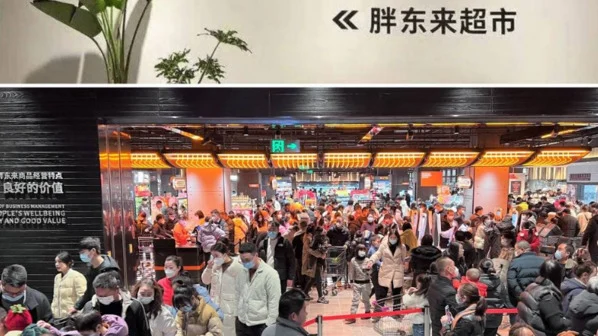
According to multiple reports by local media, including “National Business Daily” and “Southern Finance,” Pangdonglai founder Yu Donglai revealed on March 8 that the company would distribute 4 billion yuan (about $550 million) in assets among employees and management.
Founder vows ‘asset distribution’
Under the plan, approximately 50 percent of the assets would go to the management team and 50 percent to employees. The management team, comprising 718 people, including store managers and department heads, would receive assets worth 1.514 billion yuan in total. Among them, 12 store managers would share 240 million yuan, averaging roughly 20 million yuan each.
Meanwhile, 8,913 frontline employees would share about 1.811 billion yuan. The distribution would give 280 team leaders about 300,000 yuan each, while 8,633 ordinary employees would receive roughly 200,000 yuan each.
Success
You are now signed up for our newsletter
Success
Check your email to complete sign up
The announcement quickly went viral on Chinese social media, with many users expressing admiration for the company’s employee-focused approach. On March 11, Yu responded to growing online speculation, saying: “This is a real situation. There is no need to keep guessing.”
Employee ownership model
As discussions continued online, Yu issued another statement on March 14 explaining that the asset-sharing arrangement was not a sudden decision but part of a system the company has practiced for more than two decades.
RELATED: China’s Post-Holiday Job Market Collapsed Across Guangzhou and Shenzhen
He said the current restructuring was linked to plans to build a new “Dream City” store in Zhengzhou, requiring assets to be converted into equity shares. “For the past 26 years, Pangdonglai has pursued an operational model based on institutional management and shareholding,” Yu wrote. The goal, he said, is to motivate employees and help them understand that their income comes from their own contributions rather than from charity.
“When employees mature within this culture, the company gradually transitions to a genuine shareholding system,” he noted. Yu added that his own stake in the company is only about 5 percent, saying the structure helped create “an outstanding, confident, and compassionate Pangdonglai team.”
Online reactions were largely positive. “Companies like this are wonderful,” one user wrote, while another said, “So generous! I want to work there!”
Investigation sparks online debate
Despite the praise, the large-scale asset distribution also fueled speculation online. Some commentators suggested the move may have been intended to prevent outside pressure on the company, though such claims remain unverified.
Concerns about possible retaliation grew after reports surfaced days later that Pangdonglai was being investigated over allegations involving eggs sold at one of its stores. A social media blogger posted a video claiming that a brand of eggs sold at a Pangdonglai supermarket in Xuchang contained excessive levels of canthaxanthin, a coloring additive sometimes used in poultry feed.
The blogger cited a Ministry of Agriculture guideline that limits the additive in poultry feed to 8 mg/kg, claiming tests showed 9.54 mg/kg in the eggs. The following day, the Xuchang Municipal Market Supervision Bureau announced it had opened an investigation into the matter. Authorities said they would examine whether the additive was used legally and whether the product’s labeling accurately reflected its production methods.
Company responds to allegations
Pangdonglai issued an official response on March 15, stating that the blogger had applied the wrong regulatory standard. The company said the cited guideline applies to feed production, not to the final egg product itself.
Under China’s national food safety standard GB 2749-2015, fresh eggs are regulated primarily for microbial contamination and heavy metal levels, and no specific residue limits are set for canthaxanthin. The company emphasized that all eggs sold in its stores are sourced through legitimate supply channels and accompanied by complete documentation.
Pangdonglai said it had sent samples of the eggs to three independent testing laboratories for further verification. “If the final investigation finds problems with the eggs, we will immediately disclose the results, remove the products from shelves, initiate a recall, and assume legal responsibility,” the company said, adding, “If no issues are found, Pangdonglai will pursue legal action to protect its rights and hold responsible individuals, media accounts, and platforms accountable.”