To outside observers, the Chinese Communist Party’s notion of “collective leadership” has often appeared opaque and procedural—a bureaucratic arrangement that spreads responsibility across a group of senior officials.
Within Zhongnanhai, the leadership compound in central Beijing, the phrase carried a more practical meaning. It reflected a way of managing risk inside a political system that had once been shaped by the destructive force of personal rule.
Song Ping, who passed away on March 4 this year at the age of 109, was the last surviving member of the generation that helped rebuild the Party after Mao’s death. For decades he served as head of the Central Organization Department, the institution responsible for appointing and evaluating senior officials across the country. Few figures possessed greater influence over the Party’s internal hierarchy.
Song’s political worldview was shaped by the turmoil of the Cultural Revolution.
Beginning in 1966, Mao Zedong’s campaign unleashed waves of political persecution that engulfed the Party’s own leadership. Liu Shaoqi, once China’s head of state and Mao’s designated successor, died in detention after being denied medical treatment. Lin Biao, Mao’s publicly anointed heir and celebrated military ally, perished in a plane crash in Mongolia following what authorities described as a failed coup attempt.
Success
You are now signed up for our newsletter
Success
Check your email to complete sign up
For officials who lived through that period, the lesson was unmistakable. When power concentrates entirely in one individual, proximity to the leader becomes dangerous. Deputies, successors, and even long-time allies can quickly turn into perceived threats.

A blunt explanation behind closed doors
According to accounts circulating among retired officials with ties to the Central Organization Department, Song Ping once offered a stark explanation of collective leadership during a private discussion with cadres preparing to assume senior posts in the 1990s.
His comments, relayed second-hand, departed sharply from the Party’s public narrative.
“Do you think collective leadership exists to promote democracy?” he reportedly asked the group. “That’s what we tell the public.”
What followed was a more pragmatic description of how the system functioned internally.
“The real nature of collective leadership,” he said, “is a balance of terror.”
The phrase referred to a structure in which senior officials possessed compromising information about one another—corruption records, financial dealings, or family connections abroad. In such circumstances, removing a rival from office was possible. Attempting to destroy him entirely carried greater risks.
Qincheng Prison, the high-security detention facility outside Beijing used for disgraced senior officials, represented the ultimate threat. But anyone pushing an opponent toward that fate might find his own files exposed in return.
The account cannot be independently verified. Yet scholars of CCP elite politics say the description aligns with long-standing suspicions about how factional competition was managed after Mao’s era.
Under this interpretation, collective leadership operated less as a constitutional principle than as a deterrence mechanism.
A political bargain rather than a formal system
Ming Juzheng, a Taiwanese scholar who studies factional politics within the Chinese Communist Party, argues that the arrangement described by Song Ping resembled a negotiated equilibrium rather than a stable institutional framework.
During the period dominated by Jiang Zemin—from the aftermath of the 1989 Tiananmen crisis through the early 2000s—power circulated among several influential networks. These included officials associated with Shanghai, cadres who had risen through the Communist Youth League, and the so-called princelings, the children of revolutionary veterans.
Each group exercised influence in different areas of government and the economy.
Competition was persistent, but open confrontation remained limited. The reason, analysts say, was mutual vulnerability.
Because every faction possessed information capable of damaging the others, escalation carried the risk of exposing the entire system.
Corruption flourished under these conditions. At the same time, that corruption created incentives for restraint. Few senior figures could claim absolute innocence, and the consequences of total factional war—criminal prosecution, asset seizures, family disgrace—were severe enough to discourage it.

The system begins to change under Xi Jinping
The balance described above began to shift after Xi Jinping assumed leadership of the Party in 2012.
Xi launched an expansive anti-corruption campaign that has continued for more than a decade. Officially framed as an effort to restore discipline and public trust, the campaign has removed hundreds of senior officials across the Party, military, and state bureaucracy.
Supporters portray it as necessary reform.
Critics argue that it has also served to weaken rival patronage networks and consolidate authority around the central leadership.
Under the earlier factional arrangement, compromising information often functioned as a mutual deterrent. In the new environment, such information increasingly becomes evidence in formal investigations.
The old balance between competing groups has gradually eroded.
Different interpretations among analysts
Scholars disagree about how to interpret Song Ping’s reported defense of collective leadership.
Cheng Xiaonong, a U.S.-based analyst of Chinese elite politics, suggests that Song’s position reflects not only institutional concerns but also generational interests.
Under the earlier system, retired Party elders retained a measure of political relevance. Their networks, reputations, and informal consultations allowed them to influence leadership decisions behind the scenes.
Xi Jinping has steadily reduced that influence.
The once-common practice of senior leaders consulting retired figures has largely faded, and ceremonial respect for elder authority no longer carries the same political weight.
For officials who built their careers under the previous arrangement, the shift represents a fundamental change in how power operates inside the Party.

The disappearance of elite immunity
Another major difference concerns the consequences of losing internal political struggles.
During the decades associated with Deng Xiaoping, Jiang Zemin, and Hu Jintao, political defeat rarely meant complete destruction. Officials who fell from favor might be forced into retirement, placed under limited house arrest, or quietly removed from public life.
Membership in the Politburo Standing Committee—the Party’s top decision-making body—was widely believed to provide practical protection from prosecution after retirement.
That expectation began to unravel during Xi’s tenure.
The investigation and life sentence of Zhou Yongkang, a former Standing Committee member responsible for China’s security apparatus, demonstrated that even the highest ranks were no longer shielded.
Subsequent cases reinforced the message.
Today, a fall from power can lead to imprisonment in Qincheng Prison, the dismantling of political networks, and the confiscation of family wealth accumulated over decades.
The shift has altered the unwritten rules that once shaped factional competition.
The fading influence of the elders
During earlier decades, figures such as Song Ping and Qiao Shi—another influential veteran who once oversaw China’s intelligence and security systems—retained considerable authority after retirement.
Although formally removed from office, their networks and reputations continued to shape political outcomes.
Ignoring them carried risks.
That dynamic has largely disappeared. Retired leaders today appear primarily in ceremonial roles, and their interactions with one another are closely monitored.
In practical terms, the political system no longer relies on elder mediation to manage internal disputes.
For someone like Song Ping, who spent much of his career overseeing the Party’s personnel system, the transformation has been profound.
Patronage networks and the distribution of power
The changes also extend into the economic sphere.
Under the earlier factional arrangement, different networks held influence over different parts of the political economy. Officials associated with Shanghai dominated financial institutions, Youth League cadres were prominent in provincial administrations, and princelings often occupied leadership roles in state-owned enterprises or the military.
The arrangement produced widespread corruption, but it also distributed benefits more broadly among the elite.
Xi’s consolidation of power has narrowed those channels. Analysts say resources and influence now flow more heavily through networks associated with Xi’s earlier political base in Zhejiang province and through loyalists within the security services and military.
Other factions have gradually lost ground.
A symbolic moment at the 20th Party Congress
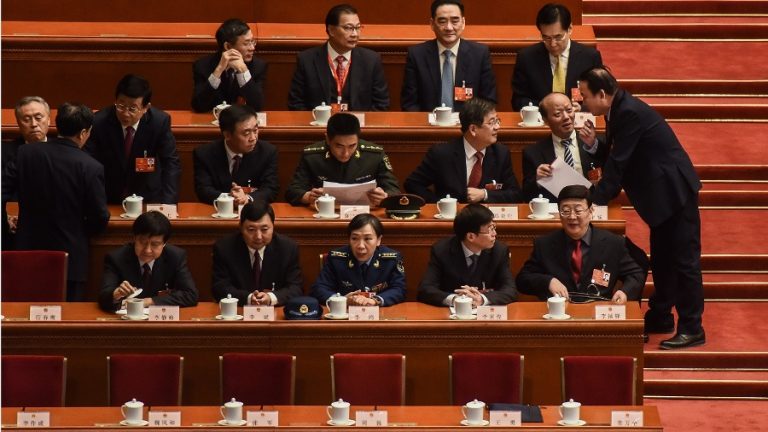
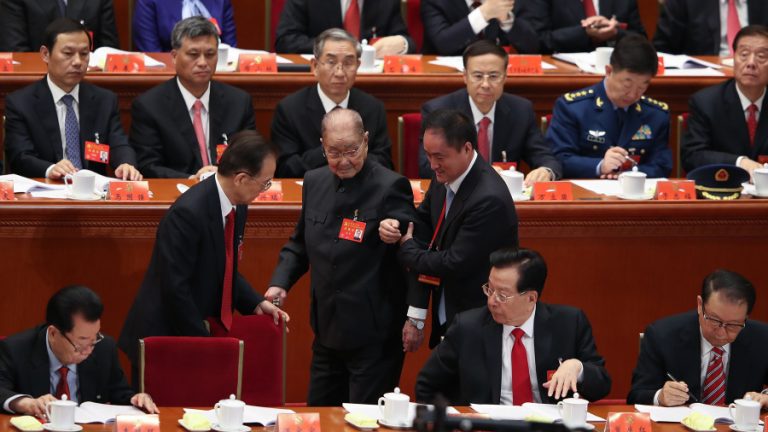
One moment that captured international attention occurred during the closing session of the Party’s 20th Congress in October 2022.
Former leader Hu Jintao, who served as China’s top official from 2003 to 2012, was escorted out of the hall in front of the assembled delegates and a global television audience.
Chinese authorities offered little explanation for the incident.
For many observers, the scene symbolized the changing balance within the Party’s leadership.
According to people familiar with Song Ping’s circle, the episode reportedly left the elderly statesman unusually quiet. Some accounts attribute to him a reflection on the system he had once helped maintain.
“We thought we had installed a safety catch,” he is said to have told associates. “Holding each other’s files was supposed to keep the peace.”
“But someone removed the safety catch and gathered all the files.”
The phrase he reportedly used—yu si wang po—describes a fish breaking through a net so violently that both are destroyed.
For decades, internal CCP politics operated under a form of mutual restraint among competing factions.
What follows the collapse of that balance remains unclear.
By Fu Longshan