In August 1998, inside a modest bookstore near the China Art Museum in Beijing, a routine literary event took an unexpected turn.
Wu Zuguang, one of China’s most prominent playwrights and cultural figures of the 20th century, stood up to speak. What followed broke with the cautious tone that had defined public discourse for decades.
He spoke loudly, forcefully, and without restraint.
Mao Zedong, he said, was a “bandit.”
According to a firsthand account by writer Zhang Yang, Wu used the term repeatedly. The reaction in the room was not silence. It was applause.
Success
You are now signed up for our newsletter
Success
Check your email to complete sign up
The event was held at the Sanlian Taofen Bookstore and centered on Nine Lives, One Survival: My Experience as a “Rightist”, a memoir by journalist Dai Huang, who had been persecuted during Mao-era political campaigns.
Around 70 to 80 people attended, a mix of senior intellectuals and younger participants. Among them were Li Rui, once an aide to Mao; economist Yu Guangyuan; reform-minded official Zhu Houze; and journalist Li Pu.
The discussion unfolded in a familiar rhythm. Speakers chose their words carefully, staying within the unspoken boundaries that had long governed public expression.
Then Wu spoke.
‘Why is his portrait still there?’
Wu questioned why Mao’s portrait continued to hang over Tiananmen Gate.
He accused Mao of driving extreme-left policies, launching the Cultural Revolution, persecuting loyal officials, and bringing disaster to the country. Mao’s legacy, he argued, should be fully repudiated. The portrait, he said, should have been removed long ago.
He went further.
Why, Wu asked, was Mao’s body still preserved in a mausoleum in Beijing, when Communist Party policy required cremation?
“Why should his corpse occupy a place?” he said, according to the account, adding that it should be cremated.
Throughout his remarks, the phrase returned again and again: “Mao the bandit.”
In mainland China’s public sphere, such language was virtually unheard of.
Applause, not silence
What followed surprised even those familiar with Wu’s reputation for candor.
Roughly 70 percent of the audience applauded. Many were middle-aged or elderly, people often assumed to be the most cautious. Some laughed, exchanged comments, or nodded in agreement.
The response suggested that Wu’s views, though rarely voiced openly, resonated more widely than public discourse would suggest.
Not everyone reacted the same way.
Several men believed to be security personnel remained rigid and expressionless. While others relaxed into the moment, they watched closely, their unease apparent. No action was taken.
Three days later, according to Zhang’s account, a publishing industry editor said officials had questioned the organizers, asking why Wu had been invited.
The publisher responded that the guest list had been arranged jointly with the author and that Wu’s remarks could not have been anticipated. They added that they had no enforcement authority, and that if intervention had been necessary, security personnel on site could have acted.
A pattern of outspokenness
The episode was not an isolated case.
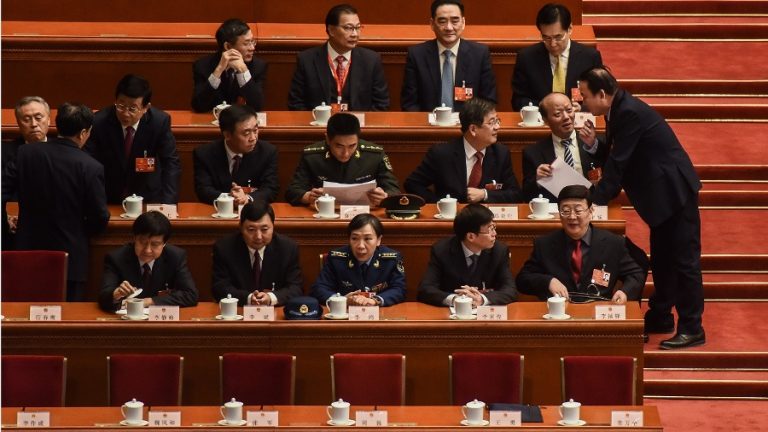
In the mid-1990s, Wu, then a member of China’s political advisory body, the Chinese People’s Political Consultative Conference, reportedly raised another sensitive issue during a group discussion: the 1989 Tiananmen Square crackdown.
According to an acquaintance’s account, Wu suggested that then–CCP leader Jiang Zemin could reinterpret the events by assigning responsibility to former Beijing Party chief Chen Xitong, who had fallen from power in 1995.
The proposal went nowhere.
Officials found themselves in an awkward position. Silencing Wu outright was difficult, yet his remarks carried clear political risk. Internal discussions produced an unusual response: Party-affiliated delegates would interrupt him collectively in future sessions to prevent him from speaking at length.
At one such meeting, participants prepared to carry out the plan.
Wu never spoke.
He sat quietly, eyes closed, appearing to fall asleep. The session ended without incident.
By 1998, when the advisory body was reshuffled, Wu was no longer included. When asked whether his removal was due to age, he pointed out that others older than him remained in their positions.
Wu Zuguang died in April 2003.
In the years that followed, many commemorative pieces were published. Yet some of these episodes, preserved in personal recollections, remained less widely known.
By Zhang Yang