The recent exposure of “sustained cyberbullying” against Chinese Olympic diving champion Quan Hongchan has ignited a wave of backlash and outrage among netizens on social media. Yet beyond the emotional reaction, some commentators suggest the incident (and its sudden amplification) may point to a more calculated narrative shaped by Chinese authorities.
RELATED: Quan Hongchan Targeted in WeChat Abuse Group, Insiders Face No Penalties
Years of abuse brought to light
Quan Hongchan, a rural native of Guangdong’s Zhanjiang, rose to international fame after her breakout performance at the Tokyo Olympics at just 14-years-old. But despite her extraordinary athletic achievements, including becoming one of China’s youngest multi-gold Olympic champions, she has reportedly endured years of targeted online harassment and incessant bullying.
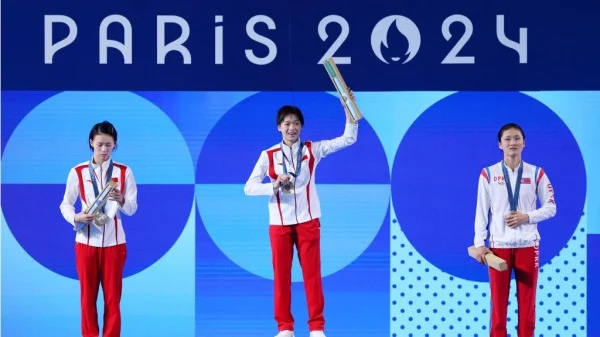
According to reports, from 2022 through April 2026, Quan was subjected to repeated verbal abuse in a WeChat group titled “Splash Conquerors Alliance.” The group, which included 282 members, allegedly comprised individuals from within the diving community, including athletes, judges, and state media reporters. Notably, the group’s rules explicitly stated: “Do not attack other athletes (except Quan Hongchan).”
On April 8, the Guangdong Ersha Sports Training Center confirmed it had reported the situation to police. The same day, China’s General Administration of Sport issued a statement condemning cyberbullying, declaring that such behavior would be dealt with “seriously and without leniency.” State media outlets quickly amplified the message, fueling a nationwide reaction.
Success
You are now signed up for our newsletter
Success
Check your email to complete sign up
In an earlier interview with mainland outlet Renwu, Quan appeared visibly distressed. With a trembling voice and tearful eyes, she pleaded: “I hope those who attack me will stop insulting me. It’s fine if they target me alone, but please try not to attack my family or my friends.” She added: “Maybe others are under a lot of pressure and just say things casually. I can understand. Life isn’t easy for anyone.”
Arrests tied to the case
On April 10, Guangdong police announced the detention of a 31-year-old man surnamed Xu for posting insulting remarks online. China’s Ministry of Public Security also stated that the suspect had created a “fan circle” group for diving, allegedly to vent frustrations.
However, some online observers questioned whether the detained individual was merely a scapegoat, arguing that the scale and organization of the harassment pointed to broader involvement. A widely-circulated commentary described the situation as deeply troubling, noting that Quan, despite helping to place China on a global stage, was pushed to the point of seeking official protection.
The article alleged that the WeChat group functioned less as a fan community and more as a coordinated space for targeted abuse. Even more concerning, participants were reportedly not anonymous outsiders but insiders within the sports establishment, including teammates, former athletes, judges, and journalists.
A culture of bullying
“They simply couldn’t accept it,” the commentary stated. “Why could someone from an ordinary background, with no connections, stand at the top of the podium and achieve what others never could in a lifetime? This distorted jealousy turned into the most vicious abuse, aimed at a girl who had no power to fight back.”
Political commentator Jiang Feng suggested that the structure of the “Splash Conquerors Alliance” mirrored the internal dynamics of Chinese officialdom. According to Jiang, the group’s composition, spanning athletes, referees, and media figures, represented overlapping spheres of influence: scoring power, media exposure, and public discourse.
Within this tightly knit network, Quan was described as an outsider, vulnerable to exclusion and targeted hostility. Jiang likened the alleged behavior to “selective enforcement” seen in political campaigns, where inclusion within elite circles determines protection.
He further noted that once the group was exposed, members quickly exited, deleted posts, and deactivated accounts — actions he compared to officials attempting to cover their tracks during corruption investigations.
Timing and narrative control
The official response has also raised questions about timing. Reports of Quan’s cyberbullying began circulating widely on March 31, yet authorities remained silent for over a week. It was not until April 8 that both central and provincial bodies issued statements and initiated legal action.
Jiang argued that this sequence suggests top-down coordination rather than spontaneous local intervention. “The central authority set the tone first, and only then did local officials act,” he said, describing it as a signal that higher-level approval was required.
He questioned why authorities waited eight days before responding and why the response was launched so prominently on a single day. In official language, the promise to punish offenders “regardless of who is involved” may indicate the involvement of individuals with significant backgrounds.
A well-timed diversion
Jiang further claimed that the timing coincided with major international developments that received little attention in China. On April 8, as domestic focus shifted to Quan’s emotional appeal, global headlines were dominated by reports of a large-scale U.S. military operation targeting Iran.
According to Jiang, Chinese authorities faced a dilemma: Promoting narratives about international events risked triggering domestic nationalist backlash or exposing geopolitical sensitivities. In this context, a high-profile domestic controversy could serve as a safer outlet for public emotion.
“Authorities needed an event that could instantly ignite public sentiment while remaining controllable,” Jiang said. “Quan Hongchan’s tears became that outlet.” While the full truth behind the cyberbullying, and the motivations behind its sudden exposure, remains unclear, the case has sparked broader debate about power, accountability, and narrative control in China.
Editorial note: Views expressed in this article are the opinions of the author and do not necessarily reflect the views of Vision Times.