The sudden removal of Sun Weidong, China’s vice foreign minister, has drawn widespread attention after authorities offered no explanation for the move or indication of his next post. The lack of transparency has fueled speculation about whether the personnel change signals promotion, internal reshuffling, or something more serious within the top levels of the Chinese Communist Party (CCP).
On April 14, China’s Ministry of Human Resources and Social Security released a new round of State Council personnel appointments. Among them, Zhao Wenfang was appointed deputy director of the National Railway Administration, while Sun Weidong was removed from his position as vice foreign minister. An Lusheng was also dismissed from a similar railway post.
RELATED: Ma Xingrui Officially Removed By The CCP, First Details of New Position Revealed
An unusual dismissal
While An’s removal drew little attention (he was born in November 1965 and has already reached the typical retirement age of 60 for vice-ministerial officials), Sun’s case stands out. Born in September 1966, Sun would not reach retirement age until later this year, making his early dismissal unusual.
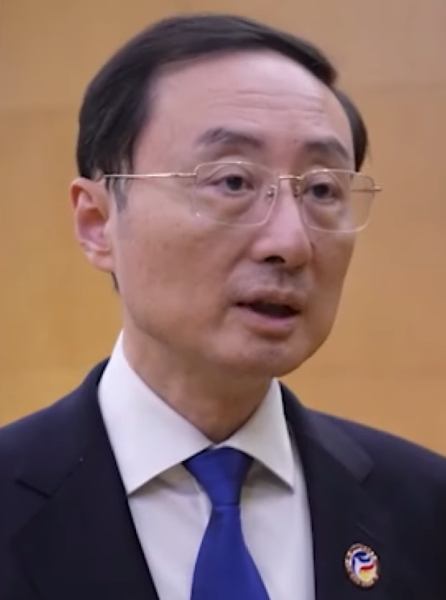
More notably, Chinese authorities did not disclose any follow-up appointment for Sun, leaving open questions about whether his departure is routine or signals a deeper political development. Observers note that in China’s political system, senior officials are typically reassigned or given honorary posts upon removal. The absence of such information has heightened speculation.
Success
You are now signed up for our newsletter
Success
Check your email to complete sign up
Sun was actively engaged in diplomatic duties just weeks before his dismissal. On March 28, he co-chaired the 11th meeting of the China–Philippines Bilateral Consultation Mechanism on the South China Sea in Quanzhou, alongside Philippine Deputy Foreign Minister Ma. Theresa Lazaro. On the same day, he also presided over the 24th round of China–Philippines diplomatic consultations.
His continued public appearances less than three weeks before his removal have made the abrupt decision appear even more striking.
Career background
Public records show that Sun Weidong, a native of Xuzhou, Jiangsu Province, has spent most of his career in Asian diplomacy. He joined the Ministry of Foreign Affairs in 1996 and served in various roles, including postings in Malaysia and India.
He was appointed ambassador to Pakistan in 2013 and later served as director-general of the Department of Policy Planning. In 2019, he became ambassador to India before being named vice foreign minister in August 2022.
According to reporting by Radio France Internationale, Sun was not a peripheral figure within China’s diplomatic system. He had long been responsible for Asian affairs, making his sudden removal without reassignment particularly noteworthy, analysts note.
A pattern of purges
Recent staff changes suggest a broader pattern of accelerated personnel adjustments within China’s political circles. From senior leadership positions to internal departmental roles, reshuffles have become more frequent.
In October 2025, ahead of a key Communist Party plenum, Chinese authorities announced a sweeping round of ambassadorial changes affecting seven countries and international organizations. These included new appointments in Morocco, North Macedonia, Malta, Romania, Ecuador, and Grenada, as well as a смена of China’s representative to the World Trade Organization.
Such large-scale changes have been interpreted by analysts as signals of internal recalibration within the system. Sun’s case is not different. Unlike typical rotations or promotions, his removal has been accompanied by silence regarding his next role. In China’s opaque political environment, such “removal without landing” has historically invited speculation.
Whether Sun Weidong’s dismissal represents a precursor to a promotion, part of a broader restructuring, or something else entirely remains unclear. Observers say the key indicator will be whether he reappears in an official capacity in the coming weeks, or continues to remain out of public view.
Editorial note: This article is based on publicly circulating reports and commentary from independent analysts. The claims described have not been independently verified by Vision Times, and relevant authorities have not publicly confirmed the allegations.