Taiwan’s President Lai Ching-te stated on April 14, after inspecting the “Han Kuang 42” war-gaming exercise, that only by strengthening self-defense capabilities can true peace be achieved. The Democratic Progressive Party (DPP) legislative caucus also called on Kuomintang lawmakers to attend the April 15 review of the central government’s general budget and the special defense legislation proposal to jointly discuss the matter.
Deputy Minister of the Interior, Ma Shih-yuan recently told Bloomberg that the government will soon conduct its first joint exercise involving the Ministry of the Interior and other agencies to ensure access to critical supplies in the event of a maritime blockade.
President inspects Han Kuang war game
According to a statement by the Ministry of National Defense, Taiwan’s military is conducting a continuous 14-day, 13-night annual “Han Kuang 42” computerized command-post exercise from April 11 to 24. The scenarios include events such as the Iran crisis and the U.S. capture of then–Venezuelan President Nicolás Maduro in January.
Lai Ching-te wrote on Facebook that he visited the Joint Operations Command Center to understand the progress of the Han Kuang 42 exercise. He also personally thanked officers and soldiers for shouldering the responsibility of defending the nation and for protecting sovereignty and peace around the clock.
Lai Ching-te also urged commanders at all levels to fully demonstrate their true capabilities without reservation, adopting the attitude that exercises are real combat, in order to identify shortcomings and uncover problems so that combat effectiveness can be continuously strengthened. He said that by simulating the most extreme battlefield environments and modeling the most complex threat scenarios, Taiwan can develop stronger response capabilities.
Success
You are now signed up for our newsletter
Success
Check your email to complete sign up
Lai noted that this Han Kuang war game incorporates the concept of whole-of-society defense resilience. It not only aims to enhance military–civilian coordination, but also ensures that the armed forces implement the spirit of “new training, new thinking, new equipment, and new technology,” in order to build asymmetric capabilities and enhance deterrence.
Lai emphasized that maintaining peace is a shared aspiration of the people, but peace cannot rely on a single agreement; it must be backed by one’s own strength. Only by strengthening self-defense capabilities can true peace be achieved.
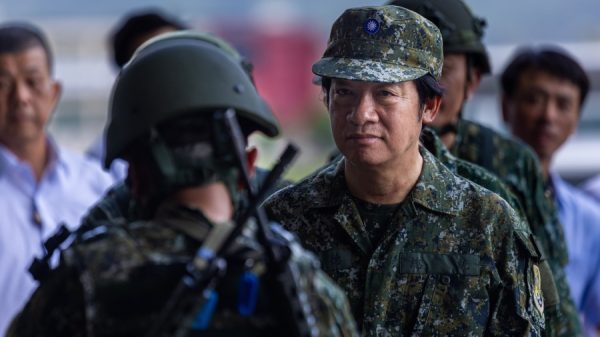
He added that as commander-in-chief, he and his government have both the obligation and responsibility to promote special defense budgets and support the armed forces. He hopes the Legislative Yuan, regardless of party affiliation, will support the government’s comprehensive plan so that the special defense budget will not be reduced and can be passed as soon as possible.
Special defense budget
He also said he firmly believes that this special budget, supported by more than 70 percent public approval, will not only help build a “Taiwan Shield,” but also effectively support the military and safeguard the lives and property of the people.
Regarding arms procurement issues, Legislative Yuan Speaker Han Kuo-yu will preside over a party caucus negotiation on April 15 to discuss the 2026 central government general budget and the special defense legislation proposal.
According to the Central News Agency, DPP caucus secretary-general Fan Yun and deputy whip Chen Pei-yu gave media interviews in front of the Legislative Yuan chamber.
Fan Yun said she strongly hopes that opposition lawmakers—especially Kuomintang (KMT) legislators—will attend, because during the previous negotiations in the Legislative Yuan Foreign Affairs and National Defense Committee on the draft special defense legislation, KMT lawmakers did not show up. A reasonable explanation at the time, she said, may have been that KMT Chairperson Cheng Li-wen was visiting China.
Fan Yun said that Cheng Li-wen has now returned to Taiwan, and the DPP caucus hopes to move forward with negotiations as soon as possible, placing public safety as the highest priority and passing the special defense legislation without any reductions. She said this is an urgent matter.
Chen Pei-yu also called on KMT lawmakers from the Legislative Yuan’s Finance Committee and Foreign Affairs and National Defense Committee to attend the negotiations. Although she believes tomorrow’s talks may still break down, the DPP caucus will proceed cautiously but remains optimistic, and also hopes Legislative Yuan Speaker Han Kuo-yu will step forward to defend the people’s budget. She said that as long as Han is willing to act fairly, there is still a chance for the general budget and the special defense bill to pass.
Regarding Han Kuo-yu’s plan to lead a cross-party delegation to Europe in May, Fan Yun said that, according to her understanding, this is an official invitation from the British and French parliaments. The DPP has always fully supported Taiwan’s engagement with the world and building friendships with democratic countries, so the caucus will send representatives to participate.

Taiwan plans cross-ministerial exercise
In response to the potential scenario in which Taiwan could be blockaded following a possible invasion by China, Bloomberg reported that Ma Shih-yuan warned that a large-scale blockade around Taiwan would impact the entire region, posing risks similar to Iran blocking the Strait of Hormuz during Middle East conflicts.
He said: “If the Taiwan Strait or surrounding areas are blockaded, it would be equivalent to a complete disruption of regional energy supply. This is not only Taiwan’s problem, but a problem for the entire region.”
Bloomberg wrote that although China has not yet threatened to cut off supplies to Taiwan or other economies, Taiwan continues to conduct regular exercises and prepare for possible hostile actions by the PLA.
A Ministry of National Defense spokesperson said on the 10th of this month that various scenarios and possible actions by the Chinese military are being incorporated into exercises in order to prepare corresponding response plans.
Taiwan’s Ministry of the Interior also told Bloomberg that the government is planning to hold a tabletop exercise simulating a blockade scenario around June. In September, it will also conduct drills to test the docking of international aid ships and the protection of domestic overland transportation.
Ma Shih-yuan noted that before July, the Ministry of the Interior will lead land transportation exercises, focusing on the domestic movement of supplies. The Navy and Coast Guard will conduct drills on escorting vessels navigating waters around Taiwan.
Ma added that unlike the Strait of Hormuz controlled by Iran, ships can bypass the Taiwan Strait by routing around Taiwan’s eastern side, into the Pacific Ocean. However, such a detour would likely increase shipping costs and extend transport times.
“We hope to maintain three maritime routes open to deal with a possible Chinese blockade,” he said, adding that large-scale disaster humanitarian relief operations are also a key focus. These routes would maintain Taiwan’s connectivity with the Philippines, Japan, and the United States.
Ma said he expects Japan and other countries to assist in future escort missions. He also noted that “freedom of navigation operations” in the Taiwan Strait have already demonstrated an emerging informal international consensus on keeping the strait open.
He emphasized: “Although there is no formal agreement, there is already a consensus among countries.” He added that even if a blockade were to occur tomorrow, he is confident Taiwan could keep shipping routes open.
By Li Zexu