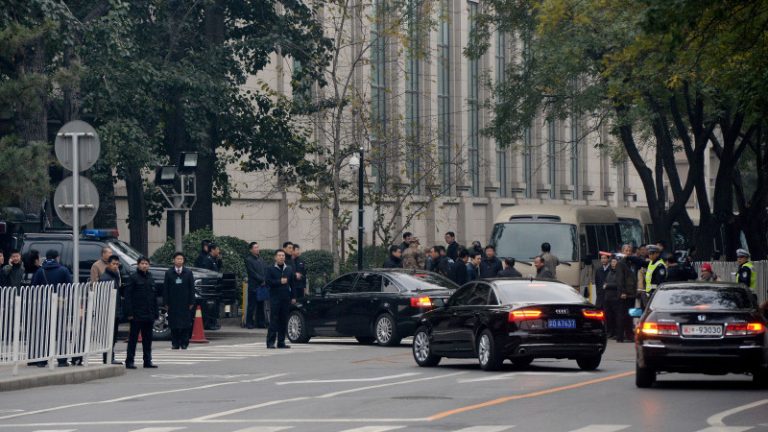
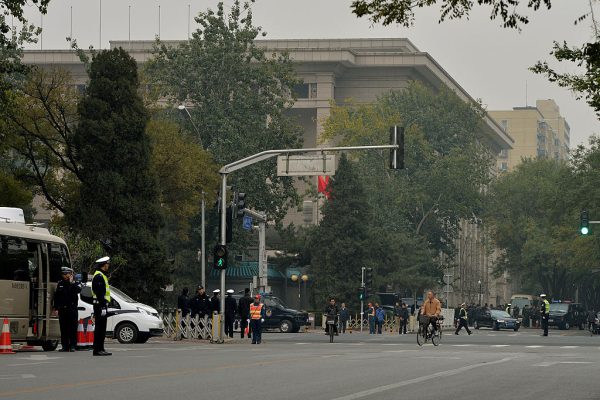
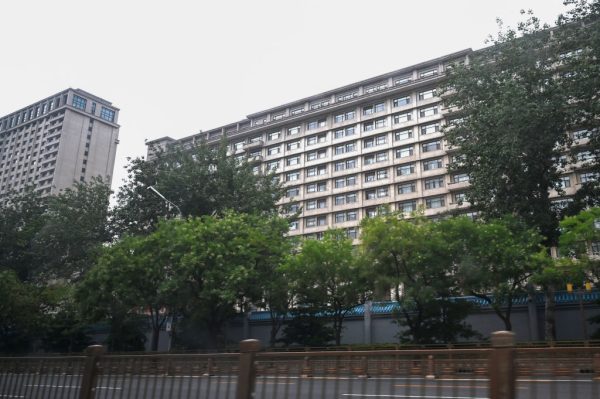
The gray building sits on the western extension of Chang’an Avenue, Beijing’s ceremonial spine, and in 2026 it continues to carry a reputation associated with internal Party matters. Historical accounts have long described the Jingxi Hotel as a location where sensitive decisions are handled outside public view, without judicial process or external oversight.
In recent years, its role appears to have expanded. According to accounts attributed to retired personnel connected to the Beijing Garrison, the facility has taken on additional functions linked to Party disciplinary activity. Li Xi, secretary of the Chinese Communist Party’s Central Commission for Discipline Inspection (CCDI), is described in those accounts as having transformed the hotel from a military reception venue into what some sources characterize as a “preliminary screening” site. Officials summoned there are said to view such notices as highly serious, and some accounts indicate that individuals prepare personal messages to family members before entering.
The Jingxi Hotel’s eight decades of political activity
The building’s role in Party history is closely tied to both its structure and its use over time.
Historical records indicate that during the Cultural Revolution in 1967, senior military figures, including Ye Jianying and Xu Xiangqian, gathered at the Jingxi Hotel and openly confronted members of the Central Cultural Revolution Group.
In October 1976, widely documented accounts show that the hotel was used as a coordination site for the arrests of Jiang Qing and other members of the group later labeled the “Gang of Four.” Meetings involving Ye Jianying and Wang Dongxing took place there prior to the operation.
Success
You are now signed up for our newsletter
Success
Check your email to complete sign up
In December 1978, while the Third Plenary Session of the Eleventh Central Committee was formally held at the Great Hall of the People, multiple accounts indicate that key negotiations over personnel arrangements and policy direction were conducted at the Jingxi Hotel.
Subsequent political arrangements, often described using the phrase “five lakes and four seas,” referred to a distribution of influence among different factions. Analysts have described this period as one in which factional balance shaped internal decision-making. Over time, particularly into the 1990s, some observers have linked such arrangements to patterns of patronage involving state-controlled assets.
Some reports also indicate that in late May 1989, during the lead-up to the Tiananmen Square crackdown, military commanders met at the Jingxi Hotel to discuss operational matters.
More recent accounts from sources familiar with Party disciplinary work say that Li Xi has held closed-door meetings there with officials in financial sectors, including insurance and securities. A Party internal communication cited in overseas reporting describes one such meeting in Building Three as being followed by the disappearance of several senior industry figures. These claims have not been independently confirmed.
Security features and communication controls
Descriptions of the Jingxi Hotel’s physical structure suggest it has been designed to restrict communication.
According to accounts circulated in technical and security discussions, core meeting rooms in Building Three are constructed with copper mesh embedded in the walls, forming a structure similar to a Faraday cage that blocks electromagnetic signals.
Reports further indicate that a renovation completed in 2025 included the installation of signal-jamming systems capable of interfering with satellite communications and newer mobile network frequencies. Individuals entering the facility are described as being unable to use personal communication devices.
Meeting rooms used for internal questioning are reported to have no windows, with soundproofing measures in place.
Some accounts describe communication inside the facility as relying on an internal system of encrypted lines, sometimes referred to as “System 39,” reportedly managed by central Party offices. Calls made through this system are described as subject to monitoring and transcription, though these details have not been independently verified.
These reported features are cited by sources as explanations for the limited ability of individuals inside the facility to communicate externally.
Disciplinary procedures and asset handling
Accounts from overseas Chinese networks and individuals familiar with disciplinary practices describe a multi-stage process used by the CCDI.
In the initial stage, officials are said to receive a summons framed as an administrative meeting. Some sources indicate that individuals are given a limited period to present assets and provide written statements. In certain accounts, cooperation is described as influencing subsequent administrative outcomes.
If such conditions are not met, or if the case involves higher-level considerations, individuals may be transferred to other facilities, including locations in Miyun or Qincheng Prison, according to these reports.
A document described as notes from a 2025 provincial disciplinary meeting, circulated online, outlines principles suggesting that voluntary cooperation and asset recovery may influence case classification. The document also refers to the consideration of investigative costs and financial recovery. Its authenticity has not been independently verified.
Asset allocation practices inside investigations
Some accounts describe an internal system for handling assets associated with corruption investigations.
According to sources cited in overseas discussions, assets identified in investigations may be divided into portions recorded in official disclosures and other portions handled through internal channels. These claims include descriptions of transfers involving offshore accounts, intermediary entities, or physical assets. Such descriptions have not been independently verified.
In certain reported cases, individuals who cooperate are described as receiving administrative rather than criminal penalties, depending on how cases are classified in official records.
One example cited in circulating accounts involves a provincial official whose confiscated assets were reportedly only partially reflected in official documents. These accounts allege discrepancies between seized items and those recorded, though no independent confirmation is available.
Centralization of authority and changing internal dynamics
Observers of Chinese politics say the current disciplinary system reflects a broader concentration of authority under Xi Jinping, the CCP’s general secretary.
In earlier periods, Party governance involved multiple factions whose interactions shaped internal outcomes. Some analysts have argued that these dynamics functioned as informal constraints within the system.
More recent developments, they say, point to a shift toward more centralized decision-making, with the Central Commission for Discipline Inspection (CCDI) playing a central role in enforcement.
Accounts describing the Jingxi Hotel’s current function place it within this broader structure. According to sources cited in overseas reporting, officials may be required under disciplinary procedures to sign asset transfer documents or grant access to financial holdings. These accounts have not been independently verified.
The Jingxi Hotel has long been linked in various accounts to major internal Party decisions. Both historical records and more recent descriptions associate it with processes that take place outside formal legal frameworks.
Editor’s Note: This article is based on media reports, publicly shared online materials, accounts attributed to individuals familiar with the situation, and documents circulated among overseas Chinese networks. The claims described have not been independently verified.