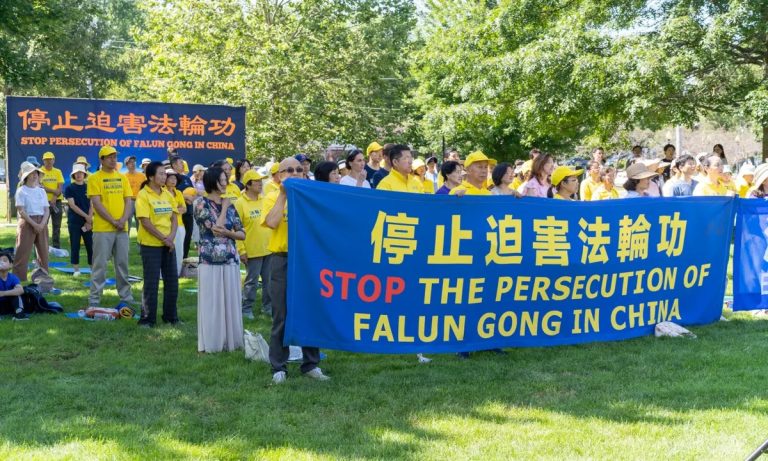
Saturday, April 25, will mark 27 years since the persecution of Falun Gong, a spiritual discipline in China, began in 1999. On this occasion, an article published on Minghui.org, a website of the Falun Gong community, describes how Jiang Zemin, the former Chinese leader, allegedly manipulated a peaceful protest of practitioners for political gain and how the protesters narrowly escaped being killed.
Through a personal account, the writer highlights how human rights violations against practitioners in China have continued unabated.
Tens of thousands of Falun Gong practitioners and supporters gathered peacefully on April 25, 1999, from across the country at Zhongnanhai, the headquarters of the Communist Party of China (CPC) and the State Council in Beijing. The protesters dispersed peacefully a few hours later, but between their arrival and departure, significant developments were unfolding in the mind of Jiang Zemin, who was then the CCP’s leader.
Titled “Insider Revelation on ‘April 25’: Jiang Zemin Illegally Defined the Event and Allegedly Deployed Forces for a Same-Day Crackdown,” the article states:
“According to a tip from a reader, a senior Chinese Communist Party official revealed that on the day of the ‘April 25’ petition, although the outside world saw practitioners waiting quietly and in an orderly manner, the atmosphere around Fuyou Street concealed an extremely tense and dangerous situation.
Success
You are now signed up for our newsletter
Success
Check your email to complete sign up
“At that time, then–top CCP leader Jiang Zemin had secretly ordered troops to be placed on standby. To avoid drawing attention, these soldiers were all dressed in police uniforms, with live ammunition loaded. Once an order was given, they would have killed all those labeled as ‘besieging Zhongnanhai’ at the petition site.”
The report further states that several central government leaders strongly opposed such action and urged that dialogue be held first with representatives of the petitioners. If the petitioners agreed to disperse, force should not be used. After several senior officials met with practitioner representatives and reached a mutual understanding, Falun Gong practitioners dispersed quickly and peacefully.
They even cleaned up litter at the site, demonstrating a high level of discipline. Had this not occurred, Fuyou Street that night might have seen a violent incident similar to the events of June 4, 1989, popularly remembered as the bloody Tiananmen Square Massacre.
Never before had China witnessed so many people petitioning together in such a quiet and disciplined manner. However the protestors had no idea that a very dangerous situation was unfolding behind the scenes.
More than ten thousand Falun Gong practitioners that day were saved from being shot by the Chinese Communist Party, which demonstrates that kindness and goodness can calm bloody intentions. Looking at it the other way, everyone might consider this: if Falun Gong were not truly very good, then many central government leaders would not have advised Jiang Zemin “not to open fire”; and if Falun Gong practitioners at the scene had not been so restrained, self-disciplined, kind, and peaceful, it would have been difficult to restrain Jiang Zemin, who was reportedly ready to give the order to open fire at any moment.
Persecution enters 27th Year
Now, the persecution of Falun Gong by the CCP has entered its 27th year. Over these 27years, every year when the “April 25” event is commemorated, Falun Gong practitioners have continued to share moving accounts of what they experienced and witnessed that day. However, the article said this is the first time that such a detailed “inside high-level revelation” report has come out.
For the first time a report has disclosed that Jiang Zemin that day had a plan for a brutal massacre. Many other memoir-style articles on the website also mention that, based on their deep understanding of the CCP, they went to appeal with a calm mindset prepared to face death.
The article also states: “Senior CCP officials also revealed a major legal absurdity: the designation of Falun Gong was not based on any factual investigation, but rather on Jiang Zemin’s personal jealousy and arbitrary decision-making.”
It further claims: “At an internal meeting attended by leaders from Beijing and the Ministry of Public Security, no ministry leader was willing to ‘take responsibility’ for a designation that contradicted investigative facts.”
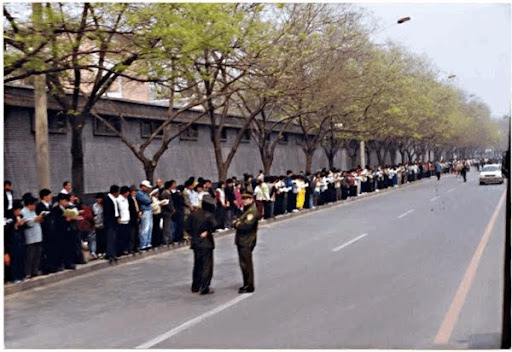
Contrary to CCP propaganda, The Falun Gong “April 25” appeal was not staged, nor was it ever rehearsed. Falun Gong practitioners did not know that guns were secretly pointed at them, and no one told them in advance how they should behave in order to avoid being shot. Unlike CCP-organized activities, which require rehearsals and selecting trusted participants who will “perform well,” Falun Gong practitioners acted entirely voluntarily and naturally, without any packaging or staging. They were ordinary, real individuals.
People came from Beijing and surrounding provinces and cities. Many did not know each other, but because they consciously disciplined themselves and followed Truthfulness, Compassion, and Forbearance, the central values in the discipline, they remained kind, and peaceful, with no aggression expressed at the site. Even the police were influenced by this atmosphere and felt no tension.
Unprecedented form of petitioning
This kind of unprecedented form of petitioning even puzzled central government leaders—how could Falun Gong have such strong organizational discipline, they wondered, according to the article.
In fact, it was not organizational discipline, but internal self-discipline. When people hold themselves to high moral standards, this kind of behavior is not difficult to achieve. This is also why, after an agreement was reached and people left peacefully, some practitioners felt embarrassed when they saw others picking up trash they had discarded. They felt they had not done well and resolved not to do it again in the future, and some even began to voluntarily pick up trash left by others. In this way, people influenced one another, and everyone gradually understood how to behave properly.
Continuing on the topic of “self-discipline”: Falun Gong practitioners went to the State Council Letters and Visits Office to appeal primarily to seek the release of more than forty Falun Gong practitioners who had been illegally arrested in Tianjin, as well as to request the restoration of their freedom to practice exercises and the publication of Falun Gong books. These were the three main reasons.
The Falun Gong practitioners in Beijing were the first to arrive. They initially stood on the sidewalks, and there were no practitioners on the main road itself—only normal traffic such as cars and bicycles passing by. As practitioners from other regions gradually arrived, they observed this situation and understood that their presence should not disrupt city traffic, so they naturally also stood on the sidewalks.
This reflected Falun Gong practitioners’ habit of considering others, their high personal conduct, and their desire to align themselves with those of higher standards, said the article.
For example, some practitioners from rural areas did not know what a “blind lane” (pedestrian guide path for the visually impaired) was. But when other practitioners reminded them, “Please leave the blind lane open and do not block the passage for blind people,” they would quickly move aside. Even when no blind person was present, they still kept the path clear. In this way, the idea spread from one person to many, and very quickly the blind lanes were all kept unobstructed. People who think of others are very willing to do this.

A Case of protecting human rights
During the April 25 appeal, Falun Gong practitioners were simply protecting their human rights and their freedom of belief in accordance with the Chinese law. Therefore, during negotiations, the issues discussed were all related to Falun Gong (such as releasing the detained practitioners in Tianjin, restoring the publication of Zhuan Falun, and allowing a legal environment for practice).
After central government leaders reached an understanding with the Falun Gong representatives selected on site, the practitioners left peacefully on their own.
More than ten thousand people came and then left, and the scene looked as if no one had ever been there. From beginning to end, there was no noise and no mess left behind—who could achieve this? Only Falun Gong practitioners. This is also why everyone who witnessed the scene was moved by the positive atmosphere.
At the time, international media praised China for the peaceful resolution of the incident, saying that April 25 showed openness, rule of law, and hope.
However, three months later in July, a nationwide persecution aimed at “group extermination” ultimately began, allegedly driven by Jiang Zemin’s personal ambition. It is also said that only the CCP was suited for such actions and such events—like wolves and hyenas conspiring together, filthy water meeting a sewer.

Another story
A friend of mine, an overseas student studying mathematics in the United States, went from his master’s degree all the way through his PhD without ever receiving any emails or leaflets presenting Falun Gong in a positive way. He found this puzzling: why has no one ever come to introduce Falun Gong to me?
Until one day, he went with two classmates to a Chinese restaurant in New York’s Chinatown. One of them suddenly asked: “What exactly is Falun Gong?” As soon as the question was asked, all three academics were stunned. Then the mathematics PhD blurted out: “Truthfulness, Compassion, Forbearance must be good! How could Truthfulness, Compassion, Forbearance be anything bad?!” After that, he had nothing more to say.
Back at school, unwilling to stop there, he went online and searched extensively about Falun Gong. He read almost all articles, special reports, and videos on the Minghui website, and then spent more than seven months reading every original Falun Gong text on the Falun Dafa website. He said that at that time, reading Falun Gong books was “like reading the history of the universe,” and they were extremely good.
When I met him, I curiously asked: “When you searched online, did you only read Minghui and not CCTV?” He replied: “In China, I could only see those (referring to negative propaganda), and I had already heard enough. In the United States, of course I wanted to see the positive side.”
On issues such as “April 25” and the “Tiananmen self-immolation,” many Chinese people were misled for more than twenty years and still are. From this perspective, Falun Gong is something that concerns everyone—because if it were not relevant, the CCP would not spend so much money and effort on suppression, defamation, forced transformation, and forced statements.
Therefore, if you are able to access the internet freely in China or are already abroad, you may wish to search for “Falun Gong,” “April 25,” and the “Tiananmen self-immolation” yourself. Do not let yourself suffer from serious information gaps on these important issues and miss matters that may concern your own life.
By JT Yiyan