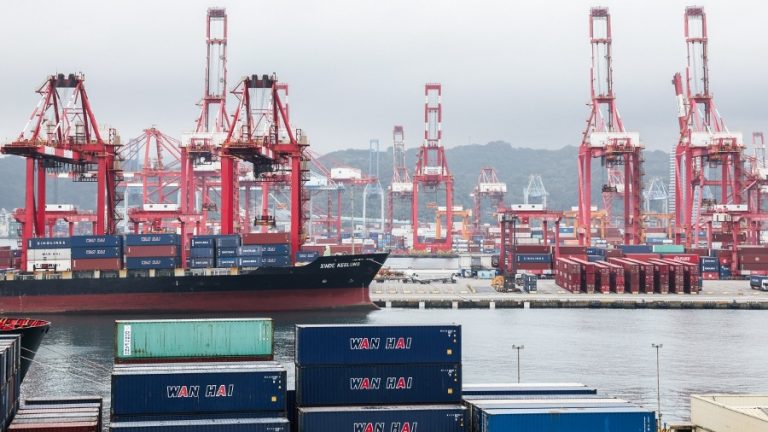
The war in the Middle East has entered its 56nd day, but this has not affected global demand for artificial intelligence (AI) chips. Taiwan’s Ministry of Economic Affairs announced on April 21 that Taiwan’s export orders for March reached a record high of $91.12 billion, a year-on-year increase of 65.9 percent, marking 14 consecutive months of growth.
The Department of Statistics noted that Taiwan has remained relatively unaffected thanks to AI acting as a “protective moat,” with the AI boom driving strong performance in semiconductors, memory, and server-related products.
Boosted by AI, March export orders reach $91.12 billion
According to the March statistic released by the Ministry of Economic Affairs, Taiwan’s March export orders totaled $91.12 billion, setting a new record for a single month and marking the second-highest year-on-year growth rate at 65.9 percent. The cumulative export orders for the first three months of this year reached $231.91 billion, also a record high for the same period, with a 50 percent annual increase.
The $91.12 billion figure far exceeded expectations of $76–78 billion. Huang Weijie, director of the Department of Statistics, said in a new conference in Taipei, according to CNA: “The March results were better than expected, mainly due to the AI boom boosting performance in semiconductors, memory, and servers. Additionally, traditional goods were not expected to turn positive last month, but they did, which also contributed to March’s export orders.”
Huang Weijie further stated that both high-tech and traditional products saw positive growth in March. The latter was mainly driven by rising energy prices due to the Middle East conflict, though the growth rate was modest, reported Taipei Times.
Success
You are now signed up for our newsletter
Success
Check your email to complete sign up
In the first quarter, year-on-year growth for plastics, rubber, and chemical products was less than 1 percent, indicating that demand has not yet recovered, with some manufacturers reporting advance stockpiling. He noted that the first quarter is typically a slow season, but the quarter-on-quarter growth this year was largely due to the AI boom.
AI gains mainly supported by two major product categories
Taiwan’s AI-driven growth is primarily supported by two major categories: information and communication products, and electronic products. According to the Ministry of Economic Affairs, orders for information and communication products reached $34.28 billion in March, a record high for a single month, with a year-on-year increase of 120.9 percent—also the largest monthly increase on record. This was mainly due to strong demand for AI and cloud computing services, which boosted orders for servers and networking equipment, along with contributions from new laptop product launches.
Orders for electronic products in March totaled $36.71 billion, also a monthly record, with a 73.7 percent year-on-year increase. This growth was likewise driven by AI-related opportunities, boosting continued demand for IC manufacturing, chip distribution, and memory products.
The Department of Statistics estimates that export orders for April will range between $87 billion and $89 billion, representing a year-on-year increase of 47.3 percent to 50.7 percent.
Huang Weijie added that traditional goods already benefited from restocking demand in March, and whether that trend will continue into April remains to be seen. “However, overall, AI has become a key investment focus for countries and enterprises. Even if the global economy slows, it is unlikely to affect AI investment. Therefore, Taiwan’s AI supply chain is expected to benefit, and the AI-driven growth momentum should continue this year.”
Taiwan’s Key Partners Continue Investing in AI Infrastructure
Amid the continued AI boom, major U.S. AI companies are increasing investments in Taiwan to build a “non-red supply chain.” Companies such as NVIDIA, AMD, and Micron are investing more than $15 billion in Taiwan to develop data centers, R&D facilities, and related semiconductor supply chains. These global flagship firms continue to establish AI R&D bases in Taiwan and collaborate with local industrial supply chains.
According to CMoney Investment Blog, Google has recently increased its investment in Taiwan, allocating NT$27 billion to expand infrastructure and introduce new AI features into Chrome. Of this amount, NT$25.3 billion is allocated for data services, while NT$1.74 billion is for semiconductor inventory procurement.
According to the Economic Daily report, StanChart’s Chief Economist for Greater China and North Asia, Dingdong Hu, said that the spillover effects of the Middle East conflict have had a relatively limited impact on Taiwan’s latest export orders. “The main reason is that Taiwan’s key trading partners continue to invest in AI infrastructure and data centers. As the global AI race accelerates, countries and companies generally do not want to fall behind in AI deployment and applications.”
Hu noted that, based on the data, export orders denominated in U.S. dollars grew by 65.9 percent year-on-year, far exceeding market expectations of 44.1 percent, and significantly higher than the combined growth rate of 41.3 percent in January–February this year. This indicates that AI-related demand momentum remains highly resilient.
He said Taiwan’s export growth is mainly driven by electronic products and information and communication products. Among them, electronic product exports rose 73.7 percent year-on-year, while information and communication products surged 120.9 percent, reflecting continued expansion by global cloud service providers and enterprises in AI-related hardware and computing infrastructure.
Hu also warned that while demand for advanced semiconductors is highly inelastic, Taiwan plays a key role in advanced manufacturing processes and the AI chip supply chain, allowing high-end chipmakers to pass a significant portion of rising costs onto downstream customers, thereby reducing the impact on overall profitability. However, this cost pressure may affect more price-sensitive industries, such as consumer electronics and some of Taiwan’s traditional export sectors.
That said, if there is a shortage of key raw materials, it could put pressure on chip manufacturers. Hu said, “This needs to be monitored in the medium term.” However, he noted that for now, the impact remains manageable, and production and exports have not been significantly disrupted in the short term.
By Li Jingyao