By Isshin (一心), Vision Times Japan
The Shōsōin Repository, located on the grounds of the Tōdai-ji Buddhist temple complex in Nara, Japan, contains thousands of unique antiques and artifacts, most of them donated by an emperor who lived 1,300 years ago.
Many of these items are priceless musical instruments, including the Mother-of-Pearl Inlaid Five-Stringed Biwa (螺鈿紫檀五絃琵琶), believed to have been crafted in India, and the Mother-of-Pearl Inlaid Rosewood Ruanxian (螺鈿紫檀阮咸) from the then-reigning Tang Dynasty of China — both dating back to the 8th century AD.
Among these treasures are also the world’s only surviving pair of konghou (箜篌), a type of ancient Chinese harp that was gradually lost to history and now only exists behind the intricate Imperial seal on the gates to the Shōsōin.
In recent years, advances in research have led to the reconstruction of the konghou as a playable instrument. However, since no traditional repertoire has survived, how faithfully these reconstructions produce the sound of the ancient instrument is a matter of debate.
Success
You are now signed up for our newsletter
Success
Check your email to complete sign up
Although those of us living today can never hear the true sound of the ancient konghou, the surviving poems and artistic representations allow us to imagine and appreciate its beauty.
One such performance on a reconstructed konghou is that by Saitō Yō (斎藤葉), whose composition Kaze no Hagoromo, or “The Feather Robe of the Wind,” provides some idea of what the ancient instrument may sounded like.
Origins and history of the Konghou
The konghou, called “kugo” in Japanese pronunciation, is believed to have been introduced to Japan during the Nara period via the Korean Peninsula from China and was used in court gagaku (雅楽, “refined music”) performances. However, from the middle Heian period onward, the instrument ceased to be played in Japan and gradually became extinct. In China as well, the konghou disappeared after the Ming dynasty (1368–1644), and its tradition was lost.
Two examples survive in the South Repository (Nansō) of the Shōsōin: the Mother-of-Pearl Inlaid Konghou (Raden Kugo, 螺鈿箜篌) and the Lacquered Konghou (Urushi Kugo, 漆箜篌). Both, however, are heavily damaged and no longer capable of producing sound.
READ MORE
- Why Buddhist Monks Sweep the Same Courtyard Every Day
- Unravelling the Mystery of Traditional Chinese Herbs: Lily bulb (百合 Bai He)
- Japan Moved by the Lost Heritage Displayed in Shen Yun Performances: ‘I Truly Long to See a China Like This’
Because no playable konghou survives today, and no records remain concerning its musical scores, playing techniques, or tuning methods, we do not know exactly what the instrument sounded like.
However, numerous visual depictions of the konghou have survived. These include many murals at Dunhuang (敦煌) in China, the Unchū Kuyō Bosatsu (雲中供養菩薩) statues at the Byōdō-in Temple in Kyoto, and various paintings depicting performers, some of them Buddhist divinities, playing the instrument.
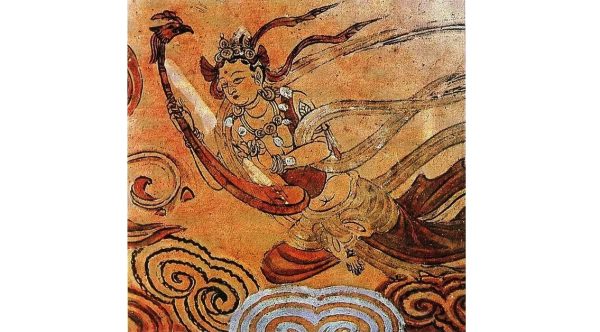
The famous Tang Dynasty poet Li He (李賀, 791–817) [1] vividly described the sound of the twenty-three-string Vertical Konghou played by the virtuoso Li Ping in his poem Li Ping Konghou Yin (李憑箜篌引). [2]
One celebrated couplet captures the master’s moving performance:
崑山玉碎鳳凰叫
芙蓉泣露香蘭笑
Kunlun jade shatters; phoenixes cry out.
Lotus blossoms weep with dew; fragrant orchids smile.
The poem’s depiction of music so magnificent that it could “split stone and astonish the heavens” gave rise to the Chinese idiom shipo tianjing (石破天驚) — a saying used to describe works of exceptional originality and brilliance in literature, music, and the arts.
Types of Konghou
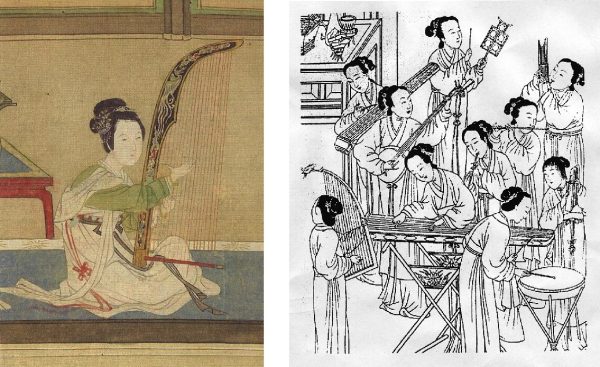
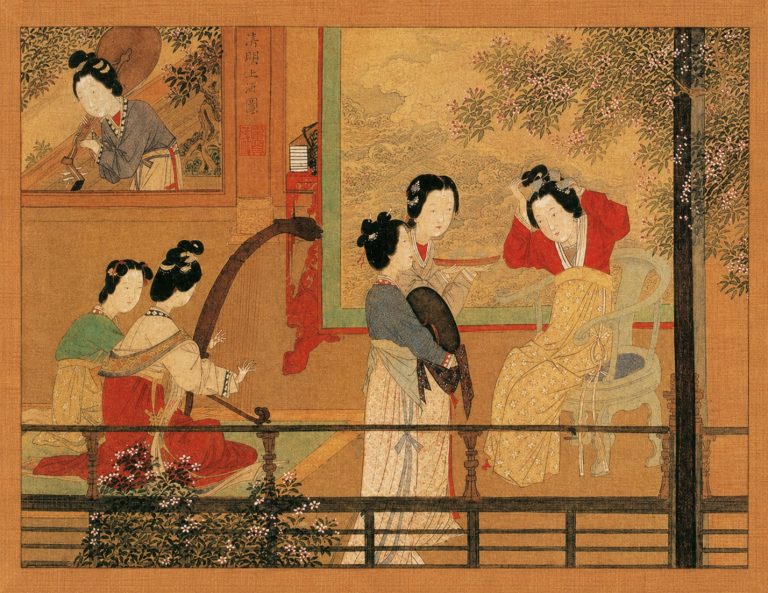
Right: An image of a female band taken from a Ming dynasty edition of Pipa Ji 琵琶記 (The Story of the Lute); a musician holding a konghou is seen in the lower left. This drawing was produced between 1573 and 1619. (Image: Unknown artist/via Wikimedia Commons/Public Domain)
In ancient China, several different instruments of distinct origins were all referred to by the name konghou (konghou, 箜篌).
1. Horizontal Konghou (臥箜篌)
The earliest documentary reference appears in the “Treatise on Feng and Shan Sacrifices” (Fengshan Shu) of the Records of the Grand Historian (Shiji) by Sima Qian (司馬遷, c. 145–87 BC). The Tongdian (通典), compiled by Du You (杜佑) during the Tang dynasty, records that Emperor Wu of Han (r. 141–87 BC) ordered the construction of a “konghou.”
At that time, the instrument was played horizontally like a qin (琴). It later came to be known as the Horizontal Konghou (Wo Konghou, 臥箜篌; Japanese: Fusekugo).
2. Vertical Konghou (豎箜篌)
During the Han dynasty, a harp-like instrument was introduced from the Western Regions (西域) of the Chinese empire. Because it resembled the existing konghou, it later came to be called either the Foreign Konghou (Hu Konghou, 胡箜篌) or the Vertical Konghou (Shu Konghou, 豎箜篌; Japanese: Tatekugo).
The Book of the Later Han records that Emperor Ling (r. 168–189 CE) particularly favored objects from the Western Regions, among them the Hu Konghou.
The two fragmentary konghou preserved in the Shōsōin are both examples of this Vertical Konghou.
3. Phoenix-Headed Konghou (鳳首箜篌)
Another harp-shaped instrument, introduced from India during the Tang dynasty, was also known as a konghou. It was reportedly used in Tenjikugaku (天竺楽), a type of gagaku repertoire of Indian origin.
Because its upper end was decorated with a phoenix head, it became known as the Phoenix-Headed Konghou (Fengshou Konghou, 鳳首箜篌).
This variety is said never to have been transmitted to Japan.
Notes
1. Li He (李賀, 791–817): A mid-Tang Chinese poet whose style was highly imaginative and unconventional. He was often praised as a poetic genius of extraordinary originality.
2. Li Ping Konghou Yin (李憑箜篌引, “Song of Li Ping’s Konghou”): Composed between 811 and 813 CE. Little is known about Li Ping beyond the tradition that he was a master harpist who served under Emperor Xuanzong of Tang. Other poets besides Li He also wrote poems praising his konghou performances.