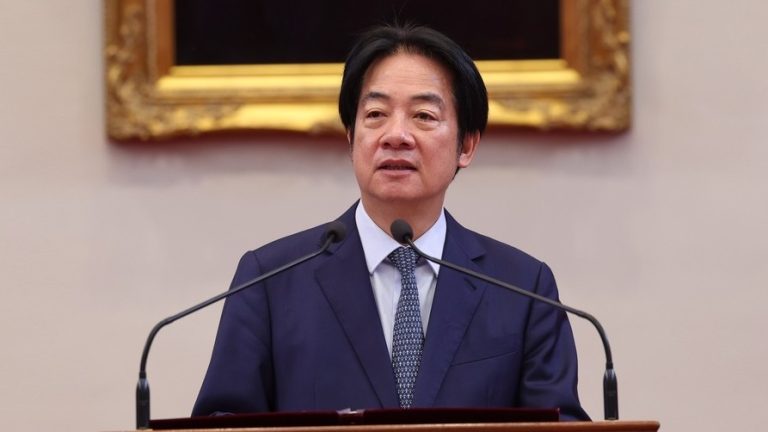
According to an official statement, Taiwan President Lai Ching-te was originally scheduled to visit the Kingdom of Eswatini, Taiwan’s diplomatic ally in Africa, from April 22 to 27. However, Presidential Office Secretary-General Pan Men-an held a last-minute press conference on the evening of the 21st, stating that the presidential aircraft’s flight route through Seychelles, Mauritius, and Madagascar had unexpectedly had its landing and flight permissions revoked.
After assessment, the visit was postponed, and a special envoy was instead dispatched to attend Eswatini’s dual celebrations.This year marks the 58th anniversary of diplomatic relations between Taiwan and Eswatini. To celebrate King Mswati III’s 40th anniversary of accession to the throne and his 58th birthday, Eswatini will hold a series of celebrations from April 24 to April 26.
Lai had originally planned to fly directly to Eswatini from April 22 to 27, with the goal of promoting “safe co-prosperity, economic co-prosperity, and digital co-prosperity.”
Regarding the latest changes, the Presidential Office held a press conference that evening. Attendees included Secretary-General Pan Men-an, National Security Council Secretary-General Joseph Wu, Deputy Foreign Minister Tseng Hou-jen, and Presidential Office spokesperson Karen Kuo, who jointly explained developments related to the president’s planned overseas trip.
At the press conference, Pan Men-an read a statement from Taiwan’s Presidential Office, saying that the president had originally been scheduled to depart on the 22nd for a visit to Eswatini. However, due to the sudden revocation of flight permits by certain countries along the presidential aircraft’s route, the national security team conducted a careful assessment. Considering the safety of the head of state, the delegation, and flight operations, the trip has been postponed.
Success
You are now signed up for our newsletter
Success
Check your email to complete sign up
At China’s behest
It is understood that Seychelles, Mauritius, and Madagascar revoked the presidential aircraft’s flight permits without prior notice. The actual reason, according to the statement, is that Chinese authorities exerted strong pressure, including economic coercion.
The statement said such behavior—coercing third countries through pressure tactics to change their sovereign decisions—is unprecedented in international affairs. It not only affects aviation safety and violates international norms and practices, but also constitutes open interference in other countries’ internal affairs, undermines regional stability, and harms the feelings of the Taiwanese people. The government of the Republic of China strongly condemns Beijing’s rough actions.
The statement emphasized that the Republic of China (Taiwan) is a sovereign state, that “Taiwan is the world’s Taiwan,” and that its 23 million people have the right to engage with the world. No country has the right to block this, nor can it do so. It also expressed sincere gratitude to like-minded countries that have assisted in diplomatic coordination in recent days.
According to France 24, Joseph Wu further explained that the trip had originally been planned as a direct flight to avoid high-risk areas related to the Middle East conflict. Eswatini is located on the southeastern coast of Africa, and the flight information regions of Seychelles, Mauritius, and Madagascar lie along a key route to Eswatini.
Joseph Wu stated that, upon the cancellation of flight permits, the national security team immediately activated relevant contingency measures and deployments, and sought assistance from multiple allied countries for diplomatic coordination. After assessment—especially prioritizing the safety of the head of state and flight safety—it was ultimately recommended that the visit be postponed.
Wu noted that when the government originally planned the trip, all flight permits from the relevant countries had been obtained smoothly in accordance with international practice and norms. The three countries only recently revoked the permits without prior notice or any stated reason, a highly unusual situation. It is understood that this was clearly due to pressure from Beijing authorities.
According to Taiwan’s Taipei Times, national security officials said intelligence indicated that China exerted pressure on Seychelles, Madagascar, and Mauritius, threatening to revoke debt forgiveness, suspend financing, and impose further economic sanctions. These “economic coercion” measures were used to demand that the three countries cancel the flight permissions for Taiwan’s presidential aircraft within their flight information regions. Under heavy pressure, the three countries made sudden, unannounced cancellations.
National security officials explained that, in practice, according to international civil aviation regulations and norms, flight information region (FIR) overflight permissions generally cannot be arbitrarily denied unless there is clear malicious intent or security threats, as such actions could seriously affect aviation safety—for example, long-haul flights may face safety risks due to lack of alternate landing options. They said such sudden cancellations are extremely rare in international practice.
International community should take notice
In response, Tseng Hou-jen said: “We understand their particular circumstances of having a high level of dependence on China,” while condemning the CCP’s interference in the internal affairs and sovereignty of other countries. He expressed hope that this incident would allow the international community to more clearly see how the CCP uses various coercive methods to interfere in other countries’ internal affairs and force changes to sovereign decisions. He added that to counter such aggressive behavior, the only way is for the international community to understand it and take collective action to curb it.
In response to a media question at the press conference—asking whether China’s announcement of zero-tariff treatment for 53 African countries (excluding Eswatini) would create greater pressure on Eswatini—Joseph Wu said that for a long time, China has used promises that are not fulfilled to lure African countries into debt traps, offering seemingly favorable trade terms in exchange for political compliance.
He expressed relief that Taiwan’s ally Eswatini has not fallen into such a trap. Taiwan and Eswatini, he said, have instead improved the lives of the Eswatini people through substantive cooperation in healthcare, technical assistance, and industrial investment.
He added that the Republic of China (Taiwan) will continue to deepen such practical bilateral cooperation, so that Eswatini will see that standing with Taiwan is truly in line with its national interests.
Pan Men-an stated that China’s “Belt and Road Initiative” can be seen across the African continent and in several island nations, and that these are all caught in debt traps.
Views from both ruling and opposition parties
As the ruling Democratic Progressive Party (DPP) issued a press release, party spokesperson Lin Chu-yin stated that the party strongly condemns the Chinese Communist Party’s violations of international norms and practices, as well as its barbaric interference in other countries’ internal affairs.
Lin Chu-yin said that the Republic of China (Taiwan) is a sovereign and independent country, and that visits by its head of state to diplomatic allies are normal diplomatic activities. However, Beijing has consistently attempted to shrink Taiwan’s international space and has escalated its efforts by coercing third countries to obstruct normal exchanges between Taiwan and its allies.
She further emphasized that the recently concluded “Zheng-Xi meeting” (referring to the meeting between KMT Chairperson Cheng Li-wen and CCP General Secretary Xi Jinping) saw the Chinese side repeatedly tout so-called “benefits to Taiwan,” with collaborators even claiming China has “great goodwill.” In contrast, today’s harsh suppression of Taiwan and interference in third countries’ domestic affairs is a stark irony and a direct rebuttal to the CCP’s official propaganda.
Lin called on all political parties, regardless of affiliation, to jointly condemn the CCP’s coercive actions that undermine regional stability and violate sovereignty. She also urged strong support and encouragement for diplomatic and national security teams currently working on the front lines, so that Taiwan can continue to be seen by the world and move forward confidently onto the global stage.
The Kuomintang (KMT) also issued a press release. KMT Culture and Communications Committee director Yin Nai-ching expressed deep regret over President Lai’s postponed visit to Eswatini, Taiwan’s only diplomatic ally in Africa. The KMT called on mainland China to exercise restraint and reduce pressure, and to provide diplomatic space for the Republic of China government. It noted that during former President Ma Ying-jeou’s administration, the “flexible diplomacy” approach promoted cross-strait “diplomatic truce,” and Taiwan had 22 diplomatic allies at that time, highlighting the importance of maintaining communication channels across the Taiwan Strait.
Yin also noted that the “Zheng-Xi meeting” between KMT Chair Cheng Li-wen and Xi Jinping took place on the 10th in the East Hall of the Great Hall of the People. She stated that from former President Tsai Ing-wen to President Lai Ching-te, Taiwan lost 10 diplomatic allies before the meeting, and that Lai’s postponed visit to Eswatini has nothing to do with the “Zheng-Xi meeting.”
The Taiwan People’s Party said through a media group that if the Chinese Communist Party continues to arbitrarily squeeze Taiwan’s diplomatic space and intimidate the Taiwanese people, it will do nothing to help cross-strait relations, regional stability, or global peace. Such actions not only fail to promote healthy cross-strait exchanges, but will also further escalate tensions in the Taiwan Strait and push the Taiwanese people further in the opposite direction.
The party stated that it fully supports the government’s continued steady efforts to advance diplomacy, enhance Taiwan’s international visibility, and maintain relationships with diplomatic allies. At the same time, it once again calls on the Chinese Communist Party to stop using coercive means to downgrade Taiwan’s sovereignty.
The Taiwan People’s Party emphasized that peace across the Taiwan Strait should be built through healthy and orderly economic and cultural exchanges to increase mutual trust and reduce conflict. It will firmly defend national sovereignty and diplomatic space, and will never back down under any threats or intimidation. It stressed that only dialogue conducted on the basis of equality and dignity is the only proper path to maintaining peace across the Taiwan Strait.
By Li Zexu