Political analysis
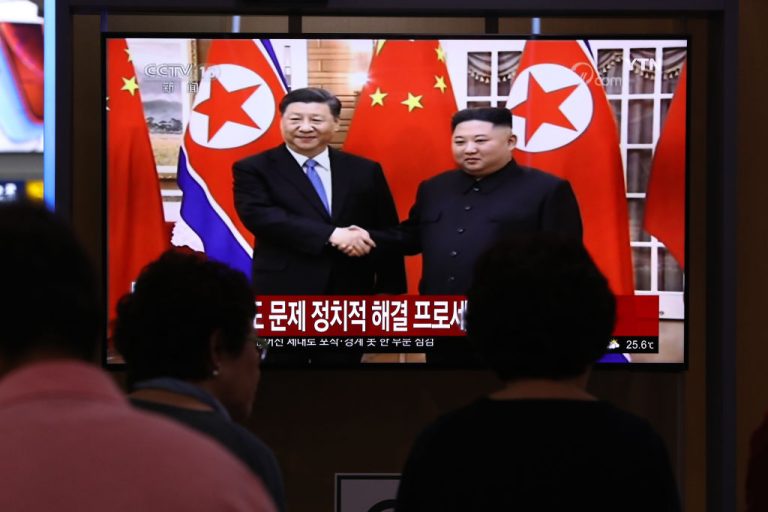
As Chinese leader Xi Jinping wrapped up his June 8-9 state visit to North Korea, officials in both Beijing and Pyongyang emphasized the enduring strength of their alliance, describing bilateral ties as “unbreakable” and rooted in a shared revolutionary history. State media described the two countries as 唇齿相依 (“as close as lips and teeth”), a traditional Chinese expression meaning a deeply intertwined and mutually dependent relationship.
But a closer examination of how the two governments covered the visit suggests that beneath the public declarations of friendship, the two sides were not entirely aligned in the messages they chose to convey.
RELATED: Xi’s North Korea Trip Raises Questions About China’s Influence in the Region
Opposing images of Xi
One of the most widely discussed moments from the visit involved not diplomacy, but imagery. North Korea’s state-run Korean Central News Agency (KCNA) published photographs of Xi Jinping and his wife, Peng Liyuan, attending a cultural performance alongside Kim Jong Un and his wife, Ri Sol Ju. In the images, both Xi and Peng were seen wearing glasses, Xi in a pair of thin-framed spectacles and Peng in dark-rimmed glasses.
Success
You are now signed up for our newsletter
Success
Check your email to complete sign up
The images attracted attention because Chinese state media appeared to avoid using similar shots. China’s state broadcaster CCTV omitted footage showing Xi wearing glasses during its evening news coverage. Likewise, Xinhua’s accompanying reports focused primarily on stage performances and official activities, avoiding audience close-ups that featured the Chinese leader.
Independent commentator Wu Jianmin noted on social media that photographs of Xi wearing glasses have rarely appeared in mainland China’s official propaganda. “Xi Jinping wearing glasses has never been shown in official Chinese publicity,” Wu wrote. “For Xi, this is part of image management.”
Observers cautioned against reading too much into the differences. However, the contrasting editorial choices highlighted the degree to which state media in each country maintain control over the public presentation of their leaders.
Difference in military agreements
A more substantive discrepancy emerged in the two countries’ official accounts of the talks themselves. According to China’s state mouthpiece Xinhua News Agency, Xi proposed strengthening exchanges in diplomacy, the military, and law enforcement. The report also called for expanding cooperation in trade, agriculture, science and technology, construction, healthcare, and people-to-people exchanges as transportation links continue to reopen.
Chinese coverage placed particular emphasis on military exchanges, a notable inclusion given that Chinese Defense Minister Dong Jun also participated in the meetings, breaking with past practice. However, North Korean state media offered a different account. Reports published by Rodong Sinmun and KCNA made no mention of expanding military cooperation or exchanges between the two armed forces.
Hong Min, a researcher cited by the newspaper, suggested Beijing may be seeking greater insight into North Korea’s evolving military capabilities and any technology transfers stemming from Pyongyang’s increasingly close relationship with Moscow. North Korea’s reluctance to publicize such discussions, he argued, could reflect its desire to safeguard the autonomy of its defense policies.
The differing accounts suggest that while both governments remain eager to project unity, they may not share identical priorities.
Russia’s role strains the relationship
Xi’s visit also took place against the backdrop of North Korea’s rapidly expanding ties with Russia. Since Russia’s invasion of Ukraine, Pyongyang has emerged as one of Moscow’s most important partners. Russian President Vladimir Putin visited North Korea in June 2024, during which the two countries signed a mutual defense treaty.
According to BBC reporting, North Korea has deepened its support for Russia’s war effort through the provision of military personnel and weapons, while receiving economic and other benefits from Moscow in return. Xi’s visit comes as Beijing seeks to reaffirm its influence over North Korea amid growing unease over Pyongyang’s strengthening ties with Moscow. Analysts cited by the Associated Press (AP) said China appears uncomfortable with North Korea’s increasingly close alignment with Russia.
Former CNN correspondent Mike Chinoy further argues that one of Xi’s objectives in visiting North Korea is to reassert China’s influence and restore balance in the triangular relationship.
While China remains North Korea’s largest trading partner and most important economic lifeline, Kim Jong Un now appears to have greater room to maneuver between Beijing and Moscow than at any point in recent years. But for Beijing, that evolving dynamic presents both a challenge and a reminder that even its closest allies have strategic interests of their own.
Editorial note: This article is based on publicly-circulating reports and commentary. The claims described have not been independently verified by Vision Times, and relevant authorities have not publicly confirmed the allegations.