Days after the Brazilian government placed Chinese electric vehicle manufacturer, BYD on a blacklist over “slave-like” working conditions, a new report by China Labor Watch (CLW), a New York–based organization, claims that similar conditions have also been found at BYD’s factory in Hungary, raising new allegations of forced labor.
A Canadian automotive industry lobbying group has once again called for opposition to the Chinese automaker’s entry into the Canadian market.
China Labor Watch investigation: Chinese workers in BYD factories
China Labor Watch (CLW) launched its investigation last year after a Chinese worker sent to Hungary filed a complaint. He was one of thousands of migrant workers sent from China to the city of Szeged, Hungary, to help build BYD’s first European factory. The factory, with an investment of 6 billion yuan, aims to supply approximately 300,000 vehicles annually to the European market. The organization released its 23-page report on its website on April 14 (pdf). .
China Labor Watch interviewed over 60 workers, most of whom were construction and installation workers recruited through subcontractors. The report describes actions that may violate Hungarian labor and immigration laws, including:
- Workers labored seven days a week with no days off. They told China Labor Watch they were instructed to lie about their working hours if inspections occurred.
- Shifts lasted as long as 12 to 14 hours, with only short meal breaks and no overtime pay.
- Wages were delayed for up to three months, and final payments were withheld until workers returned to China.
- High recruitment fees were used as a form of debt bondage. Low-income workers said they were forced to remain despite harsh conditions because they could not afford the consequences of breaking their contracts.
- Workers entered the country on business visas rather than legal work permits, making them vulnerable to abuse and unable to access services such as healthcare for workplace injuries.
Elaine Lu, a project manager at China Labor Watch, told CBC for a report published on April 8 that the multi-layered subcontracting structure blurs legal responsibility, allowing BYD to shift accountability onto intermediaries.
Success
You are now signed up for our newsletter
Success
Check your email to complete sign up
Details of the Brazilian labor investigation
In December 2024, Brazil’s labor authorities rescued 163 Chinese workers who were working on the construction of BYD’s factory in Camaçari, Bahia state, reported Agencia Brasil
These workers had been recruited through subcontractors linked to the Jinjiang Group, according to the BBC
Initial findings from Brazil’s labor prosecutors indicated that subcontractors required workers to work seven days a week, 12 hours a day. The report also alleged issues such as physical punishment by supervisors, insufficient drinking water, inadequate protective equipment, and poor living conditions.
According to legal filings, 70 percent of workers’ wages were withheld, and deposits would be confiscated if they terminated their contracts early. Workers were also required to repay travel expenses arranged by the company for their trip to Brazil; otherwise, they would not receive return airfare.
During surprise inspections, labor inspectors found multiple workers crowded into housing without mattresses, sharing a single toilet, with conditions described as “extremely poor.”
Canadian auto industry pushback against Chinese carmakers
Brian Kingston, president of the Canadian Vehicle Manufacturers’ Association (CVMA), said the CLW report is “deeply concerning” and further strengthens the case against allowing Chinese automakers to enter the Canadian market. The association represents companies such as Ford, General Motors, and Stellantis.
Kingston told CBC in an interview: “Canada’s auto industry is capable of competing and winning—but only if the playing field is fair.”
Flavio Volpe, president of the Automotive Parts Manufacturers’ Association, told CBC: “No one asks why these cars are so cheap. Because when you sacrifice social values for the sake of saving money, someone always ends up paying the price.”
He added that the public is often unwilling to examine the cost behind low prices: “What China is exporting now in high-end products is not just the goods themselves, but also its domestic business practices—and it hopes we focus only on the scale of investment without scrutinizing the underlying issues.”
Serious risk of forced labor
After Canada reached an agreement earlier this year to reduce tariffs on Chinese electric vehicles, BYD is preparing to open dealerships in Canada and establish a foothold in the North American market.
When Ottawa reached the agreement with Beijing, the Canadian Vehicle Manufacturers’ Association (CVMA) issued a joint statement with the American Automotive Policy Council, saying the move “could weaken Canada’s auto industry and threaten the future of the integrated North American automotive supply chain.”
The Office of the United States Trade Representative stated in its 2026 Foreign Trade Barriers Report that Canada does not appear to be effectively enforcing its ban on imports made with forced labor. Canada has recently been included in an U.S. investigation to determine whether it has allowed such goods into its market. If violations are found, Canadian exports could face tariffs of up to 25 percent.
Labor cost advantage of Chinese automakers
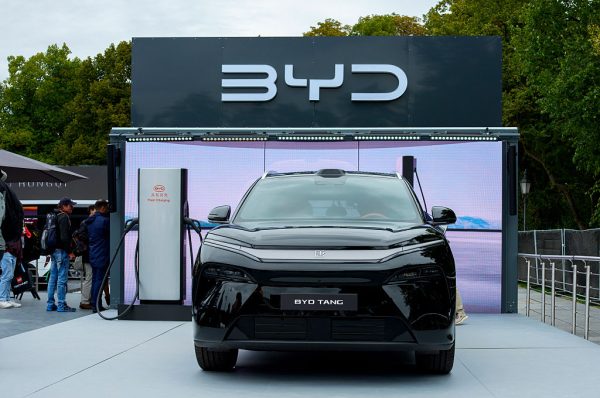
Executives at Western automakers have repeatedly said that China’s low wages, government subsidies, and excess production capacity distort the global electric vehicle market and create structural barriers to fair competition.
According to BYD’s annual report, the company’s average annual employee compensation in 2025 was about 147,000 yuan (approximately $21,400), including salary, bonuses, social insurance, and statutory benefits. This is roughly half the starting pay for new employees at U.S. factories of Rivian, Tesla, and Lucid, and about five to six times lower than the overall company averages at Rivian and Lucid.
BYD’s cost advantage is not limited to wages. In 2025, the company received 12.5 billion yuan (RMB) in subsidies from the Chinese government, covering various stages of its supply chain. In its anti-subsidy investigation, the European Commission determined that Chinese-made pure electric vehicles benefit from state support in multiple ways, and therefore imposed a 17 percentcountervailing duty on BYD imports.
By Li Xin