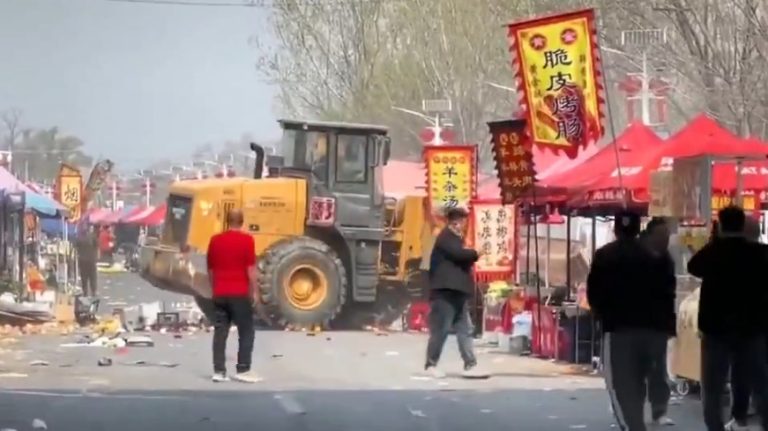
A man drove a heavy excavator into a crowded weekend market in Beijing’s Fangshan district on March 29, 2026, killing as many as 18 people, in what eyewitness accounts and a since-deleted Caixin investigation describe as one of the most lethal attacks on Chinese civilians in years. The Chinese Communist Party moved within hours to suppress all coverage, blocking keywords on Weibo and Douyin, sealing off the scene to journalists, and erasing the event from the public record entirely. The attacker, identified only by his surname Qu, was a 53-year-old man from Jinzhou, in the northeastern province of Liaoning, who had spent years petitioning Chinese authorities for redress over a forced demolition before the attack.
The market at Dahan Jida used to draw large weekend crowds. It has been shuttered since the attack, ringed by police, and stripped from China’s internet as thoroughly as if the day had never occurred. France’s Le Monde, reporting on May 1, described a neighborhood where residents still lower their voices five weeks later. “Something happened,” one local told the paper, “but we cannot say what.”
Between 11 a.m. and noon on March 29, Qu drove the excavator into the market’s tightly packed lanes. Eyewitness accounts and multiple media reports say the machine made repeated passes, crushing market stalls and pedestrians. Unverified reports claim the perpetrator had laced food stalls with poison earlier that morning before returning with the excavator for what the deleted Caixin article, from one of China’s few remaining investigative outlets, described as a “second killing.” That same article put the final toll at 18 dead and 33 injured. Other accounts cited figures of between eight and 13 dead and roughly 12 injured. Chinese authorities have confirmed nothing.
Chinese censors moved within hours to erase the Fangshan attack from the internet
The Chinese Communist Party moved to erase the Beijing excavator attack almost immediately. Censors hid keywords on Weibo and Douyin, China’s dominant social media platforms. News outlets that had briefly published reports pulled their content, and journalists were barred from the scene entirely. By the time Le Monde arrived for on-the-ground reporting weeks later, officers identified the French reporter within minutes and escorted him out of the area.
The scale of the suppression was striking even by the standards of Chinese censorship. Le Monde described it as marking “a new phase” in Beijing’s information control, one in which an event affecting an entire urban district simply ceases to exist in the public record. There were no official casualty figures, no statement on the attacker’s identity or motive, and no acknowledgment that a massacre took place at all.
Success
You are now signed up for our newsletter
Success
Check your email to complete sign up
The Party’s motive is visible in what it has long held up as proof of the superiority of one-party governance: low urban crime rates and public safety. State media routinely frame American gun violence and social instability as evidence of democratic failure. A domestic mass-casualty attack carried out by a citizen pushed to the breaking point by the state itself dismantles that narrative from within.
Years of ignored petitions over a forced demolition drove the Beijing market attacker
The deleted Caixin article, widely circulated before authorities scrubbed it, offered the most detailed account of who Qu was and what drove him to the market that morning. He had founded a factory in his home province of Liaoning. When local officials demolished his property as part of a government land seizure, the compensation they offered was, in his view, inadequate.
He turned to the only formal channel available, China’s petition system, through which citizens can theoretically seek redress from higher authorities when local officials fail them. In practice, the system routinely fails petitioners, and local governments frequently intercept and detain those who attempt to use it. Qu petitioned for years and got nowhere as his savings ran out, and the article reported that his temperament grew increasingly extreme and withdrawn.
The Caixin piece also noted that journalists who tried to enter hospitals near the scene on the third day after the attack were turned away.
Scholars link the Beijing excavator attack to China’s pattern of ‘revenge against society’ violence
Le Monde’s reporting also drew on expert analysis placing the attack within a broader pattern of Chinese revenge violence. Scholars cited by the paper argued that such incidents are symptoms of deeper structural failures in Chinese society: economic pressure, widening inequality, blocked pathways for social mobility, and a political system that offers almost no legitimate channels for expressing grievance. Under those conditions, frustration accumulates rather than dissipates, building into isolation, resentment, and psychological strain that the state’s censorship apparatus then prevents from being processed publicly.
Chinese internet users have a term for this kind of violence: bao fu she hui, or “revenge against society,” used to describe attacks directed at the public by individuals who have been failed or wronged by the state. The Party suppresses both the term and the incidents it describes, ensuring that neither the evidence nor the pattern ever reaches public scrutiny.
The Fangshan massacre was not an isolated suppression. According to The Standard, a similar mass-casualty attack reportedly occurred in Chengdu during the May Day holiday period, and authorities moved quickly to seal off information there as well. In both cases, Beijing’s response to the Chinese revenge violence followed the same script: remove the posts, clear the scene, and say nothing.