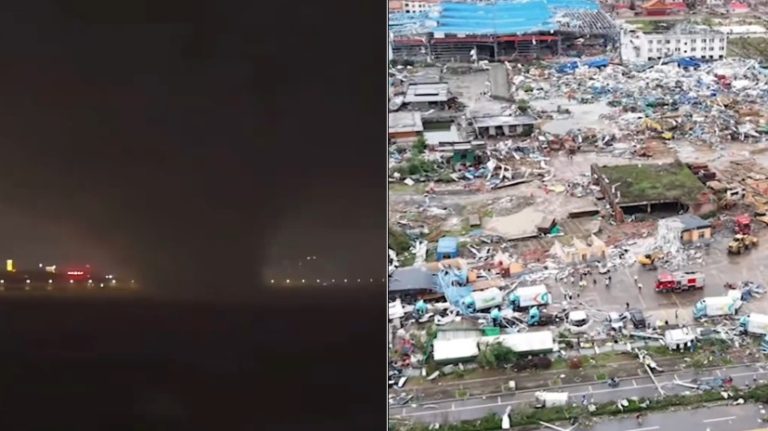
President Donald Trump publicly contradicted Chinese leader Xi Jinping in an April 21, 2026 CNBC interview, telling the network that the Iranian-flagged tanker Touska, seized by the U.S. Navy two days earlier after attempting to defy the U.S. blockade of the Strait of Hormuz, had been carrying Chinese material destined for Iran’s military supply chain. “I was a little surprised,” Trump said, adding that he had thought he and Xi had reached an understanding on the Iran question. The cargo, he said, was “a gift from China,” and “not too friendly.” Less than a week earlier, Trump had publicly said he asked Xi not to ship weapons to Iran, and that Xi told him China was “basically not doing this.” The Touska disclosure put a specific incident on the record directly contradicting that assurance.
How the Touska tanker ended up carrying Chinese cargo into the Hormuz blockade
On April 14, 2026, the U.S. Navy formally blockaded the Strait of Hormuz as part of Operation Epic Fury, the U.S. military campaign against Iran that began on Feb. 28. Five days later, an Iranian-flagged cargo vessel named Touska ignored U.S. naval warnings and attempted to push through the blockade. American warships opened fire, disabled the vessel, and took it into custody.
When the seizure became public, China’s Ministry of Foreign Affairs faced direct questioning. At Beijing’s regular press conference on April 21, a reporter asked spokesperson Guo Jiakun about U.S. claims that the seized Iranian cargo vessel was carrying chemicals used in missile production. Guo declined to address the question substantively, telling reporters only that the matter involved a “foreign-flagged container ship.”
Su Tzu-yun, director of the Institute for National Defense and Security Research in Taiwan, told The Epoch Times that Trump’s “gift from China” framing most likely referred to missile-production precursor materials, and that the disclosure had directly undercut Beijing’s public denials.
Trump said on May 12 the US does not need Chinese help on Iran
The Touska incident hung over Trump’s preparations for his Beijing summit with Xi Jinping. On May 12, on the eve of his trip to Beijing, Trump spoke to reporters at the White House. Asked whether Xi might need to be involved in resolving the Iran situation, Trump was direct. “No, I don’t think we need any help with Iran,” he said. “We’ll win it one way or the other, peacefully or otherwise.”
Success
You are now signed up for our newsletter
Success
Check your email to complete sign up
He pointed to the operational result of the U.S.-Israeli campaign. “Their Navy’s gone, their Air Force is gone, every single element of their war machine is gone,” he said. “They killed a lot of people. They drove 42,000 people at least, over the last month and a half.”
US Navy mine-clearing in Hormuz reveals the scale of Iran’s defensive network
While the Touska incident exposed Chinese material flowing into Iran, the Iranian mines U.S. forces have been clearing from the Strait of Hormuz have been Iranian-manufactured. On April 11, 2026, U.S. Navy destroyers USS Petersen (DDG 121) and USS Michael Murphy (DDG 112) transited the Strait as part of a broader CENTCOM operation to clear mines laid by Iran’s Islamic Revolutionary Guard Corps. CENTCOM commander Admiral Brad Cooper said the United States would establish a new passage and share the safe corridor with the maritime industry. According to CBS News, U.S. intelligence assessments concluded that at least a dozen mines had been placed in the waterway, including Iran’s Maham 3, a moored mine using magnetic and acoustic sensors, and the Maham 7, a bottom mine that rests on the seabed until a target passes within range.
Trump indicated that the United States deployed capabilities during the mine-clearing operations that have not been publicly disclosed. “Reverse-tracking technology,” he said, allowed U.S. forces to trace incoming weapons back to their launch points within three minutes and to neutralize the source. The Trump administration has also used electronic warfare techniques first deployed in the U.S. operation against Venezuela’s Maduro regime, which Trump described as having caused enemy weapons systems to fail before they could be fired. The Maduro regime, Trump said, had been equipped with Russian and Chinese rockets that had failed to fire when activated. The remark amounted to a public U.S. presidential confirmation that both Beijing and Moscow have been arming the Venezuelan government.
A former Pentagon analyst warned of broader Chinese-Russian pressure on undersea cables
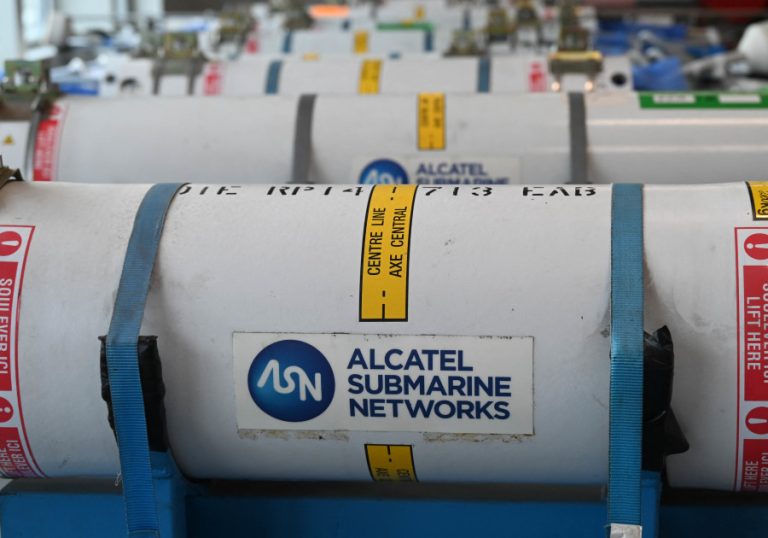
The CCP’s arming of Iran is one element of a broader campaign of pressure on U.S. and Western infrastructure now drawing attention from U.S. defense analysts. On May 10, 2026, Fox News reported that Andrew Badger, chief strategy officer at U.S. defense technology firm Coalition Systems and a former Pentagon staffer, warned that Beijing and Moscow are working to convert the undersea environment into a grey-zone battleground. Beijing and Moscow, Badger said, could produce massive disruption to the global economy without firing a shot, by targeting the undersea cables that carry international communications, financial transactions, and military command traffic.
Badger called U.S. undersea infrastructure “extremely fragile.” Chinese and Russian investment in offensive undersea capability, he said, has outpaced Western defensive capacity. He specifically argued that Beijing could use the threat against U.S. undersea cables as a deterrent against American intervention in a future Taiwan crisis. A coordinated attack on U.S. undersea cable infrastructure, Badger said, would generate economic losses “impossible to estimate” and could trigger political and financial instability inside the United States.
Taiwan has already lived through the smaller version of what Badger described. Roughly thirty undersea cable incidents have been reported in recent years, with Chinese vessels implicated in several. In one episode, communications to a Taiwanese island were severed for months after a Chinese vessel cut a cable.
Stanford University researcher Ike Freeman issued a parallel warning, noting that an escalation in the Taiwan Strait could see Beijing strike at semiconductor supply chains and undersea communications systems to trigger global market disruption, with downstream consequences for American retirement funds and the broader Western financial system.
Beijing telegraphed the relevant capability in its own state media a month before the Badger warning. On April 14, 2026, the official Xinhua News Agency, citing China’s Ministry of Natural Resources, reported that on April 11 the Chinese research vessel Marine Geology Two (海洋地质二号) had completed the year’s first deep-sea mission. The mission included the use of a “deep-sea underwater electro-hydraulic actuator” to cut cables at depths of up to 3,500 meters. The operation was described in dual-use scientific-research terms. The demonstrated capability is the same capability that would be needed to sever transoceanic communications cables at strategic depth.