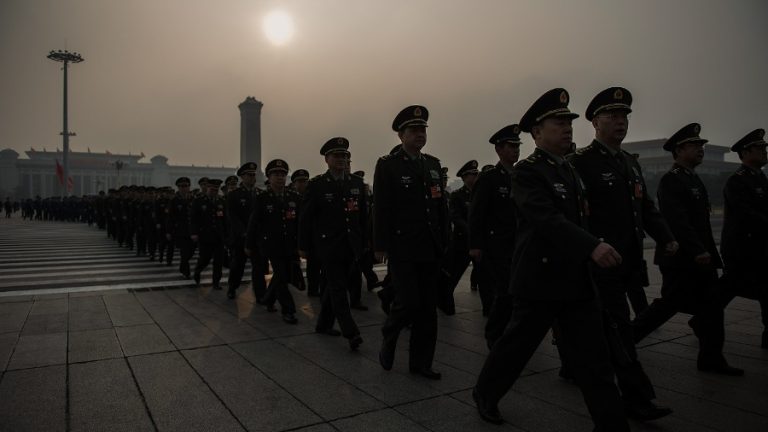
For years, Beijing’s strategy rested on a single assumption: that democratic governments were too fractured, too economically dependent on Chinese trade, and too risk-averse to organize a coherent response to CCP expansionism. May 2026 proved every part of it wrong.
Canada’s navy defied Beijing, then hosted its foreign minister
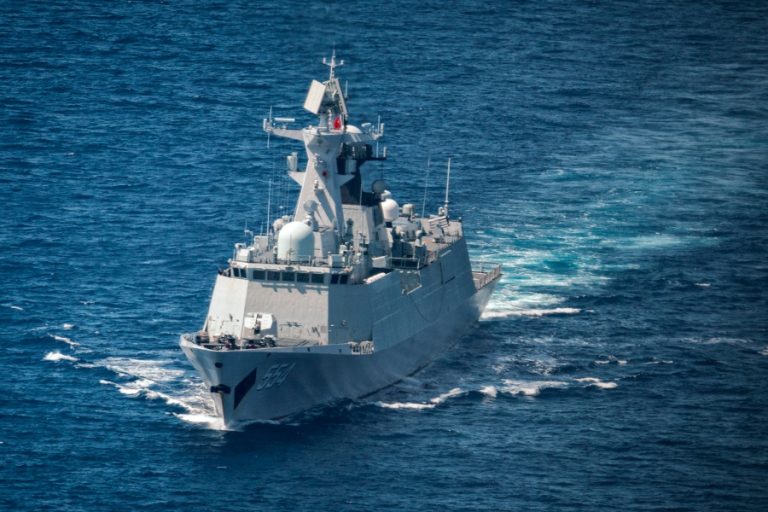
According to Canada’s Globe and Mail, the Royal Canadian Navy frigate HMCS Charlottetown transited the Taiwan Strait on May 22 and 23, without any allied warships alongside, completing the passage on its own. The Taiwan Strait is the 180-kilometer waterway separating mainland China from Taiwan. Beijing insists foreign navies have no right to sail through it; Canada, the United States, and their allies maintain that international maritime law applies.
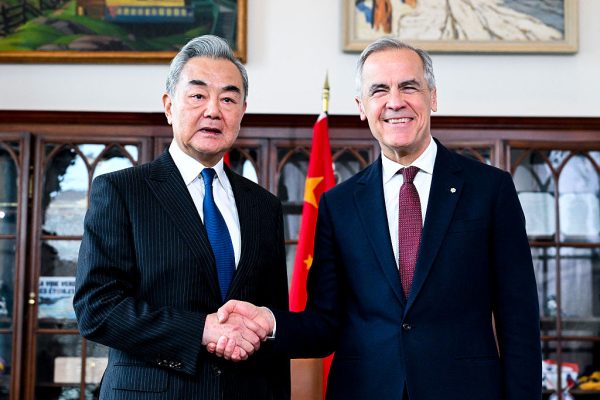
Wang Yi, China’s foreign minister, arrived in Canada on May 28 for a three-day visit, the first Chinese foreign minister to visit Canada in a decade. Beijing had designed the visit to exploit Ottawa’s anxieties over American tariff pressure and to reopen a bilateral relationship that had grown cold. Instead, Wang Yi landed in a country whose navy had just demonstrated, in the plainest possible terms, that it would not be deterred from operating in waters that Beijing considers politically sensitive.
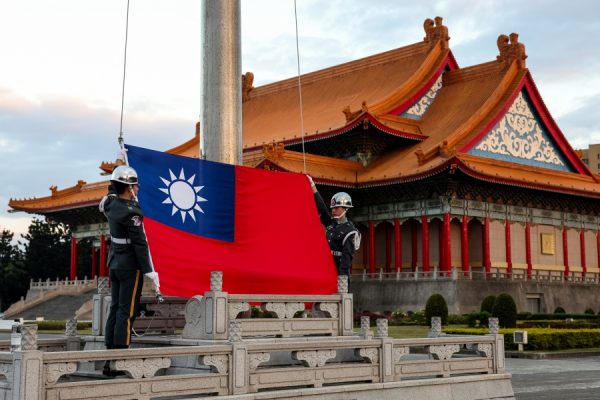
China’s ambassador to Canada, Wang Di, had issued explicit warnings in late April: if Canada continued sending warships through the Taiwan Strait or maintaining official contacts with Taiwan’s government, it “would damage bilateral relations.” Canada’s response was to do both. Michael Chong, the Conservatives’ foreign affairs critic, flew to Taipei in early May and met with President Lai Ching-te, brushing aside the ambassador’s warning without ceremony. “I thought it was important to make it clear that we are not going to take direction from a foreign government about where Canadian MPs can travel internationally,” Chong said.
Vina Nadjibulla, vice-president of the Asia Pacific Foundation of Canada, a think tank that tracks Canada’s relations in the region, described Ottawa’s posture as a deliberate two-track approach: limited economic engagement with Beijing on one side; uncompromising positions on national security and freedom of navigation in the Indo-Pacific on the other.
Success
You are now signed up for our newsletter
Success
Check your email to complete sign up
What Beijing could not do, confronted with this, was respond with anything credible. Neither China’s foreign ministry nor its military’s Eastern Theater Command, which is responsible for operations around Taiwan and routinely issues threatening statements whenever Taiwan-adjacent activity occurs, released any formal condemnation of the HMCS Charlottetown transit. The silence revealed what bluster conceals: Beijing calibrates its pressure against targets it believes will back down. Canada did not.
The US, Japan, the Philippines, and the Netherlands seal China’s exits
On May 27, a Dutch warship entered waters in the South China Sea that Beijing claims as its own sovereign territory, prompting sharp protests from China’s foreign ministry. At nearly the same time, the United States and Japan were finalizing joint naval exercises in waters surrounding Taiwan, with some drills conducted as close as 100 to 200 kilometers from the island’s coast.
The proposition that “a Taiwan contingency is a Japan contingency,” once debated as a policy question, now describes active military coordination. Beginning in June 2026, the United States will temporarily deploy its Typhon mid-range missile system to Japan. The Typhon is a ground-launched cruise missile battery with a range covering much of the region, and its deployment directly addresses China’s ability to project military power across the western Pacific. When Washington deployed its Terminal High Altitude Area Defense system, a missile defense battery, to South Korea in 2017, Beijing reacted with furious economic retaliation, pressuring Seoul for years. The Typhon deployment targets a broader range of threats, and Beijing finds itself with far fewer levers to pull against Japan than it had against South Korea, and considerably less appetite to test them.
The Philippines extended the ring further. Philippine President Ferdinand Marcos Jr. visited Japan for a state visit from May 26 to 29, with security and defense cooperation in the South China Sea at the center of talks. The United States, Japan, and the Philippines now operate as an integrated security front along what military planners call the First Island Chain: the arc of islands stretching from Japan through Taiwan to the Philippines that forms the principal geographic barrier between China’s military and the open Pacific.
Legislators from across the democratic world descended on Taipei
A cross-party delegation of Israeli legislators visited Taiwan in early May. Paraguay’s president traveled to Taipei to reinforce his country’s formal diplomatic ties with Taiwan, one of the handful of governments that maintains official recognition. On May 23, the first secretary of France’s Socialist Party arrived in Taipei and stated publicly, for an international audience, that Taiwan is “a de facto state.”
From May 23 to 31, a cross-party delegation from the German Bundestag’s Berlin-Taipei Friendship Group arrived in Taiwan, the latest evidence that European governments have largely stopped adjusting their Taiwan posture in deference to Beijing’s sensitivities. The governments that sent representatives or legislators to Taiwan in May alone: Canada, the Netherlands, the United States, Japan, the Philippines, Israel, France, Germany, the United Kingdom, the European Union, and Paraguay.
Britain’s former spy chief: China is keeping Russia’s war alive
In an interview with the Wall Street Journal, Richard Moore, who served as director of Britain’s Secret Intelligence Service, known as MI6, from 2020 to September 2025, was unequivocal: “Without China, Russia would have lost. It’s as simple as that.” Moore specified Chinese chemicals and components flowing into Russian artillery and drone production as central to the military supply chain keeping the war alive. He added: “The thing that keeps Putin in Ukraine is Chinese support.”
On May 29, European Commission President Ursula von der Leyen delivered a firm statement signaling further measures against Chinese-subsidized exports to Europe. European governments had maintained varying degrees of hope that China could be separated from its practical support for Russia’s war effort. Moore’s statement, delivered with the authority of a career intelligence chief, substantially closed off that space.
The original Chinese-language source for this article attributes a version of this remark to Russian President Vladimir Putin himself, framing it as a cynical maneuver against China by Moscow. The available record shows the statement came from Moore, not Putin, and the significance is different but no less damaging to Beijing: the accusation comes from a senior Western intelligence official, directed at a Western audience making decisions about trade, investment, and security cooperation with China.
Beijing’s intimidation strategy produced the opposite of its intended result
Governments that once hedged have stopped hedging. Military deployments that once required months of negotiation are proceeding on accelerated timelines. Parliamentarians who once avoided Taipei to spare Beijing’s feelings are now traveling there as a deliberate political signal.
North Korea’s public restatement that it will never relinquish its nuclear weapons has sharpened the security calculus across Northeast Asia and strengthened the case within Japan, South Korea, and the United States for tighter military coordination, using precisely the threat that Beijing is supposed to help manage. Xi Jinping had reportedly scheduled a visit to Pyongyang that was postponed, reportedly due to domestic pressures inside China. The partnership between Beijing, Moscow, and Pyongyang, which CCP propagandists have presented as a coherent strategic axis reshaping global order, is producing strategic liabilities faster than strategic advantages.
Beijing faces a tightening ring of military deployments, a shrinking set of governments willing to accept its framing on Taiwan, and a European trade posture moving toward confrontation rather than accommodation. And a senior Western intelligence chief has now placed China at the center of the bloodiest land war in Europe since 1945.
Note: The views expressed in this article are those of the author and does not necessarily represent the editorial position of Vision Times.