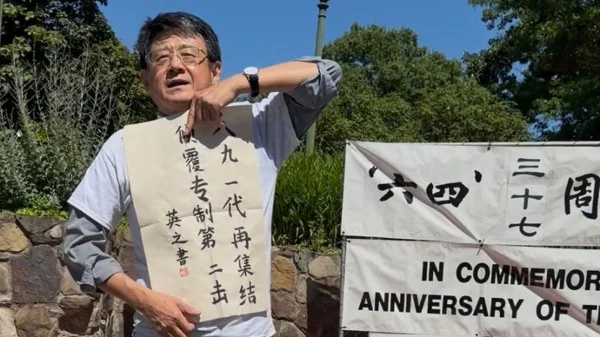
37 years after the Tiananmen Square crackdown, former Peking University student Li Yingzhi still remembers the spring of 1989 like it happened yesterday.
Now living in the United States, the former history major reopened the diary he kept during the student-led democracy movement. In an exclusive interview with Vision Times, he recounted writing what he believed might be his final letter before joining a hunger strike, witnessing armed troops surround Tiananmen Square, and spending six months behind bars after the military crackdown.
On June 4, 1989, the Chinese Communist Party (CCP) deployed troops and tanks to crush a nationwide pro-democracy movement led largely by students. Though publicly-available information is scarce, the military assault ended weeks of peaceful demonstrations centered in Beijing’s Tiananmen Square and resulted in the deaths of hundreds, and according to some estimates, thousands of civilians.
RELATED: Thousands Gather in Toronto to Mark 37th Anniversary of Tiananmen Massacre
Prepared to sacrifice everything
Li entered Peking University’s history department in 1987 after placing tenth in the college entrance examinations in Urumqi. When former Communist Party General Secretary Hu Yaobang died on April 15, 1989, student activism quickly spread across Chinese campuses. Li joined demonstrations almost immediately, attending rallies, writing posters documenting events, and participating in marches.
Success
You are now signed up for our newsletter
Success
Check your email to complete sign up
On May 12, students gathered at Peking University to debate launching a hunger strike. Li addressed the crowd and soon became captain of the university’s 17th Hunger Strike Team. Hours before the strike began, he wrote what amounted to a farewell letter in his diary. 37 years later, he recited it aloud:
“Many patriots at Peking University have already resolved to die. When we place our lives aside, that is when we are at our bravest. I have already resolved to make the ultimate sacrifice. My final words to myself are that there will be no compromise. I will not eat. My individual life is insignificant. I feel deeply how immense the life and destiny of our nation are.”
“For my country, and for the advancement of democracy and freedom in China, I am willing to sacrifice my young and insignificant life. I will fall, and I will never turn back.”
“That was genuine, without question,” Li said. “When young people become passionate, they can throw caution aside. At that moment, if sacrifice was required, then sacrifice was what we were prepared to make.”
Five days on hunger strike
Li spent five days participating in the hunger strike in Tiananmen Square. As his condition deteriorated, medical personnel warned that he needed hospitalization. When nurses informed him he could no longer continue, he suddenly broke down in tears.
“I wouldn’t necessarily call it a mental collapse,” he recalled. “Your body reaches its limit. Someone merely touches you, and you start crying. Mentally, I still wanted to continue, but physically I had reached the edge.”
He was eventually taken to a hospital and later returned to campus. But looking back, Li believes the hunger strike resonated so deeply because it touched ordinary families across China. “Every university student was somebody’s treasured child,” he said. “Parents saw young people risking their health and lives. That’s why it moved China and moved the world.”
Witnessing the crackdown
On June 3, reports spread that security forces were beating demonstrators and residents. Li immediately decided to return to Tiananmen Square. Throughout the night, he witnessed growing violence across Beijing. He recalled seeing soldiers fire weapons, crowds clash with troops, and civilians attempting to assist the wounded.
One memory remains especially vivid. As troops advanced toward the Monument to the People’s Heroes in the early hours of June 4, students remained gathered around the monument while soldiers carrying fixed bayonets moved into position below. “If they had charged up those steps with bayonets, people would have been killed,” he said.
He also remembers seeing bullet impacts on the monument itself. “For 37 years, I’ve never forgotten it,” he said. “There were bullet holes in the relief sculptures on the monument. Even as we were leaving, gunfire was still hitting it.”
“After June 4, they quickly erased all those traces, as if nothing had ever happened,” he added. At approximately 5 a.m., students began withdrawing from the square. Li recalled a somber silence as crowds lined the streets watching them leave. “The sky was gray,” he said. “Everyone was quiet.”
Six months in detention
Four days later, on June 8, Li attempted to leave Beijing after receiving word that his grandmother was critically ill. But he never made it home. Near a police station in western Beijing, soldiers stopped him and searched his belongings. Notes he had kept from Tiananmen Square became evidence against him.
After arguing with authorities, he was taken into custody. At the police station, he says officers accused him of being on a wanted list and physically assaulted him. “That was the first time I was hit like that,” he recalled. “I was twenty years old.”
Held under a system known as “shelter and investigation,” Li spent roughly six months in detention before being released in December 1989. While imprisoned, thoughts of his family often overwhelmed him. “I would think about my mother and start crying,” he said. “A 20-year-old who grew up surrounded by love and sincerity suddenly found himself locked away.”
Though he ultimately received only a minor disciplinary notation, he says the consequences followed him for years and derailed career opportunities that had once seemed certain.
Looking ahead
Li believes the events of 1989 fundamentally altered both his life and China’s trajectory. Reflecting on the decades since the crackdown, he argues that the suppression of reform-minded voices within the Communist Party contributed to broader social and political decline.
Today, he continues to speak publicly about Tiananmen and remains active in efforts to preserve historical memory. “I often say that I am a survivor of history,” he said. “That night, if a bullet had struck me, or if a tank had reached me, perhaps I would never have left Beijing alive. But I survived, and 37 years later, I am here in America.”
The diary containing his farewell letter remains in China. One day, he hopes it can be preserved as part of the historical record. “I simply want these experiences to be remembered,” he said. “I want people to know that there was an ordinary Peking University student who lived through these events.”