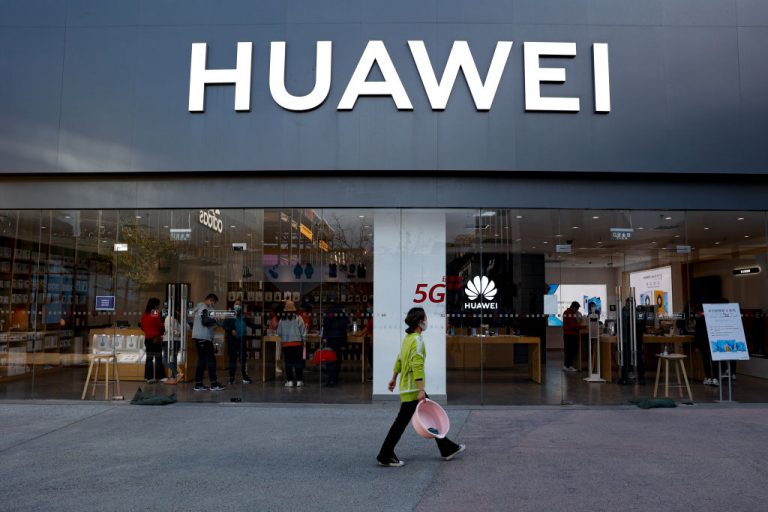
According to Reuters, as global competition in the semiconductor industry continues to intensify, China’s chip sector is accelerating efforts to achieve technological breakthroughs. Analysts say that although Huawei is advancing architectural innovations and packaging technologies, it remains constrained by critical equipment shortages and structural limitations in the global supply chain. As a result, it is unlikely to significantly narrow the gap with leading semiconductor companies in the near term.
While Huawei continues to introduce new technological concepts, analysts estimate that by 2031 it could still lag behind international competitors by approximately six to eight years, the Wall Street Journal wrote. This assessment is based on a comprehensive evaluation of the development trajectory of advanced semiconductor manufacturing and China’s current technological constraints.
At a recent semiconductor industry conference in Shanghai, He Tingbo, head of Huawei’s semiconductor business, introduced the so-called “Tau Law” (τ Law), which she presented as an alternative path to Moore’s Law.
Since the 1960s, Moore’s Law has driven semiconductor progress by roughly doubling the number of transistors on a chip every two years through continued miniaturization of transistor features (geometric scaling). Huawei’s new approach, however, shifts away from relying primarily on further transistor shrinking. Instead, it introduces the Tau (τ) Scaling Law, which focuses on reducing signal propagation delay (τ) through LogicFolding architecture — an innovative form of three-dimensional stacking and circuit folding — combined with system-level architectural optimizations to improve overall transistor density, performance, and power efficiency.
According to Huawei technical documents, the approach could increase chip density by approximately 55 percent and aims to achieve performance levels approaching those of advanced manufacturing processes by 2031.
Success
You are now signed up for our newsletter
Success
Check your email to complete sign up
However, several semiconductor analysts argue that the strategy is essentially an extension of existing advanced packaging technologies rather than a fundamentally new technological breakthrough.
Industry observers generally agree that the main obstacle to China’s development of advanced chips remains extreme ultraviolet (EUV) lithography technology.
EUV systems, almost exclusively manufactured by Dutch company ASML, are essential for producing advanced chips at the 7-nanometer node and below.

China struggles to obtain EUV equipment
Since 2019, under a U.S.-led export control regime, Chinese companies have been unable to obtain EUV equipment, significantly restricting long-term development of advanced semiconductor manufacturing capabilities.
At the same time, restrictions on electronic design automation (EDA) software and high-end manufacturing materials have further complicated efforts to upgrade the industry.
Industry experts also note that three-dimensional stacking and advanced packaging technologies are not unique to Huawei.
Companies such as TSMC, Intel, Samsung Electronics, and AMD have invested in advanced packaging research for many years.
The difference, analysts say, is that these companies generally build their stacking technologies on advanced wafers manufactured using EUV lithography, enabling greater performance gains. Huawei’s current approach is viewed as relying more heavily on optimizing mature manufacturing processes, which limits the potential performance improvements.
Reuters notes that some Chinese semiconductor fabrication plants continue to struggle with manufacturing yields. Some analysts estimate that the proportion of usable chips may be only around 20 percent.
Three-dimensional stacking requires multiple chips to be integrated with extremely high precision, placing even greater demands on manufacturing yields. If the underlying chips lack sufficient reliability, the complexity of production increases significantly.
Analysts believe this issue could become one of the key obstacles to large-scale deployment of Huawei’s proposed approach.
Supply chain restructuring
Meanwhile, the global semiconductor supply chain is undergoing rapid restructuring.
The United States, Japan, and the Netherlands have strengthened export controls on critical equipment and materials, encouraging the regionalization of supply chains. Competition in the semiconductor industry is increasingly shifting from a race focused solely on technology to one involving entire ecosystems, industrial systems, and supply-chain networks.
Analysts argue that China’s semiconductor industry is developing along a dual-track strategy of pursuing alternative technological pathways while building an independent domestic ecosystem. Nevertheless, a significant gap remains in advanced manufacturing technologies.
Overall, Huawei’s “Tau Law” represents an attempt by China’s semiconductor industry to innovate under restrictive conditions. Whether it can genuinely narrow the gap with the world’s leading semiconductor companies remains uncertain.
The prevailing industry view is that, until breakthroughs are achieved in core technologies such as EUV lithography, China’s semiconductor industry will largely remain in a phase of optimizing existing systems rather than making a full generational technological leap.