Nanjing activist Shi Tingfu, known as the first person in China’s street protests to publicly give speeches urging people to “Never Forget June 4,” is 67 years old. A human rights defender, Shi actively supported the 1989 student movement and later became a practitioner of street activism during his rights-defense efforts. He publicly called to “Never Forget June 4” and shouted slogans such as “Long live the Republic of China! Long live the Three Principles of the People!” In 2024, he was sentenced to three years in prison for helping farmers in Xinjiang send petition materials to foreign media journalists, and he is currently serving his sentence in a Xinjiang prison.
On June 4, Human Rights in China posted an article on the X platform titled “The First Person in China’s Street Public Speeches ‘Never Forget June 4’ — Nanjing Hero Shi Tingfu.” The article states that Shi, a human rights defender, was formerly an employee at the 11th Radio Components Factory in Nanjing. He often paid attention to fellow citizens in difficulty and actively donated money to help others.
In 1989, he actively supported the student pro-democracy movement, advocating “opposing official corruption and seeking democracy and freedom.” From 1995 to 1999, he was attacked three times in civil disputes and sustained multiple injuries; the attackers, allegedly children of senior officials, escaped legal punishment. In 2001, during petitioning activities, he was falsely accused and sentenced to four years in prison by a local court for “extortion.”
In 2003, his 15-year-old son Shi Jing was attacked and hacked with a knife while visiting him, suffering lasting injuries. The perpetrators were again said to be from powerful families connected to local judicial authorities and remained unpunished, prompting Shi to continue petitioning. In 2007, he was again beaten during rights-defense activities. From that point on, Shi transitioned from a petitioner to a firm rights-defense activist and gradually became an active participant in street democracy movements.
On April 13, 2015, Shi debated pro-CCP individuals at Taipei 101 in Taiwan, publicly exposing their mindset and tearing down a CCP flag. On June 2, 2016, during an event at Sun Yat-sen Mausoleum in Nanjing marking the 79th anniversary of the July 7 Incident, he shouted “Long live the Republic of China” when KMT anti-Japanese war veterans from Taiwan visited.
Success
You are now signed up for our newsletter
Success
Check your email to complete sign up
On June 3, 2016, Shi was intercepted at the Shenzhen border and forcibly returned to Nanjing while attempting to travel to Hong Kong for the 27th anniversary of June 4 commemorations. He was detained in a tiny one-square-meter cell in Nanjing for four days. On Oct. 31 the same year, he was arrested again for shouting “Long live the Three Principles of the People” during a visit to the Sun Yat-sen Mausoleum by former KMT Chairperson Hung Hsiu-chu. That year, he was also placed under surveillance for activities such as observing the Wang Jian case in Nanjing, attending memorial events for Lin Zhao in Suzhou on April 29, holding placards in support of Guo Feixiong, and organizing assistance for the family of lawyer Gao Zhisheng.
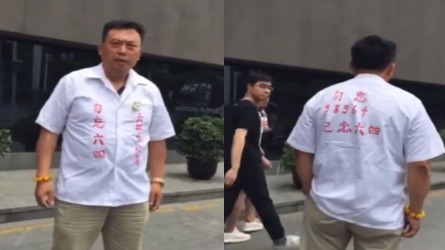
On June 4, 2017, Shi wore a blood-stained shirt reading “Never Forget June 4” in front of the Nanjing Massacre Memorial Hall, delivered a speech marking the 28th anniversary of June 4, and uploaded the video online. He was summoned by police in Nanjing’s Yuhuatai District that same afternoon, and on June 5 was criminally detained on suspicion of “picking quarrels and provoking trouble.” He was formally arrested on July 6 of that year.
Repeatedly abused by guards
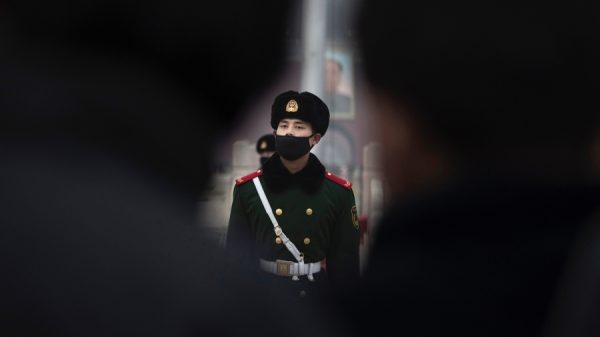
It is reported that Shi was repeatedly abused by guards and inmate enforcers in detention, causing his health conditions to worsen. His sleeping space was so narrow he could barely lie down, and he often woke up gasping for air. Even after falling asleep, he was frequently shaken awake by other inmates under orders from cell bosses, and his clothing used as pillows was taken away. The food was spoiled and inedible, and prison vendors reportedly refused to sell him food, claiming it was “ordered by leadership.” On Feb. 11, 2018, he was sentenced to one year in prison with a suspended sentence of one year and six months, and released the same day.
Later, on Jan. 15, 2024, Shi was arrested by police in Aral City, Xinjiang Production and Construction Corps, after helping send petition materials from fruit farmers in Aksu, Xinjiang, to foreign media journalists. On Feb. 8, he was formally arrested and accused of “picking quarrels and provoking trouble” for allegedly fabricating and spreading false rights-defense information online, as well as for online activities involving the promotion of terrorism and extremism. As a result, lawyer visits were initially denied.
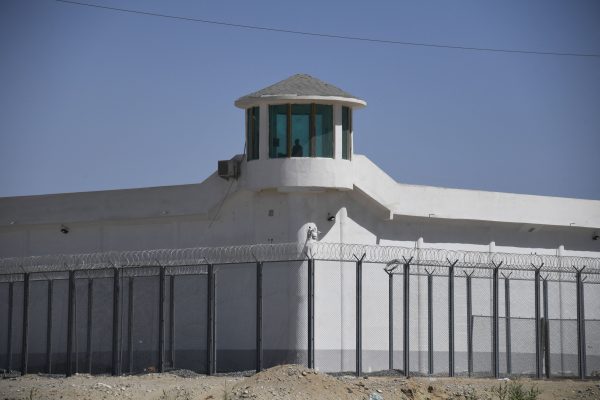
On April 11, 2024, a lawyer met Shi at the Aksu-Aral detention center. Due to pre-existing conditions such as hypertension and pneumonia, his health deteriorated further in custody. He was reportedly restricted in food intake, often not getting enough to eat, and became very thin with poor mental condition.
On July 16, 2024, it was learned that Shi Tingfu was sentenced to three years in prison by the Aral Court of the Xinjiang Production and Construction Corps for “picking quarrels and provoking trouble,” with his sentence ending on Jan. 14, 2027. On April 17, 2025, Shi called his son, saying he felt weak every day and hoped his son and friends could send him letters and postcards for moral support. He is currently held at Shahe Prison of the First Division of the Xinjiang Production and Construction Corps.
‘Picking quarrels and provoking trouble’
According to a 2017 Voice of America report, on the morning of June 4 that year, Chinese citizen Shi Tingfu delivered a speech outside the Nanjing Massacre Memorial Hall to mark the 28th anniversary of the June 4 incident. He was taken away by police and his home was searched before being detained. Video he posted on WeChat shows him urging people to widely spread the message and not forget June 4, though most young people appeared indifferent, with only a few stopping to watch, seemingly unaware of the historic events of 1989. That afternoon, he was taken from his home by two police officers on suspicion of “picking quarrels and provoking trouble.” By 2 a.m. the next day, police issued a formal detention notice.
On the 37th anniversary of the 1989 “June 4” incident, despite heightened state security and censorship, many Chinese citizens have not forgotten the event and continue to speak out in various ways. As a result, authorities have tightened internet censorship, with phrases like “Crazy Thursday,” “June 6,” and others reportedly becoming sensitive or banned terms. Restrictions on livestreaming and speech have also increased, including limits on speaking loudly or saying phrases like “sorry” and “I love you.” These actions have sparked widespread online ridicule.
In a commentary published in Vision Times, author Chen Jing stated that “in a totalitarian country filled with lies, remembering real names and history is the highest dignity of those who refuse to obey. Today’s absurd censorship, throttling, and suppression are a white paper of the regime’s fear, reflecting how the light of those martyred souls from 37 years ago has never been extinguished.”
Chen Jing also argued that this wave of repression confirms that the June 4 incident is not “past history” but an ongoing psychological trauma the regime has never escaped. Any resistance or restriction, she wrote, is an involuntary reaffirmation of that legacy. “Do not doubt it: when the collapse of an authoritarian system reaches a critical point, it often happens in an instant.”