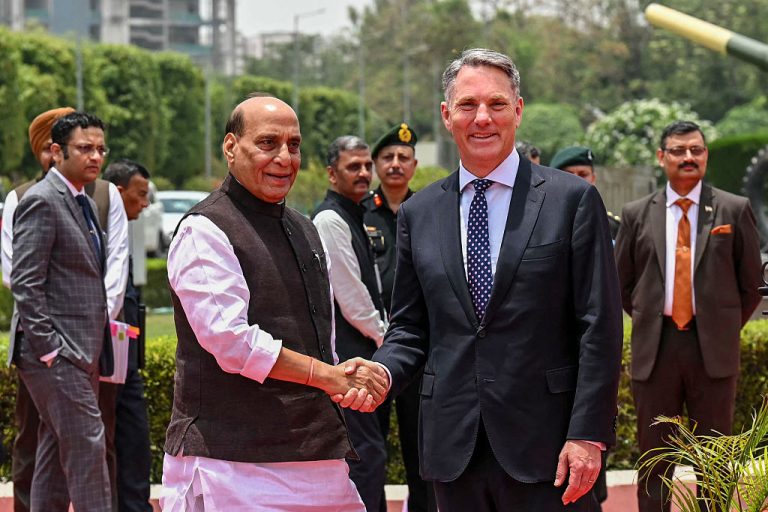
India and Australia agreed to strengthen defense and security cooperation during their second bilateral defense ministers’ dialogue on June 1. Among a range of security initiatives, the two countries committed to expanding cooperation on maritime domain awareness, including undersea surveillance and maritime patrol aircraft operations.
The maritime collaboration forms part of the “Joint Maritime Security Collaboration Roadmap” that both governments are currently finalizing.
Experts told Vision Times that India and Australia, both being middle-income democratic nations with significant strategic interests in the Indo-Pacific, share an interest in strengthening regional security and supporting a free and open Indo-Pacific.
“Ministers discussed advancements in bilateral maritime security cooperation and efforts to finalise the Joint Maritime Security Collaboration Roadmap,” the Australia’s Department of Defence said in a joint statement, adding the two sides have encouraged collaboration between the Indian Coast Guard and Australia’s Maritime Border Command.
The two countries’ “ministers agreed to progress the collaborative maritime domain awareness activities by maritime patrol aircraft and explore opportunities to enhance undersea domain awareness,” it continued.
Success
You are now signed up for our newsletter
Success
Check your email to complete sign up
Grant Newsham, a senior fellow at the Center for Security Policy and the Japan Forum for Strategic Studies, told Vision Times in an email that maritime patrol aircraft remain a critical component of maritime surveillance operations.
RECENT COVERAGE
- Media Battle Erupts Over Alleged Israeli Espionage Threat to US Amid Iran Talks
- Exclusive: Analyst Says Taiwan Must Confront Limits of US Support as $14 Billion Arms Package Remains in Limbo
- Deep Beneath the Pacific, Japan Hunts for a New Source of Rare Earth Metals
“Satellites and various types of sensors (surface and subsurface included) are part of the ‘mosaic’, but you still need aerial and maritime patrols out keeping an eye on things — and linked with the electronic surveillance tools,” said Newsham, the author of the recently released book, When China Attacks: A Warning to America.
Newsham said enhanced India-Australia cooperation should be viewed in the context of Beijing’s increasing military and economic assertiveness across the Indo-Pacific. He added that coast guards play an important role in building interoperability among regional partners.
“The Indian Ocean is a very big place, and you never have enough ships to keep an eye on it. So by combining efforts, the Indians and Australians are expanding their individual capabilities many times over,” he said.
The Joint Maritime Security Collaboration Roadmap
During the meeting in New Delhi between Indian Defence Minister Rajnath Singh and Australian Deputy Prime Minister and Defence Minister Richard Marles, the two countries also announced plans to begin work on a Memorandum of Understanding regarding the Provision of Defence Articles and Defence Services as the next step in expanding defense-industrial cooperation.
Arnab Das, founder and director of an India-based maritime research center, told Vision Times that given India and Australia are both Indo-Pacific powers with significant strategic stakes in the region, each is seeking greater strategic autonomy while also expanding their domestic military production.
“Strategic autonomy will demand that they both invest in strategic capacity and capability building with allies to counter the onslaught of developed powers to dominate their military industry complex,” Das said.
As part of their growing defence-industrial partnership, India welcomed Australia’s first defense trade mission in October 2025. The delegation brought Australian industry representatives to India to explore partnerships, technology cooperation, supply-chain integration, and potential defense exports.
The trade mission was held concurrently with the inaugural India–Australia Defence Ministers’ Dialogue and the Australia–India Defence Industry Roundtable.
According to Das, efforts to expand joint defense production come at a time when major global defense manufacturers increasingly view Indo-Pacific countries as export markets. Regional cooperation, he said, can help build local industrial capacity.
“However, we ignore the unique tropical characteristics of the Indo-Pacific strategic space, which ensure sub-optimal performance of the military hardware that were designed during the Cold War Era, for their deployment in the temperate waters,” he said.
Das added that the region requires defense systems designed for local operating conditions, along with the production capabilities needed to sustain them.
Participation in regional military exercises
Both countries have increasingly participated in multinational military exercises across the Indo-Pacific in recent years. During the dialogue, the two ministers welcomed each other’s participation in a growing range of military engagements.
“They welcomed the evolution of Army Exercise Austrahind this year to focus on amphibious combat and littoral maneuvers,” the Indian government said in a statement.
Austrahind is a bilateral military exercise first held in India in 2022. It is designed to strengthen the strategic partnership between the two militaries through training across a range of operational scenarios, including counterterrorism missions.
Operation Render Safe is a longstanding Australian-led effort to remove unexploded ordnance and other explosive remnants of war, primarily from Pacific Island nations.
Das said bilateral and multinational military exercises help participating countries improve domain awareness and evaluate operational performance under conditions similar to those during a potential conflict.
“The follow-up of such exercise is to identify gaps and then focus on research and innovation to bridge the gaps,” he said.
The Australian side welcomed India’s enhanced participation in Exercise Talisman Sabre 2027, the largest military exercise conducted in Australia and jointly organized with the U.S. military.
Australia participated in India’s Exercise Milan in February 2026, while India took part in Australia’s Exercise Kakadu in March 2026.
More than 70 countries, including the United States, Australia, France, Russia, and Japan, participated in the 13th edition of Milan, the Indian Navy’s flagship multilateral naval exercise, held in Visakhapatnam and the Bay of Bengal from Feb. 15–25, 2026.
The Royal Australian Navy conducted the 17th edition of Exercise Kakadu with approximately 6,000 personnel from Australia and 18 partner nations, including India, Malaysia, the Philippines, Thailand, Vietnam, Japan, the United States, Canada, New Zealand, Indonesia, and Singapore.
India deployed INS Nilgiri, the lead ship of a new generation of stealth guided-missile frigates, to the exercise.
Newsham described the strengthening of India-Australia defense ties as a “positive development” but said long-term success would require sustained political commitment and effective coordination at the operational level.
“It is important that both India and Australia prioritize this effort and continue to do so. Such joint efforts also have political knock-on effects and tend to deepen the overall bilateral relationship between two nations,” he said.