NEW DELHI — Secretary of State Marco Rubio is on his first official visit to India from May 23 to 26, meeting Indian leaders, visiting key U.S. diplomatic missions, and attending the QUAD foreign ministers’ meeting on Tuesday, May 26.
Speaking to the press and in media interviews in India, Rubio discussed the strategic importance of India-U.S. relations, the upcoming QUAD meeting, and Washington’s recent positioning on Iran.
The visit comes just 10 days after India hosted the BRICS foreign ministers’ meeting from May 14 to 15, attended by officials from Brazil, Russia, China, South Africa, Egypt, Ethiopia, Iran, the United Arab Emirates, and Indonesia.
The close timing of the two gatherings has drawn additional attention because Iran’s foreign minister attended the BRICS meeting, while Rubio is representing Washington at the QUAD summit amid continuing tensions involving Tehran.
In an interview with India Today on Sunday, May 24, Rubio said the Iran situation must be viewed from two urgent perspectives.
Success
You are now signed up for our newsletter
Success
Check your email to complete sign up
“The straits need to be opened immediately and fully, and so that’s the first stage of it,” Rubio said.
“The second is that Iran needs to enter into serious negotiations on three topics: their pledge never to have nuclear weapons, restrictions long term on their enrichment capabilities, and what do you do with the highly enriched uranium?”
- India-Nordic Summit: $100 Billion Trade Framework to Boost Tech, Green Transition and Arctic Cooperation
- India, Japan Deepen Economic Security Ties With Focus on Semiconductors, Critical Minerals
- US Trade Court Blocks Trump’s Global 10% Tariffs in Win for Small Businesses
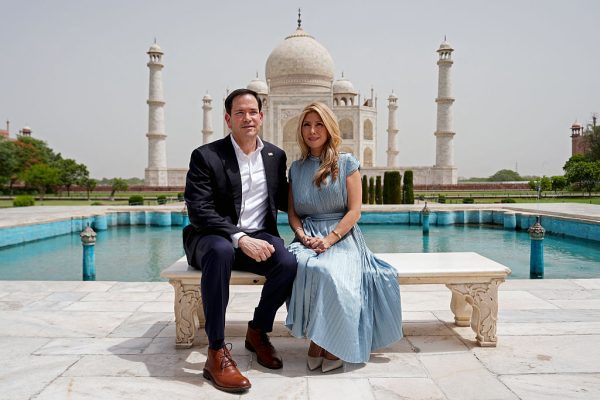
Rubio reiterated President Donald Trump’s position that the United States would do everything possible to prevent Iran from obtaining a nuclear weapon. Earlier in a joint press conference with Indian Minister of External Affairs S. Jaishankar, Rubio said in response to a journalist’s question that “significant progress” had been made in negotiations involving Iran, though he described it as “not final progress.”
Iran’s embassy in India later rejected Rubio’s remarks, stating Sunday, May 24, that the International Atomic Energy Agency had not reported any diversion in Iran’s nuclear activities, as detailed in a piece by the Indian Express:
“With regard to the claims made by the US Secretary of State concerning Iran’s nuclear programme, Iran once again recalls that, as a committed member of the Treaty on the Non-Proliferation of Nuclear Weapons (NPT), it has consistently declared that its nuclear programme is entirely peaceful and remains under the supervision of the International Atomic Energy Agency (IAEA).”
India-US ties
Rubio met Indian Prime Minister Narendra Modi shortly after arriving Saturday, May 23, and later held talks with Jaishankar on Sunday, May 24.
“The Secretary underscored the strategic importance of the U.S.-India partnership, rooted in our shared democratic values, profound economic and commercial opportunity, and the strong personal ties between President Trump and Prime Minister Modi,” U.S. State Department spokesman Tommy Pigott said in a statement.
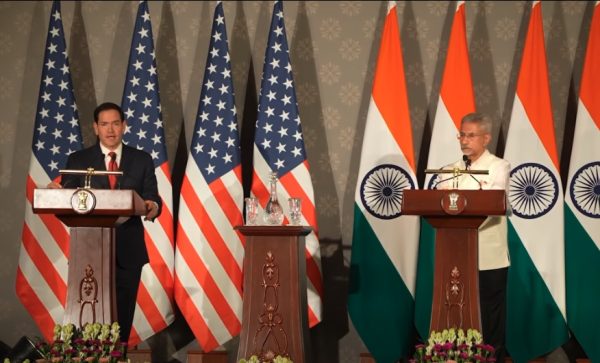
Pigott added that Rubio extended an invitation from Trump for Modi to visit the White House.
The Indian External Affairs Ministry said that Rubio and Modi had a detailed discussion on “sustained progress in bilateral cooperation” across multiple sectors like “defence, strategic technologies, trade and investment, energy security, connectivity, education and people-to-people ties.”
In his interview with India Today, Rubio described the relationship as a “strategic alliance,” adding that there are many areas where the two countries’ interests overlap and should be built upon.
“We have a lot of alliances around the world, we have a lot of countries we deal with, but we have a handful of really important strategic alliances, and India is one of them,” said Rubio.
India-U.S. relations faced strain last year after Trump imposed an additional 50 percent tariff on Indian imports over New Delhi’s purchases of Russian crude oil, on top of an earlier 25 percent tariff. Indian officials also reacted negatively to Trump’s claims that he helped defuse the India-Pakistan conflict in May 2025.
Rubio rejected characterization of bilaterial ties as having lost momentum when asked about this concern during the press conference.
“The President did not say, ‘let’s figure out a way to create friction with India over trade.’ The President came in and said, ‘we have a trade situation involving the U.S. economy that doesn’t work moving forward,” he said of Trump’s position.
“There’s a huge imbalance that’s built up and it needs to be addressed. And he pursued it from a global perspective.”
Focus on QUAD and Indo-Pacific security
Rubio also stressed the importance of the QUAD — the strategic grouping of the United States, India, Japan, and Australia — as a platform for maintaining a free and open Indo-Pacific.
In his interview with India Today, Rubio said he expected two major topics to dominate discussions at Tuesday’s QUAD foreign ministers’ meeting: maritime security threats and critical mineral supply chains.
According to Rubio, the concept of a “free and open” Indo-Pacific extends well beyond the region itself.
“Likewise, on the unimpeded flow of commerce, especially in international airspace and international waters. This is true in the Indo-Pacific, ensuring that there is a free and open Indo-Pacific, but it extends beyond the Indo-Pacific,” Rubio said during Sunday’s joint press conference.
Rubio emphasized that no country should be allowed to nationalize international waterways or airspace, adding that opposition to such actions represents another area of strong strategic alignment between Washington and New Delhi.
Rubio also told India Today that he expects leaders of the QUAD nations to meet later this year.
“And it’s our job as the ministries to sort of make sure that we’ve positioned it so that, when they meet, they’re there to announce something important, something that’s been worked out, something that we’re going to be working on together,” Rubio said.