The Communist Youth League posted a graphic about graduate unemployment. Chinese users said it had finally told the truth.
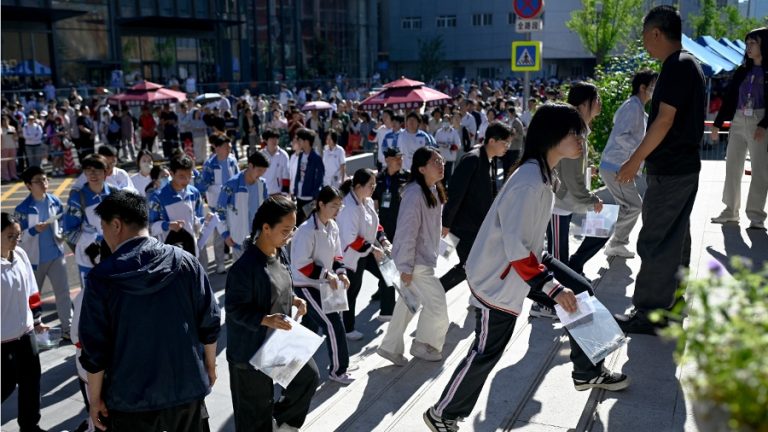
On June 7, the first day of China’s gaokao, a social media account run by the Communist Youth League of the Chinese Communist Party (CCP) put up a graphic that stopped the internet cold. “A message to yourself on exam day,” it read: “if you don’t get in, you’ll be delivering food in four days. If you do get in, you’ll be delivering food in four years.”
The account, called “Voice of Youth,” is an official propaganda channel of the League, the Party’s mass organization for people under 28. It deleted the graphic within hours. By then, it had spread across Chinese social media and onto X (formerly Twitter), where overseas Chinese users tore into it.
“When the department whose entire job is papering over problems can only write jokes, it tells you how far gone the Xi Jinping era really is,” one user wrote. “Why are they delivering food? It’s this system that did this to them,” wrote another. A third called the graphic “sick” and declared the country finished. “Words this subversive, and they came from the Communist Youth League itself,” a fourth wrote.
On the mainland, where open criticism requires careful indirection, commenters were equally caustic. One described delivery work as “flexible,” invoking the regime’s euphemism for contractless gig work. “Can the college entrance exam still change the fate of rural kids?” another asked. “Early or late, it’s all food delivery.”
Success
You are now signed up for our newsletter
Success
Check your email to complete sign up
Three decades of credential inflation broke an implicit bargain
A June 8 commentary published on X by the pseudonymous overseas Chinese writer Tianji Qitan (天機奇談) was blunt. “This poster did not misfire,” he wrote. “It was the first time the authorities told the truth.”
For roughly three decades, Chinese society operated on an implicit social contract: academic performance would be rewarded with employment and social mobility. Score high enough for a prestigious university, the logic went, and a decent job would follow. That contract held through roughly 2010. After that it began unraveling.
From 1990 to 2005, university graduates were scarce enough that employers competed for them; a degree was a near-guarantee of stable work and upward mobility. From 2006 to 2015, rapid enrollment expansion began eroding that premium. From 2016 to 2024, credential inflation took hold: employers demanded higher degrees for jobs that had not changed, while graduates entered a labor market that could not absorb them. By 2025 and 2026, the commentator wrote, the system had reached what he called “education bankruptcy.”
China’s labor market can no longer absorb its own graduates
China’s universities produced 12.22 million graduates in 2025. Projections put the 2026 figure above 12.5 million.
A report released in early June by China’s New Employment Forms Research Center drew on more than 28,000 survey responses covering food delivery couriers, express parcel workers, truck drivers, domestic workers, live-streamers, factory workers, construction laborers, security guards, and cleaners. It found that China’s population of “flexibly employed” workers surpassed 280 million in 2025. The center projected that figure would reach 320 million by the end of 2026.
The regime’s official definition of “flexible employment” is anyone who performed at least one hour of paid work per week. That definition is written to maximize the count of people classified as employed. China’s working-age labor force totals roughly 725 million people. If 320 million of them qualify as flexibly employed under the regime’s own minimalist standard, more than 44 percent of the workforce holds no stable labor contract and no formal employment relationship. The research center’s 2025 report described flexible employment as having shifted from a “supplementary form” of work to a “key pillar” of the labor market, a shift the regime’s own statisticians have now confirmed in writing.
The Communist Youth League deleting the post only confirmed the joke was true
The “Voice of Youth” graphic was almost certainly drafted as breezy, self-deprecating humor meant to make the Party’s youth apparatus appear relatable to younger audiences. Chinese users on the mainland and overseas converged on the same reading: the youth employment crisis is a structural product of a system that for three decades sold young people a credential-for-security bargain it could no longer honor. The deletion made the point for them: if the statement had been wrong, there would have been nothing to delete.
The Communist Youth League has not commented further.