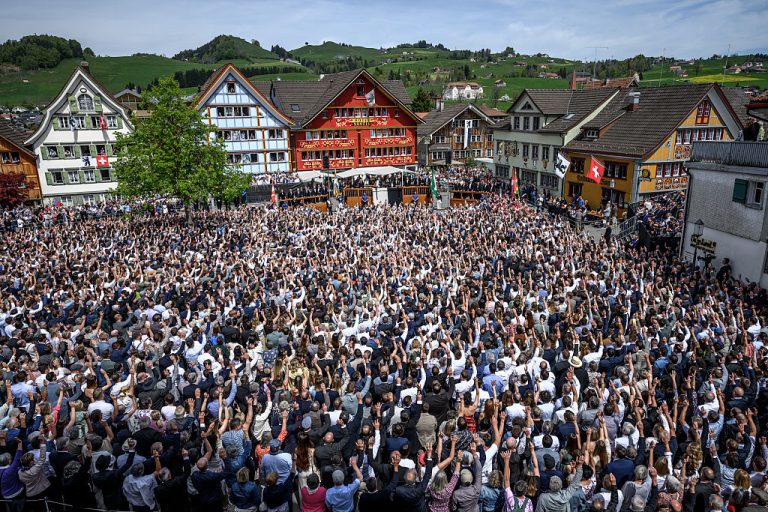
On June 14, Swiss voters rejected the “No to a Switzerland with 10 Million! (Sustainability Initiative),” which proposed capping the country’s permanent resident population at 10 million until 2050. According to official government sources, the measure was defeated with 54.79 percent voting against and 45.21 percent in favor. Voter turnout was 59 percent, well above recent average participation which sits around 48 percent for referendums.
Switzerland’s population is currently estimated at around 9.1 million, with foreign nationals making up roughly 28 percent of residents. Swiss authorities project that the total population could reach 10 million in the early 2040s, according to Reuters.
Marcel Dettling, the leader of the Swiss People’s Party, said the initiative enjoyed strong support in rural regions but ultimately failed to pass due to opposition from urban voters.
“Not a single problem has been solved,” he lamented according to Reuters. “We will continue to push for sensible immigration.”
The initiative argued that since the introduction of the “free movement of persons” in 2002 the country’s population has surged by 1.7 million, primarily due to immigration.
Success
You are now signed up for our newsletter
Success
Check your email to complete sign up
“The number of people immigrating depends primarily on the labour market. When the economy is strong, companies struggle to find enough workers within Switzerland. Companies, as well as public institutions like hospitals and care homes, often recruit the skilled workers they need from the EU,” Swiss federal authorities wrote.
Under the proposal, if Switzerland’s permanent resident population were to surpass 9.5 million before 2050, the Federal Council and Parliament would be required to implement corrective measures, particularly targeting asylum policy and family reunification rules.
The government would also be obligated to seek exemptions or activate safeguard clauses in international agreements seen as contributing to population growth.
Had it been successful, the initiative would have required Switzerland to begin winding down key international agreements once the population surpassed 10 million, including the EU free movement accord after a two-year transition period.
That in turn could have put the broader Bilateral Agreements I framework at risk, while also raising questions over Switzerland’s continued participation in the Schengen and Dublin systems, with potential knock-on effects for security and asylum cooperation.

Distinct urban-rural divide on population issues
Swiss voters’ rejection of the initiative, which required both a popular majority and a majority of cantons under the country’s double-majority system, highlighted deep geographic and demographic divides.
Support for the initiative was strongest in rural, German-speaking cantons, where concerns about rapid development and the erosion of local character were most pronounced.
Opposition, meanwhile, was concentrated in urban centers, border regions, and French-speaking areas, where voters placed greater emphasis on economic stability and international integration, according to The New York Times.
Government and business leaders welcomed the result. The BBC reported that Justice Minister Beat Jans described it as “a sign of stability, openness and reliability.”
Employers’ associations and economic forecasters had warned that sharp immigration curbs could exacerbate existing shortages in healthcare, tech, finance, and skilled trades, potentially shaving GDP growth significantly over decades.
The Swiss People’s Party, however, framed the 45 percent “Yes” share as evidence of widespread discontent. Marcel Dettling vowed to continue advocating for “sensible immigration” controls, pointing to persistent pressures on housing, public transport, and the environment, Reuters reported.
Ultimately the vote averted an immediate upheaval in Switzerland’s relationship with the European Union.
Success would have triggered obligations to renegotiate or exit elements of the Bilateral Agreements I framework, including free movement of persons, with ripple effects on Schengen/Dublin cooperation, Switzerland’s association agreement with the EU.
Opponents had likened the initiative to a “Swiss Brexit,” a risk voters ultimately sidestepped in favor of continued ties with their largest trading partner.