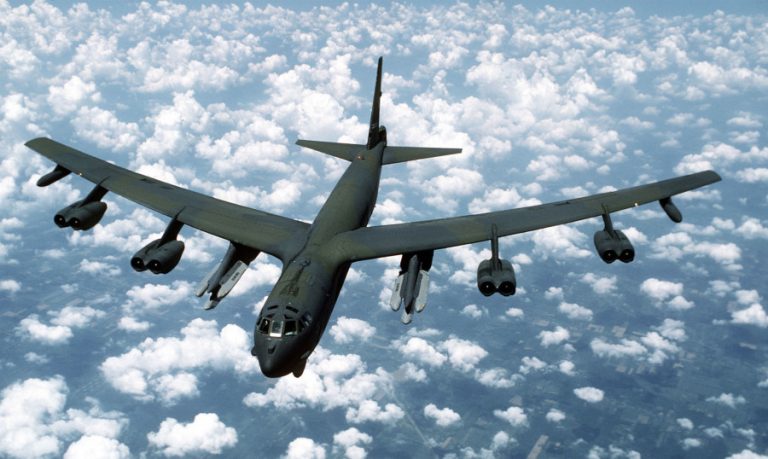
On Monday, June 15 a U.S. Air Force B-52 Stratofortress strategic bomber crashed, exploded, and caught fire during takeoff at Edwards Air Force Base in California. All eight people on board were killed. The U.S. Air Force has suspended all flight operations at the base and launched an investigation into the cause of the accident.
According to Reuters, the crash occurred at Edwards Air Force Base in the Mojave Desert region of Southern California. U.S. Air Force officials said the approximately $85 million B-52 bomber was conducting a routine test mission when it lost control and crashed shortly after leaving the runway.
At a press conference held several hours after the accident, U.S. Air Force Colonel James Hayes said the aircraft was performing test operations related to a radar modernization upgrade program.
He stated that the aircraft carried a total of eight personnel, consisting of a mixed crew that included government civilian employees, defense contractors, and active-duty military personnel.
Hayes said the cause of the crash remains unknown and that an investigation is already underway.
Success
You are now signed up for our newsletter
Success
Check your email to complete sign up
Because authorities are still notifying family members, the U.S. Air Force has not yet released the identities of the victims.
A large fire broke out immediately after the crash, sending thick smoke into the air. Aerial footage showed a vast charred area at the crash site, still smoldering and covering more than the size of a football field. Emergency vehicles continued to patrol the perimeter.
“After reviewing footage of the crash, it was determined that no one could have survived,” Hayes said.
Due to damage to the runway, all flight operations at Edwards Air Force Base have been suspended at least until Tuesday. However, the Air Force emphasized that normal operations at other bases and units will not be affected.
B-52 Bomber modernization effort and fleet background
Located about 100 miles (161 km) north of Los Angeles, Edwards Air Force Base is the U.S. Air Force’s largest flight test center, covering approximately 1,245 square kilometers (481 square miles). It has long served as a testing site for advanced American aircraft and spacecraft.
In 1947, legendary test pilot Chuck Yeager made history there by becoming the first person to break the sound barrier while flying the Bell X-1 experimental aircraft. Later, the X-15 high-altitude, high-speed research aircraft and NASA’s Space Shuttle program also conducted major tests and landing operations at the base.
The B-52 Stratofortress entered service with the U.S. Air Force in 1955 and was designed and manufactured by Boeing. The aircraft can carry up to 70,000 pounds (31.8 metric tons) of ordnance and has an unrefueled range of approximately 8,800 miles (14,200 kilometers).
Last December, a B-52 Stratofortress equipped with a newly upgraded radar system flew from Boeing’s facility in San Antonio to Edwards Air Force Base as part of the Air Force’s broader B-52 modernization program.
The new radar system is one component of a comprehensive upgrade effort designed to improve the bomber’s combat capabilities and ensure that the aircraft remains operational for decades to come.
According to the U.S. Air Force, the B-52 is capable of carrying out not only strategic bombing missions but also close air support, air interdiction, air superiority operations, and maritime strike missions.
The aircraft involved in the crash belonged to the U.S. Air Force’s 412th Test Wing, which is based at Edwards Air Force Base. The Air Force’s active B-52 fleet now consists exclusively of the B-52H variant, with most aircraft stationed in North Dakota and Louisiana.
According to statistics from the Geneva-based Bureau of Aircraft Accidents Archives, this was the first major B-52 crash since a B-52 crashed in Guam in May 2016. All seven crew members survived that earlier accident.