By Jian Yi, Commentary
Former U.S. State Department China policy adviser Miles Yu is warning that academic exchanges between the United States and China have become increasingly one-sided, arguing that the Chinese Communist Party (CCP) is exploiting the openness of American universities while denying comparable freedoms and reciprocity to U.S. scholars.
In a June 22 essay published by The Washington Times, Yu, director of the Hudson Institute’s China Center, contends that many American institutions mistakenly assume Chinese scholars operate under the same academic freedoms enjoyed in the West.
“The greatest mistake American universities, think tanks and policymakers make when engaging scholars from the People’s Republic of China is assuming that both sides participate in the same intellectual system,” Yu wrote. “They do not.”
RELATED: China’s Academic World Rocked as Whistleblower Exposes Research Fraud, Plagiarism
Academic freedom is not reciprocal
Success
You are now signed up for our newsletter
Success
Check your email to complete sign up
Yu argues that the central issue is not the qualifications or intelligence of Chinese scholars, but the political system in which they work. “American academics operate within a culture that prizes free inquiry, open debate, dissent and the pursuit of truth wherever it leads,” he wrote. “Chinese scholars operate within a political system that demands unanimity of opinion.”
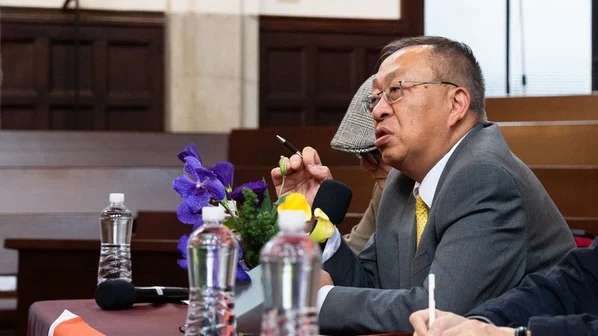
He added that challenging the CCP “on any matter, big or small, can end a career, deepen surveillance or trigger criminal punishment.” “The issue is not whether Chinese scholars are intelligent or capable. Many are. The issue is whether they are free.”
Because of these constraints, Yu argues that many academic exchanges cannot function as genuine intellectual dialogue. “Virtually all academic exchanges with China’s scholars are not genuine dialogues but merely the importation of officially sanctioned CCP perspectives into institutions built on intellectual freedom,” he wrote.
Access can become a form of influence
Yu also challenges how expertise on China is often evaluated within Western academic circles. He compares independent scholars such as Frank Dikötter and Perry Link, who have faced restrictions or exclusion from China because of their criticism of the CCP, with researchers who continue to receive invitations to elite conferences and frequent access to China.
“This does not necessarily mean they are agents of influence,” Yu wrote. “It does mean that China’s gatekeeping system rewards compliance and punishes dissent.”
According to Yu, access itself becomes leverage. “The CCP understands that access itself is a form of leverage,” he wrote. “Scholars who fear losing visas, invitations, research opportunities or professional relationships have powerful incentives to self-censor.”
Over time, he argues, this creates an academic environment in which the most visible China experts are often those least likely to challenge Beijing’s preferred narratives.
A ‘blame America first’ mindset
Yu also criticizes what he describes as a growing tendency among some China analysts to interpret nearly every deterioration in U.S.-China relations through the lens of American responsibility. “Whenever Beijing acts aggressively, whether through military coercion against Taiwan, repression in Hong Kong, intimidation of foreign governments, industrial espionage or human rights abuses, the first instinct of many commentators is not to evaluate CCP behavior on its own merits,” he wrote.
Instead, he said, many analysts immediately search for an American action that supposedly provoked Beijing. “This framework effectively strips the CCP of agency while assigning Washington responsibility for nearly every deterioration in bilateral relations.”
He warns that once this perspective becomes habitual, academic analysis risks becoming advocacy. “A scholarly community that reflexively interprets events through this lens ceases to function as an objective analytical enterprise,” Yu wrote. “It becomes an amplifier for CCP messaging.”
Openness as strategic vulnerability
Yu extends the same argument to educational exchanges, warning that the current imbalance poses national security concerns. “The United States allows hundreds of thousands of Chinese students and researchers access to American campuses,” he noted. Before the pandemic, approximately 370,000 Chinese students studied in the United States. Today, roughly 270,000 remain, while fewer than 1,000 Americans study in China.
“For every American studying in China, roughly 300 Chinese nationals are studying in the U.S.,” Yu wrote. Many are enrolled in fields involving next-generation technology and other areas with national security implications.
Citing Chinese Ministry of Education statistics, Yu noted that nearly 90 percent of Chinese students studying in advanced industrial countries eventually return to China. He argues that Beijing does not view universities as independent institutions but as instruments of state power, making academic engagement fundamentally different from Western assumptions about higher education.
Calling the current imbalance “a Cold War level of academic decoupling,” Yu concludes that the United States must distinguish between engagement and accommodation. “The purpose of engagement should be to learn about China,” he wrote, “not to serve as a platform for CCP narratives, to cultivate future American proxies or to legitimize a system that denies its own citizens the freedoms American universities take for granted.”
Until Chinese scholars enjoy the same academic freedoms in Beijing that they enjoy in Boston, Chicago, or Berkeley, Yu argues, it is misleading to describe the relationship as a true academic exchange. “It is an encounter between an open society and a closed one,” he concluded, “and only one side is taking risks.”