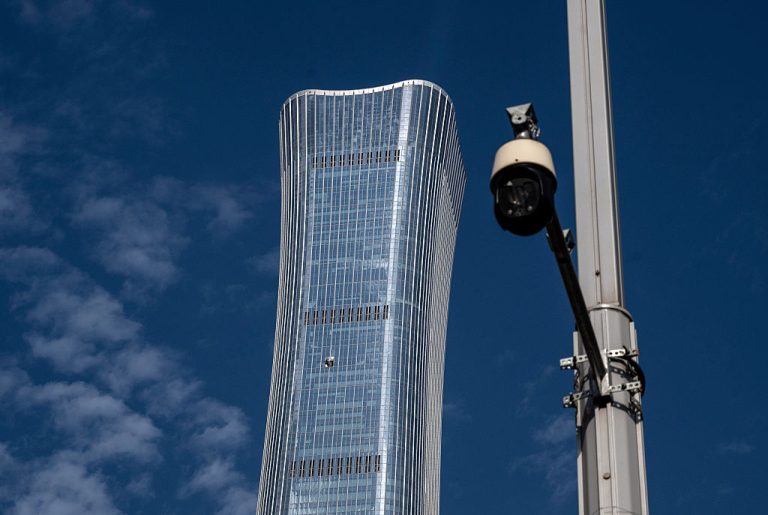
The June 26 crash of a light aircraft into Beijing’s tallest skyscraper, CITIC Tower (China Zun), has sent shockwaves through China’s rapidly growing “low-altitude economy,” with analysts warning the incident could trigger stricter regulation and disrupt one of Beijing’s key emerging industries. The term refers to commercial activities involving drones, light aircraft, air taxis, flight training, aerial tourism, and other aviation services operating below roughly 1,000 meters (3,300 feet).
The aircraft struck the eastern side of CITIC Tower, scattering debris onto nearby sidewalks and landscaped areas. Standing 528 meters (1,732 feet) tall, the landmark building sits near the headquarters of China Central Television (CCTV) and just a few kilometers from Zhongnanhai, the leadership compound of the Chinese Communist Party (CCP).
The timing of the crash, just days before the CCP’s July 1 anniversary celebrations, has further heightened its political sensitivity.
Industry faces immediate fallout
The aircraft involved was operated by a company affiliated with Oriental Fashion Driving School Co., China’s first publicly listed driver training company, which has expanded into general aviation. The company has faced mounting financial pressure in recent years, and industry observers believe the crash could expose it to regulatory penalties, operational suspensions, or substantial compensation claims.
RELATED: Beijing Plane Crash Exposes Cracks in China’s Air Defense and Crisis Response
Success
You are now signed up for our newsletter
Success
Check your email to complete sign up
Investor concerns were reflected in the stock market. On June 29, shares of companies linked to China’s low-altitude economy broadly declined, with CITIC Offshore Helicopter Co. falling about 4 percent and Zongshen Power Machinery dropping 7.7 percent.
Analysts say businesses involved in general aviation, flight training, and light aircraft manufacturing could face increased regulatory scrutiny and tighter safety requirements. The longer-term impact, however, will likely depend on the official investigation and whether current restrictions become permanent reforms.
A strategic industry under pressure
China has identified the low-altitude economy as a key emerging industry, encompassing economic activities conducted below approximately 1,000 meters (3,280 feet) using civil aircraft for passenger transport, cargo delivery, emergency response, tourism, agriculture, and other commercial operations.
According to China’s 2025 Civil Aviation Industry Development Statistical Bulletin, the country had 3,140 registered general aviation aircraft and 513 registered general aviation airports by the end of 2025. Registered drones exceeded 3.28 million nationwide.
The Civil Aviation Administration of China (CAAC) previously also described the coordinated development of general aviation and the low-altitude economy as a rapidly expanding growth sector. The Beijing crash has now cast uncertainty over that outlook.
Flight restrictions spread nationwide
In the days following the accident, reports emerged that general aviation operations had been significantly curtailed across much of China. According to Hong Kong’s Ming Pao, flight clubs across China said nearly all general aviation operations, except emergency rescue missions, had been suspended following the crash. The aircraft’s operator, Dongshi Shuangyue General Aviation, was also reported to have suspended operations and was listed as temporarily closed on the Chinese review platform Dianping.
The Financial Times likewise reported that operators across China had been instructed to halt flights involving privately operated fixed-wing light aircraft. Three light aircraft operators and one gliding company told the newspaper that their fleets had been grounded following the June 26 crash.
An employee at a skydiving club in Danzhou, Hainan Province, said the business had suspended skydiving and paragliding activities after receiving notice of a nationwide airspace control order affecting recreational aviation. The employee, who requested anonymity, said no timetable had been provided for lifting the restrictions.
Flight tracking platform Flightradar24 also showed a sharp decline in non-commercial and non-cargo aviation activity across China in the days after the incident.
Meanwhile, an aviation club in Chengdu said its aircraft had remained grounded since the weekend and would not resume operations until receiving authorization from the CAAC. A glider operator near Beijing similarly cited a nationwide CAAC notice suspending glider flights. The CAAC did not immediately respond to requests for comment.
Impact across aviation sectors
Despite the shock, not every segment of the industry appears to have been affected equally. An instructor at a drone training school in Beijing’s Yanqing District said the company received notice that all outdoor flight activities were prohibited beginning June 28 and had shifted instruction indoors.
However, a drone hobbyist in Shenzhen said he encountered no restrictions while flying in the city on June 27. Drone training schools in Shenzhen, Guangzhou, and Foshan also reported that classes were continuing as normal. Analyst say that the conflicting reports suggest that restrictions may vary by aircraft type, region, or local implementation.
Though authorities have yet to announce whether the current measures are temporary or part of a broader regulatory overhaul, the crash has already exposed the vulnerability of one of China’s fastest-growing aviation sectors. Whether Beijing ultimately responds with short-term security measures or a comprehensive tightening of oversight could shape the future of China’s low-altitude economy for years to come.