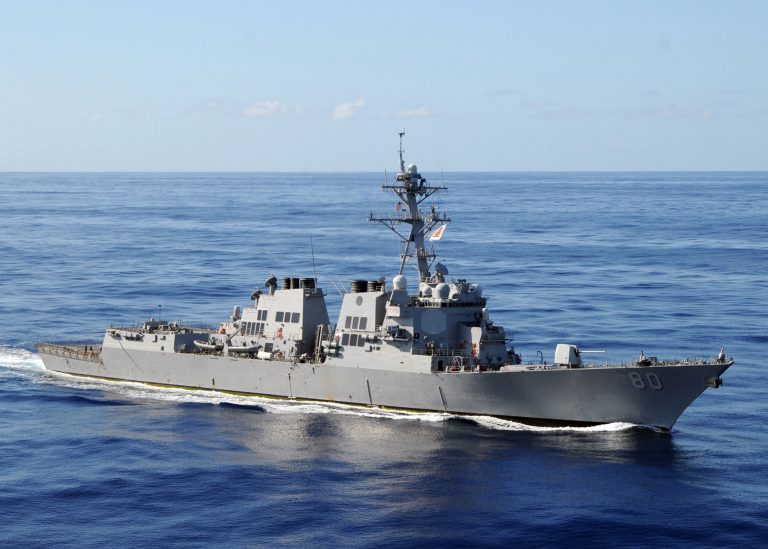
Beijing has constructed a full-scale replica of a U.S. Arleigh Burke-class guided-missile destroyer in a remote desert in the western Chinese region of Xinjiang, a move analysts say is intended to improve China’s ability to detect, track, identify, and strike moving naval targets under realistic combat conditions.
The replica is believed to support China’s efforts to strengthen its anti-ship missile capabilities amid intensifying military competition with the United States and its continued preparations for a potential conflict over Taiwan, according to multiple media reports.
First deployed in 1988, the U.S. Navy’s Arleigh Burke-class destroyer is a multi-mission guided-missile warship capable of conducting anti-air, anti-submarine, and anti-surface warfare. According to the website of the U.S. Navy, the class remains in production and continues to receive upgrades, including advanced sensors, weapons systems, and support capabilities.
Satellite imagery shows the Arleigh Burke replica was constructed at the Ruoqiang missile testing range in Ruoqiang (Qarkilik) County on the southeastern edge of Xinjiang’s Taklamakan Desert, according to Marine Insight, a maritime news publication.
RECENT COVERAGE
- Russia Begins Production of Su-35S Fighter Jets for Iran, Report Says
- US Removes Four Indian Companies From Russia-Related Sanctions List as Trade Deal Nears
- Iraq Arrests 67 Officials in Sweeping Anti-Corruption Campaign
The report said the Ruoqiang facility has previously been used for ballistic missile testing. Recent satellite imagery also shows a six-meter-wide rail system with a ship-sized target that analysts believe can simulate a moving vessel during weapons tests. Compared with earlier U.S. target replicas built at the site, the new DDG-51 mock-up appears significantly more detailed.
Success
You are now signed up for our newsletter
Success
Check your email to complete sign up
According to CNN, open-source intelligence analyst Joseph Wen first identified the replica while it was still under construction about a month ago.
“It’s the first time,” Wen, an OSINT researcher at the Taiwan Inspiration Association, told CNN when asked whether China had previously built a full-scale 3D mock-up. “I do think this is quite surprising. The scale of the construction is really massive.”
Growing military competition in the Pacific
Analysts say the detailed DDG-51 replica reflects China’s efforts to better understand U.S. naval capabilities and prepare for a potential conflict over Taiwan, while also highlighting Beijing’s broader focus on military competition in the Indo-Pacific.
According to Marine Insight, Arleigh Burke-class destroyers are assigned to Destroyer Squadron 15 (DESRON 15), an operational headquarters based in Japan under the U.S. Seventh Fleet. The squadron serves as the U.S. Navy’s principal surface warfare force in the Western Pacific and Indian Ocean, where its ships regularly operate near Chinese naval forces.
The replica at the Ruoqiang test range is believed to support China’s anti-access/area-denial (A2/AD) strategy by improving its ability to target rival naval forces during a potential conflict in the Indo-Pacific, particularly one involving Taiwan, Marine Insight reported.
CNN reported that Arleigh Burke-class destroyers would likely be among the first U.S. warships deployed in the event of a conflict over Taiwan.
“The Chinese, they try to prepare everything from A to Z. The Chinese military has ballistic missiles that can attack from high angles and cruise missiles that can attack horizontally. So, they’re trying to combine both and enhance their anti- access and area denial capability,” Hans Su, Director of Taiwan’s Institute for National and Security Research, told CNN in an interview reagrding the Chinese replica.
According to Wen, the construction of such a detailed replica sends a broader strategic message that China is maintaining a constant state of military preparation.
CNN reported that China does not require a “realistic 3D replica to simulate a warship’s radar signature.” Instead, the network said the highly detailed mock-up serves a dual purpose: helping the People’s Liberation Army prepare “for a future fight, while also sending a psychological warning to anyone watching from above, especially the U.S.”