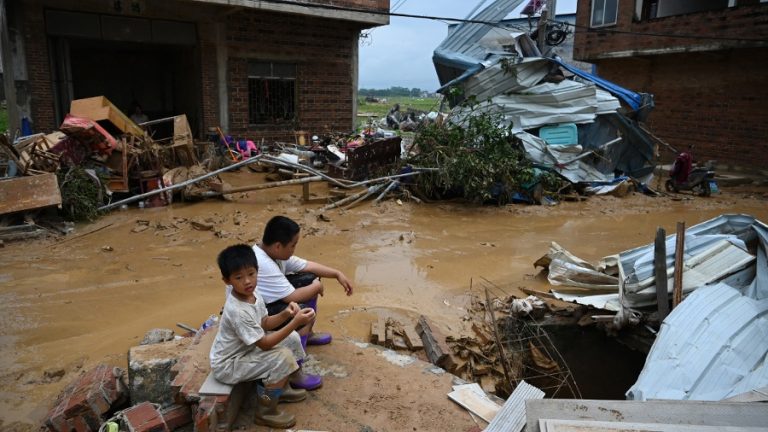
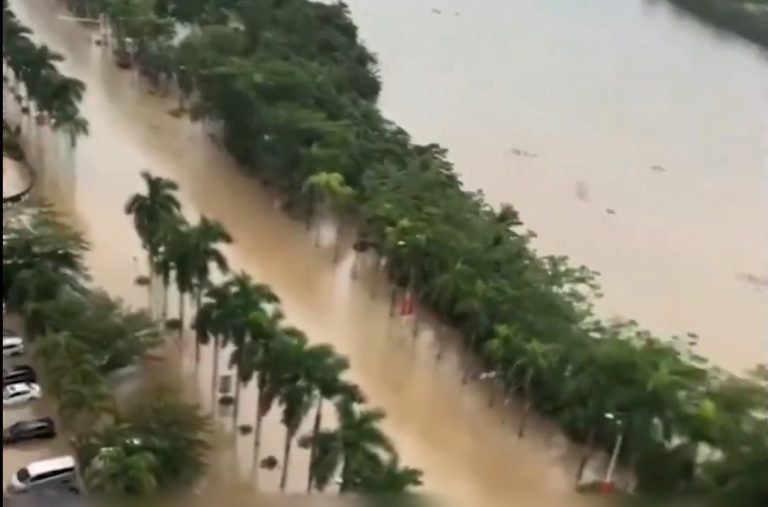
Due to the impact of Typhoon Tramy, multiple areas in Hainan Province have experienced continuous heavy rainfall since Oct. 26, leading to widespread flooding across the southern Chinese island. Over 100 villages were inundated and several people killed as local authorities opened dams to release excess rainwater.
As of Oct. 30, most regions in Hainan have seen rainfall exceeding 100 mm, with some areas, including the Qiongzhong Li and Miao Autonomous County, Tunchang County, and Qionghai city, recording over 250 mm of rainfall. Due to the rapid rise in water levels of the Wanquan River, authorities have decided to release water from Niuluoling Dam and Hongling Dam to lower the upstream water levels.
At 5:00 a.m. on Oct. 30, the release of water from the Niuluoling Dam and Hongling Dam began, causing flooding in 123 villages across seven towns along the downstream Wanquan River. The most severely affected areas were Shibi and Longjiang towns in Qionghai, where communication was cut off, roads were severed, and telecommunications were temporarily lost. Due to the release, 42 power lines in Qionghai were disrupted, impacting 25,700 households; 22 roads became impassable. City authorities took emergency measures, evacuating 7,154 people.
- China Escalates Tensions With Taiwan Via Live-Fire Drills as Regional Concerns Mount
- Once the ‘World’s Factory,’ Closing Businesses and Decaying Industrial Parks Litter Dongguan, China
Qionghai is a municipality on the eastern coast of Hainan island, and has about 500,000 residents. Hainan Province, an island home to around 10 million, is a popular vacation spot given its tropical climate and beaches.
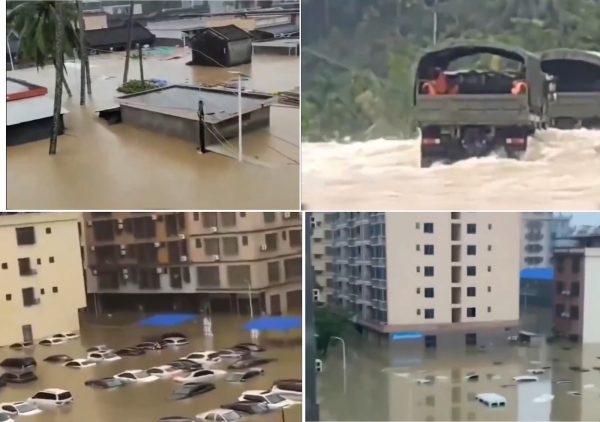
Videos posted on social media captured the scene on the ground, showing severe flooding in the Qionghai area, with many roads and vehicles submerged. Some residents reported that water levels had already exceeded two meters (about 7 feet) and were still rising.
Success
You are now signed up for our newsletter
Success
Check your email to complete sign up
One user lamented, “This time, Qionghai is in really bad shape; with the dam water released, there’s nowhere to run.”
The water release caused extensive damage to agriculture, aquaculture, and residents’ property, with many lamenting losses of “millions of yuan, everything is underwater.”
In one village, residents were forced to take refuge on rooftops due to rising water levels, waiting for rescue. Some areas continue to suffer from water, power, and food shortages, with disaster footage showing entire villages underwater and cars submerged.
Additionally, on the morning of Oct. 30, a landslide triggered by intense rainfall hit the Qiongzhong Li and Miao Autonomous County, resulting in at least three deaths and four injuries.
Some residents and dissidents argued that water levels in the dams should have been lowered before the typhoon’s arrival, questioning the decision to release the water.
Liu Yinquan, chairman of the Chinese Social Democratic Party, criticized the authorities, saying their lack of advance water-release preparation showed a disregard for the lives and property of the people.
Sheng Xue, Canada-based vice chairwoman of the Federation for a Democratic China, also stated that the government’s negligence left residents vulnerable in times of disaster.