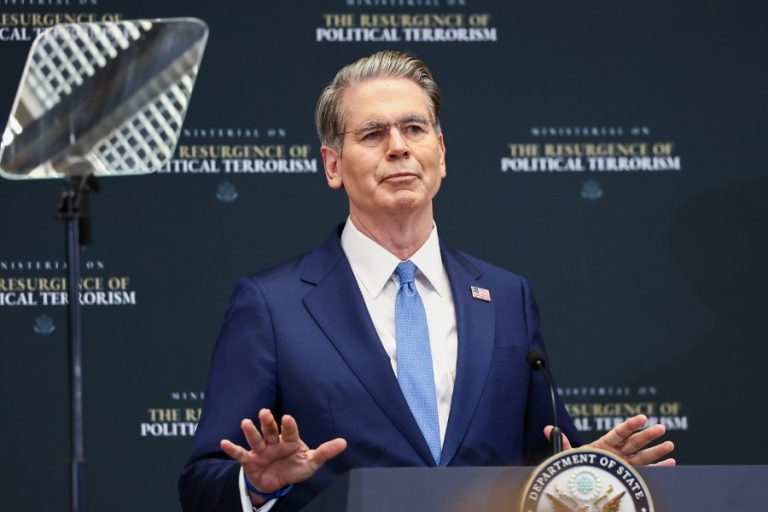
U.S. Treasury Secretary Scott Bessent warned on Tuesday, July 21, that the Trump administration would consider imposing sanctions on China if Chinese artificial intelligence models are found to have stolen intellectual property from American companies.
In an interview with Fox Business, Bessent said the Trump administration supports the development of open-source models but will not tolerate the theft of intellectual property.
“This administration supports open source models, but what we do not support is IP theft. And if we see, especially, that overseas models are stealing from our great companies, we have the ability to sanction them because of this theft,” he said.
Bessent also revealed that the United States has detected “watermarks” from American large language models in several Chinese AI models, emphasizing that such activity is unacceptable.
He said the U.S. government would investigate the matter further in the coming days or weeks.
Success
You are now signed up for our newsletter
Success
Check your email to complete sign up
Bessent also raised the question of whether companies using Chinese AI models should be required to disclose that information to their customers.
His remarks came after Chinese AI company Moonshot AI released its new Kimi K3 model last week. The launch quickly attracted widespread attention in Silicon Valley and Washington, reigniting debate over competition between the United States and China in artificial intelligence.
READ MORE:
- AI Data Center Boom Sparks Backlash Across Canada
- Taiwan Busts Alleged Underground Network Smuggling Nvidia AI Servers to China
- Elon Musk Says Space Colonization Will Begin This Year, With Optimus Robots Leading the Way
Moonshot AI claims that Kimi K3 performs at a level comparable to the leading models developed by Anthropic and OpenAI. An AI evaluation organization subsequently ranked Kimi K3 first on a leaderboard measuring front-end programming capabilities, placing it ahead of models from Anthropic and OpenAI and drawing further attention from the U.S. technology industry.
Unlike most closed-source American models, Kimi K3 uses an open-weight architecture. Although open-weight models do not make their full source code publicly available in the same way as open-source models, they release their model weights and information about their training methods, making them easier to study and further develop.
Kimi K3 has also renewed industry discussion about “model distillation.” Model distillation is a training method used to transfer the capabilities and knowledge of a large model to a smaller one. Some U.S. AI companies have previously alleged that certain Chinese models may have been trained through distillation using leading American models.
Meanwhile, sources familiar with the matter told Reuters that the United States and China will hold artificial intelligence talks in September, with Bessent expected to lead the U.S. delegation.
The sources said the AI talks were a significant outcome of the summit between President Donald Trump and Chinese leader Xi Jinping in May.
They said the talks would likely take place before Xi’s planned visit to the United States on Sept. 24. Because the information has not yet been made public, the sources requested anonymity and said the exact date had not been finalized.