Commentary
On Feb. 11, what should have been a routine AFC Champions League match between China’s Shandong Taishan and South Korea’s Gwangju FC unexpectedly turned into a politically-charged spectacle, according to Zhao Lanjian, a former senior media professional from China.
The reason? A fan confrontation that carried deep historical significance. But since the incident involved two of East Asia’s most sensitive political events — the 1980 Gwangju Uprising in South Korea and China’s 1989 Tiananmen Square crackdown — all related news was swiftly censored in mainland China. Chinese-language media remained collectively silent, while only scattered reports emerged in South Korea.

A battle of political symbols
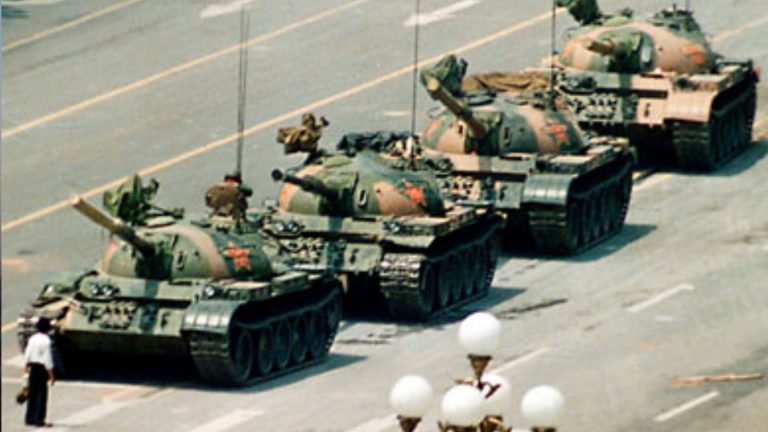
The conflict was ignited when Shandong Taishan fans displayed a photo of former South Korean President Chun Doo-hwan in the stands. Chun, the military leader responsible for violently suppressing the Gwangju Uprising, remains a widely reviled figure in the city. For the people of Gwangju, this act was a blatant provocation. In response, after the match, several carloads of Gwangju fans arrived at the stadium, each carrying a photo of the iconic “Tank Man” from the 1989 Tiananmen Square protests — a direct counterstrike against the Chinese supporters.
Success
You are now signed up for our newsletter
Success
Check your email to complete sign up
The sight outside the stadium was striking: on one side, an image of Chun Doo-hwan, a dictator whose legacy is tainted by the brutal suppression of South Korean democracy activists; on the other, the “Tank Man,” a symbol of defiance against China’s own authoritarian past. In a single moment, two different yet eerily similar histories were brought face to face in an unprecedented visual standoff.
For Gwangju fans, invoking the “Tank Man” was a deliberate act of historical resistance. The Gwangju Uprising, a pro-democracy movement crushed by Chun’s government in 1980, resulted in hundreds, possibly thousands, of deaths. The massacre remains a painful scar in South Korea’s history, and any perceived glorification of Chun is considered an insult to the victims.
Meanwhile, the “Tank Man” remains one of the most enduring images of democratic resistance in China, a reminder of the pro-democracy movement that the Chinese government has worked tirelessly to erase from history. By using this image, Gwangju fans struck a nerve — exposing a wound that China refuses to acknowledge, thereby elevating the fan dispute into a politically explosive event.
Had this incident remained confined to the realm of sports, it might have quickly faded into obscurity. But when Chun Doo-hwan and the “Tank Man” appeared in the same stadium, the match became more than just a football game — it became an ideological and historical showdown between East Asia and China.
Beijing’s response
Recognizing the political sensitivity of the situation, Beijing swiftly enacted a multi-pronged strategy to suppress the controversy:
- Social Media Censorship
Within hours, discussions of the incident were erased from Chinese platforms like Weibo and Zhihu. Keywords such as “Gwangju fans,” “Chun Doo-hwan,” and “June 4th” were all blocked. Even neutral posts merely describing the events were deleted. - Media Narrative Management
While the story received widespread attention in South Korea, Chinese state media completely avoided any reference to its political implications. Reports mentioned only “controversial behavior by Shandong fans” while omitting the Chun Doo-hwan banners and the Gwangju fans’ “Tank Man” response. The incident was deliberately reframed as an isolated fan dispute rather than a politically symbolic confrontation. - Preemptive Damage Control by Shandong Taishan FC
Before Chinese authorities could step in, Shandong Taishan took swift action, permanently banning the fans involved and issuing an official apology to Gwangju FC. This move not only aimed to mitigate potential penalties from the AFC but also signaled to Chinese regulators that the club had taken measures to de-escalate the situation, making further state intervention unnecessary.
South Korea speaks out, China stays silent
In South Korea, media coverage focused on two major narratives: “Gwangju fans were provoked” and “China’s censorship response.” The Chosun Ilbo wrote, “This was not just a fan altercation; it was the accidental unearthing of deep historical wounds between the two nations.” On social media, debates emerged over whether Gwangju should resist any pressure from China to downplay the event.
Western media showed limited interest, though some overseas Chinese-language outlets, including The Epoch Times and Radio Free Asia, covered the incident extensively—focusing primarily on Beijing’s censorship rather than the fan dispute itself.
AFC’s dilemma
The Asian Football Confederation (AFC) has long maintained that football should remain separate from politics. However, political controversies in Asian football have been increasingly difficult to ignore. From Hong Kong fans booing China’s national anthem in 2019 to Iranian players refusing to sing theirs at the 2022 World Cup, and now the Shandong Taishan vs. Gwangju FC incident, the sport is increasingly becoming a stage for geopolitical conflicts.
Gwangju FC has formally lodged a complaint with the AFC, calling for an investigation into Shandong fans’ actions. However, given the extreme sensitivity of the issue in China, it remains unclear whether the AFC will take disciplinary action or attempt to downplay the matter.
Future ramifications
This incident is likely to result in stricter regulations for Chinese football fans at international matches, for three key reasons:
- Stronger AFC Regulations on Chinese Fans
Given past controversies involving Chinese supporters, the AFC may introduce stricter rules to prevent political symbols from appearing in stadiums. - Tighter Chinese Government Control Over Traveling Fans
Just as it did with Hong Kong supporters in 2019, Beijing may begin vetting Chinese fans traveling to international matches to prevent politically sensitive incidents abroad. - Enhanced Stadium Security by Chinese Clubs
To avoid further controversies, Chinese football clubs may implement stricter security screenings at international matches and potentially require fans to sign agreements pledging to refrain from political expressions.
The inescapable political reality
Football is meant to be just a game, but when historical wounds and political grievances spill into the stadium, the sport transforms into a battlefield of national memory and ideology. The clash between Shandong Taishan and Gwangju FC fans not only revealed the deeply embedded political sensitivities in East Asia but also demonstrated how football has become an extension of broader historical disputes.
Despite the significant attention this incident received in South Korea, it was swiftly erased from China’s digital landscape. However, while news can be censored, history cannot be erased.
As Chinese football fans continue to engage with international sports, will similar confrontations arise again? And if so, how will Beijing respond next time? Perhaps the next answer will unfold in the stands of another stadium, where history and politics will once again collide.