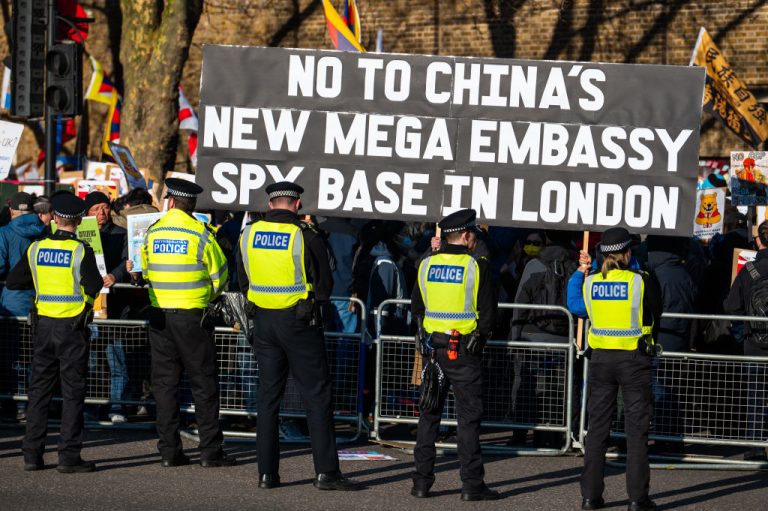
On March 15, hundreds of protestors took to the streets of London to express their outrage against Communist China’s potential “mega-embassy” in the UK, fearing Beijing would use the opportunity to expand its spying operations and target dissidents abroad.
A video by Radio Free Asia (RFA) Cantonese shows protestors holding up banners and pictures of mockery against the Chinese Communist Party (CCP). One such image is a picture of kids’ character Winnie the Pooh — often used as a protest meme directed at Chinese leader Xi Jinping — with fangs, grasping the Union Jack flag in his hands.
“You really want this to happen?” read the plaques featuring the image.
Other pictures showed UK Prime Minister Keir Starmer kissing up to “Pooh’s” feet, and the communist hammer-and-sickle symbol threatening to control the UK.
Those who flocked to protest were mainly rights groups from Hong Kong, as well as Tibetans, Uyghurs and other local residents. Together, they chanted words of defiance, requesting the UK government to reject the initiative.
Success
You are now signed up for our newsletter
Success
Check your email to complete sign up
“No ‘mega-embassy’!” they shouted.
Police officers were deployed to disperse the crowds. No arrests were made and the rallies ended peacefully.
China’s plan to build the “mega-embassy” has been in the making since Beijing bought the site in 2018 for 255 million pounds ($327 million).
It would be 10 times the size of China’s current embassy at London’s Portland Place and nearly twice the size of the Chinese Embassy in Washington, D.C.
This was the second protest to happen in the last five weeks. The first erupted on Feb. 9, when around 4,000 people rallied outside the site of the embassy — the former Royal Mint Court — located near the Tower of London. Many came to the protests in masks, dressed in black as they waved their flags to send their message to London lawmakers.
“UK Government, don’t reward repression. Say no to China’s super embassy,” read one slogan.
A U.S. House of Representatives committee has advised that the People’s Republic of China’s “super-embassy” project raises “significant security concerns.”
“The PRC’s mega-embassy in the UK raises significant security concerns: from interference and surveillance to risks for sensitive infrastructure like London’s financial services,” the Select Committee on the Chinese Communist Party wrote on X on Feb. 19.
“We must work to urgently address this issue and work with our allies to protect national security.”
READ MORE:
- Canadian MP Condemns CCP Attacks on Shen Yun, Calls for Stronger Action
- Convictions of Tiananmen Vigil Group Dropped by Hong Kong Court
- Timeless Elegance: The Enduring Fashion Influence of Jackie, Diana, and Melania
Concerns of transnational repression
In recent years, the CCP has intensified its efforts to target Chinese political and religious dissidents abroad. Governments around the world have discovered networks of undercover Chinese police stations and officers in their countries, which monitor, harass, and sometimes abduct targeted persons as part of Beijing’s expanding “transnational repression.”
The protests in London were sparked after Prime Minister Starmer pushed for increased engagement with Beijing after years of strained relations, particularly due to the CCP’s crackdown on rights in Hong Kong. He became the first UK Prime Minister to meet with Xi Jinping during the G20 summit in Brazil.
Once the site of production of British coins for almost two centuries, the area had been vacated by the Mint as they relocated to Llantrisant between 1967 and 1975. Since then, its ownership history has been intricate, involving multiple sales and claims of fraud and questionable transactions before Beijing’s purchase.
They cooperated with David Chipperfield Architects (DCA), which provided architects to plan out the project’s design.
One architect involved in the project shared details, which includes “a tunnel connecting two of the former Royal Mint buildings, basement rooms and accommodation for hundreds of staff,” RFA reported.
“It will be like a headquarter [for China] to catch the [Hong Kong] people in the UK to [send them] back to China,” an anonymous protester named only “Zero”, and member of “Hongkongers in Leeds,” said during the first protest.
Hong Kong, a former British colony that reverted to Chinese sovereignty in 1997 but was allowed a measure of autonomy and political freedoms, has had that arrangement greatly curtailed since the CCP imposed a strict “National Security Law” upon the major port and financial center in 2020. That action followed millions-strong protests by the city’s people in 2019 to protect their autonomy.
Many Hongkongers have emigrated to other countries, including the UK, in the years since.
According to the Financial Times, British ministers, including the foreign secretary and home secretary, had supported the “mega-embassy” project, emphasizing the “importance of countries having functioning diplomatic premises in each other’s capitals.”
However, they also urged China to modify a design element and relinquish diplomatic accreditation for seven sites in London.
Other than dissidents, critics and other government officials had voiced their concerns over what China could do with a new “mega-embassy” in London.
Meanwhile, Tom Tugendhat, Conservative Party lawmaker and former security minister, warned that the CCP’s expanded reach in London could endanger national security.
“This is about the future of our freedom, not just the site of a Chinese Embassy in London,” he told AFP during the first protest, as reported by Voice of America (VOA).
“I think it would be a threat to all of us because we would see an increase in economic espionage… and an increase in the silencing of opponents of the Chinese Communist Party [in the UK],” he added.