It’s not always easy to give advice or suggestions to your friends or colleagues, as people often take offence at criticism. Even at home, you can’t force your family to behave the way you think they should. Telling a story, however, is a gentle and effective way to teach rules and wisdom. Panchatantra, a collection of interesting fables with moral lessons, provides a wealth of material for this purpose.
Origins and history
Panchatantra dates back to ancient India, around 200 BC. According to legend, there was a scholar named Vishnu Sharma. He was not just an ordinary teacher, but a sage of great knowledge and wisdom.
During that time, a king named Amarashakti ruled over a vast kingdom. The king had three sons, but he was deeply worried about them, as they had no interest in studies and lacked the wisdom to rule the kingdom in the future.
The king wanted his sons to learn important life lessons, including leadership, morality, and cleverness. He called upon his ministers to find a solution, and they suggested Vishnu Sharma.
When Vishnu Sharma met the king, he promised to make the three princes wise within six months. Because they had no interest in learning, he decided to teach them in an unconventional way — through stories.
Success
You are now signed up for our newsletter
Success
Check your email to complete sign up
The sage believed that wisdom could be gained through examples better than lectures, so he created many fables to teach valuable lessons about life, politics, and human behavior. He composed a collection of stories known as the Panchatantra.
Over the centuries, it has spread around the world and been translated into more than 50 languages.
The five sections of the Panchatantra
The name “Panchatantra” means “Five Principles,” as the book is divided into five sections, each focusing on a certain topic. They begin with one story, which cleverly leads into the next, and so on, until the principle has been thoroughly taught from various angles.

1. Mitra-bheda (The Loss of Friends)
This collection focuses on how friends can be torn apart by lies, betrayal and foolish behavior; and the misfortune that results from a broken friendship. One example is the story of The Two Bulls and the Jackal, which can be summarized as follows:
Once, two strong bulls were best friends. They lived together, ate together, and protected each other from danger. A cunning jackal saw them and thought of separating them.
Hence, the jackal devised a plan and whispered to one bull, “Your friend secretly wants all the food for himself.” Then, he went to the other bull and said the same thing. Slowly, the bulls started doubting each other, became enemies, and went their separate ways.
Seeing this, the jackal called a hungry lion and said, “The bulls are alone now. You can hunt them easily.” The lion attacked them one by one and ate them, leaving the bones for the jackal.
Moral: A divided friendship makes it easier for enemies to win.
2. Mitra-labha (The Gaining of Friends)
This collection focuses on the value of good friendships and teamwork. One example is the story of The Elephant and the Mice, which can be summarized as follows:.
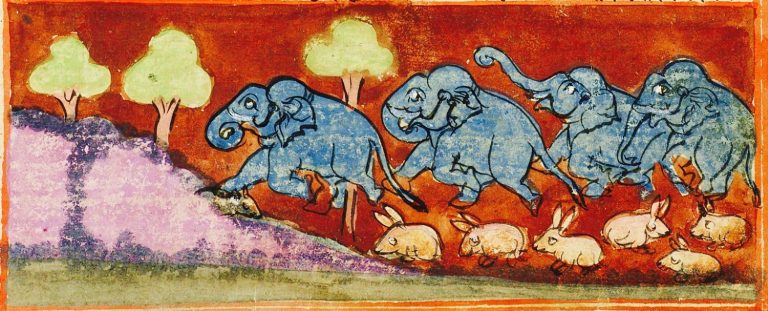
A group of mice lived in a village. One day, a herd of elephants came and trampled over their homes. The mice pleaded, “Please take another route. You are destroying our homes!”
The kind elephant king agreed, and the elephants changed their path. The mice were happy and promised to help the elephants someday. Later, hunters came and trapped the elephants in nets. The mice chewed through the nets, freeing the elephants.
Moral: Even the smallest friends can save your life.
3. Kākolūkīyam (War and Peace: Crows and Owls)
These stories focus on lessons about war, strategy, and diplomacy. One example is the story of The Wise Old Bird.
A large tree stood in the middle of a jungle. Many birds lived there happily. One day, an old bird warned, “A hunter will come and set traps here. Let’s leave before it’s too late!” The other birds laughed and ignored the warning. But the hunter came and set traps. Many birds got caught. The old bird, who had flown away earlier, returned with some friends. Together, they cut the nets and freed the trapped birds.
Moral: Always listen to wise advice.
4. Labdhapraṇāśam (Loss of Gains)
These stories focus on how to appreciate what we have and not be careless with it or greedy for more. One example is the story of The Greedy Dog and the Bone, which can be summarized as follows:
A dog once found a juicy bone. He happily carried it in his mouth and walked to a river. As he looked into the water, he saw his reflection. But he thought it was another dog holding a bigger bone. Greedy for more, he barked to scare the other dog away. But as he opened his mouth, his bone fell into the river and was lost.
Moral: Greed can make you lose what you already have.
5. Aparīkṣitakāritam (Ill-Considered Actions)
These stories focus on the dangers of acting without thinking. One example is the story of The Farmer and the Snake, which can be summarized as follows:
One winter morning, a farmer found a half-frozen snake on the ground. Feeling pity, he picked it up and placed it near the fire to warm it. As soon as the snake regained its strength, it bit the farmer! Shocked and in pain, the farmer asked, “Why did you bite me when I saved your life?” The snake replied, “It is in my nature to bite. You should not have trusted me.”
Moral: Use good judgment, and be wary of those with bad character.
Importance of Panchatantra
Through the traditional method of storytelling, Panchatantra has taught valuable lessons for many generations. Amusing tales make learning right from wrong painless and enjoyable. Critical thinking is instilled through hearing about the mistakes made by foolish animals in the fables, while the more clever characters offer examples of diplomacy and leadership.
As a source of material for the French Fables of La Fontaine, the Greek Aesop’s Fables, the Middle Eastern Arabian Nights, and more, Panchatantra has undoubtedly influenced the whole literary genre of fables around the world. Although it was written thousands of years ago for educating young princes, the lessons remain valuable today, as they continue to offer moral guidance and wisdom in the form of charming entertainment.