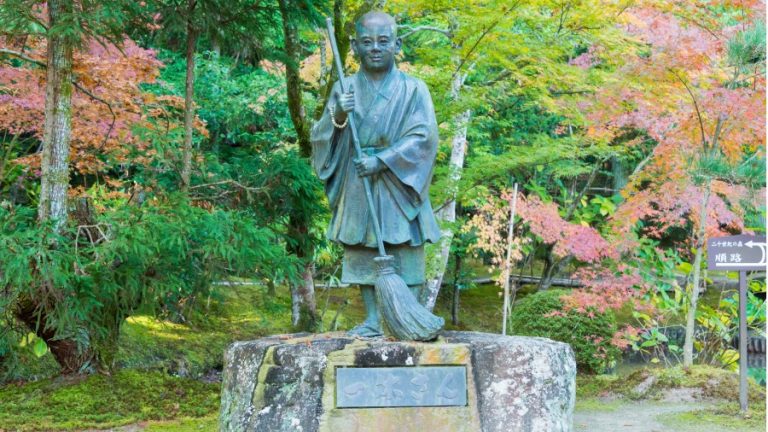
Walk into almost any Buddhist monastery and you will find the junior monks doing chores. Sweeping fallen leaves, wiping down altar tables, scrubbing stone pathways. It never ends. Wind scatters the leaves again by afternoon. Dust resettles overnight. And yet the sweeping resumes each morning without complaint, without the expectation that the work will ever be finished. For outsiders, it can look like futile labor. For practitioners, it is among the most serious work of the day.
The aim is to sweep away mental agitation, scattered thoughts, and the subtle attachments that accumulate like grime. The broom, in this view, is as much an instrument of inner cultivation as a cushion in a meditation hall.
Zen and the meaning of ordinary work
A well-known Zen teaching captures this simply: “Before enlightenment, chop wood, carry water. After enlightenment, chop wood, carry water.” The actions do not change; the quality of attention brought to them does. Washing a bowl, raking gravel, folding a robe — these are the spiritual path, made visible in ordinary motion.
An Associated Press feature on cleaning and mental health found that clinicians and contemplatives have arrived at similar conclusions from very different directions: repetitive, structured physical tasks have a measurable calming effect on the nervous system. Holly Schiff, a clinical psychologist based in Greenwich, Connecticut, explained the mechanism. “Repetitive, physical activities like cleaning can be regulating for the nervous system because they’re predictable, structured and give a clear sense of completion,” she said. When the hands are occupied with a rhythmic task and the eyes are tracking something immediate and concrete, attention narrows. The internal noise — the cycling worries, the half-formed plans, the ambient dread — quiets, because the mind has found somewhere more specific to land.
Anxiety, Schiff noted, is often rooted in a feeling of lost control. Housework offers a simple, reliable path back to order. You cannot fix the economy or reconcile a fractured relationship by force of will. You can make the kitchen clean. That modest restoration of cause-and-effect is not trivial; for many people, it functions as a genuine reset.
Success
You are now signed up for our newsletter
Success
Check your email to complete sign up
Cleaning as spiritual service
Japanese Buddhist monk Shoukei Matsumoto has written and spoken extensively on the spiritual dimensions of cleaning. “We sweep dust to remove our worldly desires,” he writes in his book A Monk’s Guide to a Clean House and Mind. “We scrub dirt to free ourselves of attachments.” By repeatedly noticing disorder, facing it directly, and resolving it through patient effort, practitioners develop a relationship with their own inner life that is neither avoidant nor reactive.
When a person cleans a space, the person and the space are not as separate as they might appear. The room we inhabit is part of our inner life, not a backdrop to it. Tending to a courtyard is, in this sense, tending to oneself. A monastery swept by generations of monks does not merely look orderly. Visitors often report sensing something in the quality of the silence there, some residue of sustained, unhurried attention. This is what accumulated care looks like when it has been maintained long enough.
When a monk sweeps, no one applauds. The work leaves no record. The courtyard will be dirty again tomorrow. Chores in this tradition are designed to erode what practitioners call “pride mind” — the tendency to measure one’s worth by visible achievement. Much of what matters in a well-lived life is performed for no audience. The visitor who walks on a clean path benefits without knowing who cleaned it. The monk who did the cleaning benefits without being acknowledged for having done so.
A study published in the Proceedings of the National Academy of Sciences found that meditation produces immediate, measurable changes in immune cell activity and gene expression. Whether household labor achieves the same depth of effect remains an open question, but the parallel is suggestive. Tasks that share meditation’s core qualities — rhythmic repetition, sustained attention, a clear beginning and end — appear to engage similar regulatory mechanisms in the nervous system.
READ MORE:
- Ancient Chinese Health Wisdom: What the Book of Rites Says About the Body
- 6 Health Habits Older Adults Should Break as Soon as Possible
- Why Dementia Rates Are Rising — and Three Daily Habits That Lower Your Risk
Physical chores as a counterweight to screen-heavy work
Contemporary life is unusually hard on attention. Many people spend their working hours motionless in front of screens, absorbing information faster than they can process it, with no natural breaks in the flow of stimulation. The mind, under these conditions, can struggle to distinguish between urgency and noise. Simple physical tasks — making a bed, washing dishes, organizing a drawer — offer something screens cannot: a direct, tactile return to the present moment. The hands are doing something the eyes can follow. The result is clear before and after. The sense of suspended incompletion that characterizes so much of digital work dissolves, at least briefly, into the satisfaction of a thing actually done.
Schiff suggests that one reason people dread household chores is the anticipatory weight they accumulate when left undone. Breaking the work into very small, bounded units — one counter, one shelf, one corner — removes most of that psychological friction. “Break the task down into very small, defined actions to reduce that barrier,” she says. “Just choose one surface, one task or one room for starters.” The goal shifts from finishing everything to beginning something, and that shift alone tends to produce calm.
Leaves fall. Dust returns. The monk who sweeps every morning is practicing the response: notice, attend, clear, and begin again.