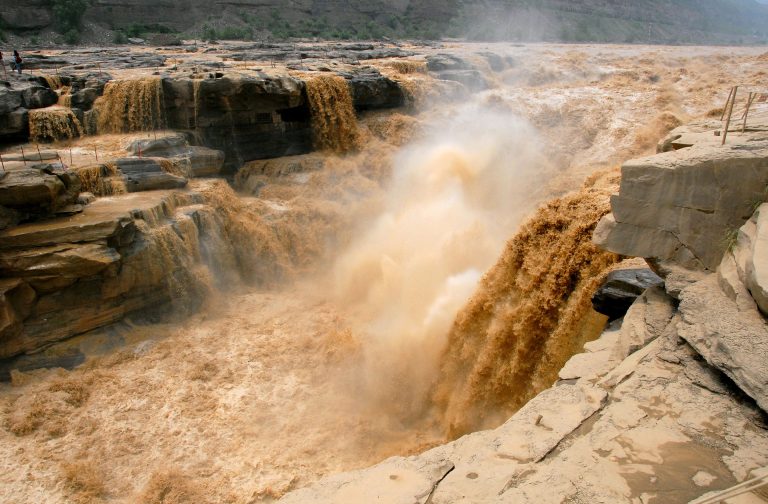
In mid-April, videos began appearing on Chinese social media showing waters in the upper reaches of the Yellow River turning clear, leading many internet users to refer to an ancient book of prophecies to divine possible meanings from the event.
The Yellow River, which has nourished Chinese civilization since legendary times thousands of years ago, is famous for its yellow-tan waters, caused by the movement of silt from the northwest on its way east to the Pacific Ocean.
One video posted April 19 shows the normally sand-colored hues of the Hukou Waterfall, located along the Yellow River where it divides the provinces of Shanxi and Shaanxi, turning clear. The puzzling event quickly gathered attention, as reflected in searches for the topic on popular Chinese microblogging site Weibo.
Some pointed to sayings in ancient Chinese texts claiming that the river’s water clears up only once every 500 years, and that “when the Yellow River runs clear, a sage will appear” (黄河水清,聖人出).
- Is Uranium Obsolete? China’s Thorium Reactor Achieves Continuous Operation
- Chinese Report Surge in Leukemia Cases, Post-Vaccine Complications and Deaths
Li Erong (李鄂荣), an expert in geological history, noted in his articles “The Formation of the Hanging Lower Yellow River” and “Discussing the ‘Yellow’ in the Yellow River” that there have been 43 recorded instances of the Yellow River becoming clear in ancient Chinese history. The first was in the year 165 AD, and the longest such event occurred in 1727, when over 2,000 li (roughly 1,000 kilometers) of the river ran clear for more than 20 days.
Success
You are now signed up for our newsletter
Success
Check your email to complete sign up
This year’s “clear flow” marks the 45th time in history that the Yellow River’s waters have been recorded as running clear.
Some Chinese have taken the latest clearing of the ancient river as a sign of societal upheaval.
As early as the Three Kingdoms period, scholar Li Kang (李康) of the Wei Dynasty wrote in his work “On Destiny” (運命論) that: “When the Yellow River runs clear, a sage is born.” In the Ming Dynasty, Luo Guanzhong, famous for his novelization of the Three Kingdoms era, wrote in Chapter 8 of Ping Shan Leng Yan (平山冷燕): “When the Way prevails through the world, a sage is born. Mountains and rivers respond with spiritual signs. The dust and filth are all washed away, and the Yellow River runs clear for ten thousand li.”
A cryptic fortelling: Diagram 54 of the Tui Bei Tu
The Tui Bei Tu (推背圖) is a famous book of prophecies written in the 600s, during the early Tang Dynasty.
According to one interpretation, focusing on the Tui Bei Tu’s Diagram 54, the Yellow River running clear portends the end of the Chinese Communist Party (CCP) and the emergence of a “true dragon” to bring order out of chaos.
In Chinese, the term “true dragon” (真龍) is used to refer to the founding emperor of a new dynasty, or some figure of comparable historical importance.
Diagram 54 contains a prophetic riddle (讖曰):
磊磊落落 殘棋一局
啄息苟安 雖笑亦哭
Stones scattered and fallen
A desperate round of go (a traditional strategy board game)
Drifting in a false peace
Smiling yet weeping
And an accompanying verse (頌曰):
不分牛鼠與牛羊,去毛存鞟尚稱強。寰中自有真龍出,九曲黃河水不黃。
No difference between ox and rat, or ox and sheep; the skin remains after the fur is gone, still claiming strength. From the center of the world, a true dragon emerges; the water of the nine-bend Yellow River no longer runs yellow.
Diagram 54 is prefaced by the characters 丁巳 (the year of the Fire Snake in the 60-year cycle of the Chinese calendar corresponding to e.g. 1917, 1977, or 2037), as well as the Yijing hexagram ䷪ (夬), often translated as “breakthrough.”
The illustration for Diagram 54 shows five young herders each holding a stick, driving a single ox. The ox symbolizes the Chinese communist regime, as 1949 — the year the CCP took power — was the year of the Ox (己丑) in the traditional Chinese calendar, with a leap seventh month. The five herders driving the ox metaphorically represent the five major leaders of Communist China: Mao Zedong, Deng Xiaoping, Jiang Zemin, Hu Jintao, and Xi Jinping.

The line “stones scattered and fallen, “a desperate round of go” may be taken as a reference to the collapse of communism in the Soviet Union and Eastern Europe — after which, for the global communist movement, the situation has become akin to an unwinnable round of the strategy board game.
“Drifting in a false peace, laughing yet weeping” refers to how the CCP, while facing myriad crises from economic downturn and social unrest to environmental collapse and international isolation, does all it can to maintain a facade of strength, hence a state of false security.
The lines “No difference between ox and rat, or ox and sheep; the skin remains after the fur is gone, still claiming strength”: This line indicates that the “ox” — the CCP and its ideology — has lost its following, particularly with the adoption of capitalist reforms after the death of Mao Zedong. The term for “fur” or “hair” in Chinese is 毛 (mao), which is also Mao’s surname.
Indeed, what followed the death of Mao was systemic corruption, plunder of public resources, and disdain for the people that the regime claimed to represent. Communism still drives the CCP, but only as an empty instrument of political control.
“From the center of the world, a true dragon emerges; the water of the nine-bend Yellow River no longer runs yellow”: This foretells that from the “central land” of the world — China — a “true dragon,” that is, a true leader or sage, will appear. When that time comes, the Yellow River will run clear again.