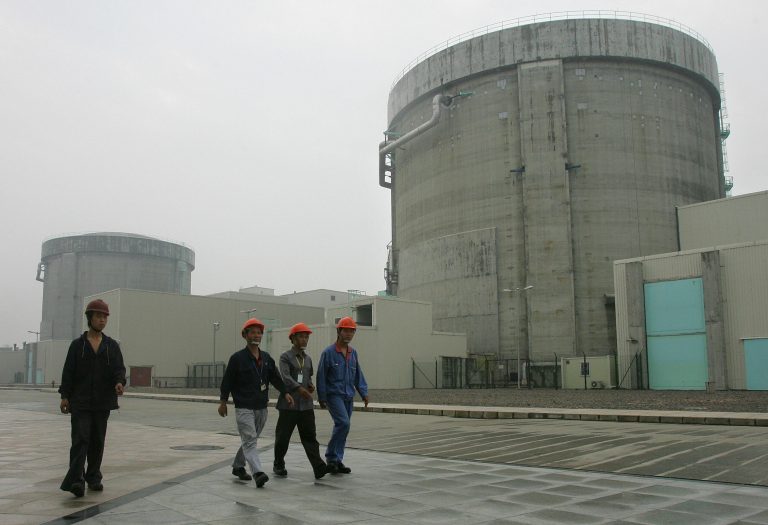
In a private meeting earlier this month, researchers from the Chinese Academy of Sciences announced a major milestone: the successful sustained operation of a thorium-fueled nuclear reactor in the Gobi Desert. According to the South China Morning Post (SCMP), the team achieved “full-power operation” last June and has now accomplished a world first by demonstrating the ability to reload the reactor while it remained online.
The element thorium has long been considered a more accessible and less volatile alternative to uranium. The element is also much less likely to be successfully used in weapons. According to the World Nuclear Association, “thorium-based power reactor fuels would be a poor source for fissile material usable in the illicit manufacture of an explosive device.”
A thorium-fueled molten salt reactor is not a new concept. It was first explored in the 1960s by American scientists at the Oak Ridge National Laboratory.
The technology was ultimately shelved in favour of more conventional methods of producing electricity, however China began experimenting with the technology in 2011.
In 2018, Chinese engineers at the Shanghai Institute of Applied Physics (SINAP) began constructing a reactor, and expanded their team from a few dozen researchers to over 400 today.
Success
You are now signed up for our newsletter
Success
Check your email to complete sign up
The Chinese prototype reached full operational status in June 2024 and by the following October, researchers achieved a monumental breakthrough: the ability to reload fuel into the reactor while it was still operating, allowing continuous operations.
READ MORE:
- US Could Replace China’s Rare Earth Supply, But Building the Infrastructure Would Take Years
- War Over Taiwan Would Cause 500,000 Deaths, Economic Devastation, US Admiral Paparo Says
‘The frontier of global nuclear innovation’
Xu Hongjie, the chief scientist on the project said, “we are now at the frontier of global nuclear innovation,” according to Daily Galaxy.
The reactor uses molten fluoride salts to dissolve the thorium fuel, serving both as the coolant and the medium for nuclear reactions. This setup enables operation at temperatures above 700°C (1,292 °F) without the need for the high pressure typical of conventional reactors.
Unlike traditional uranium-based systems, this design relies on thorium-232, which must be converted into fissile uranium-233. This alternative fuel cycle offers a lower risk of nuclear proliferation (because the byproducts cannot be used to build atomic bombs) and produces far less long-lived radioactive waste.
Thorium is also much more abundant than uranium, available globally at three to four times greater quantities.
China also has large thorium resources. According to the U.S. Geological Survey (USGS), China is one of the countries with the largest identified thorium resources, along with India, the U.S., and Australia.
Much of China’s thorium is a byproduct of its rare earth industry, especially in provinces like Inner Mongolia, Jiangxi, Sichuan, and Guangdong.
Should China be successful in applying this technology commercially, it would mean the country would be much less reliant on uranium imports from Kazakhstan, Namibia, Canada, Uzbekistan and others as China produces very little domestically.
China has plans to build more than 150 nuclear reactors by 2050, plans that may now be adjusted due to their most recent breakthrough.