On March 11, 1944, the World War Two bomber, Heaven Can Wait ,embarked on a mission over the Pacific but was brought down by Japanese anti-aircraft fire, resulting in the deaths of all 11 crew members. For nearly 80 years, their remains were thought to be lost at sea.
Eight decades later, the remains of four of the crew members have been recovered from the ocean floor and are finally being returned home to the U.S, The Associated Press (AP) reported. This was possible thanks to the efforts of family members who have spent more than a decade investigating and searching for the lost plane and its crew.
The burial ceremonies are thanks to Scott Althaus, one of the crewman’s relatives, who conducted a 12-year search for the missing plane and its fallen crew.
“I’m just so grateful,” he said to The Associated Press . “It’s been an impossible journey — just should never have been able to get to this day. And here we are, 81 years later.”
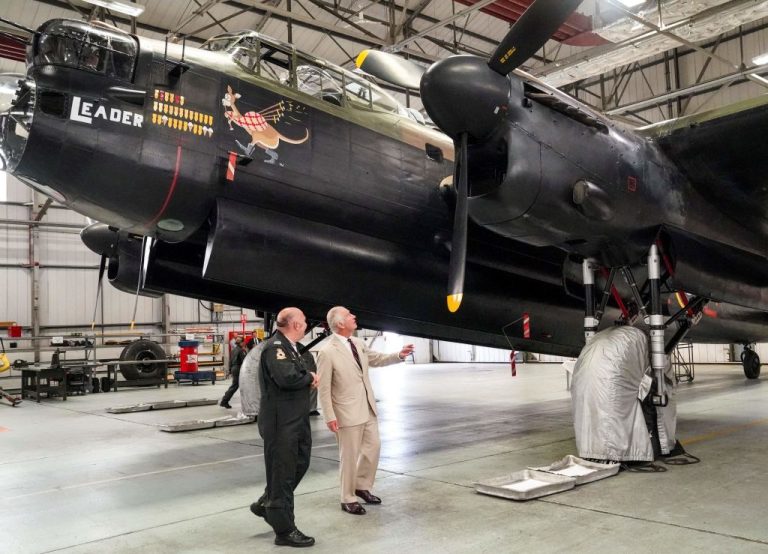
The Heaven Can Wait was part of the U.S. Army Air Forces, and was decorated with a cartoon caricature of an angel on its nose. At the time of its final mission, eleven crewmen were on board.
Success
You are now signed up for our newsletter
Success
Check your email to complete sign up
Among them were the four whose remains were found; 2nd Lt. Thomas Kelly, 1st Lt. Herbert Tennyson, 2nd Lt. Donald Sheppick, and radio operator Staff Sgt. Eugene Darrigan. All of them were in their twenties when they disappeared.
On Mar. 11, 1944, the plane took off on a mission in a squadron of eleven B-24 Liberator bombers to bombard Japanese installations in Papua New Guinea, targeting an airfield and anti-aircraft positions. Blocked by “an undercast of clouds” and intercepted by enemy aircraft, the plane was eventually shot down and crashed into the sea. Crews of the other planes did not find any survivors. A search was conducted, but the bomber and its crew were gone.
The crewmen were survived by their wives, parents and siblings, who continued to remember them. Sheppick and Tennyson’s wives were pregnant.
Darrigan was able to attend his son’s baptism during an off-day, but the boy would never see his father again. His wife kept photos of him and the telegram declaring his death even after she remarried.
Tennyson’s wife — Jean — however, did not remarry until her death at the age of 96.
“She never stopped believing that he was going to come home,” Scott Jefferson, Jean’s grandson, said
READ MORE:
- Chinese Ship Detained by Malaysia, Suspected of Salvaging World War II Shipwrecks
- Cancer Treatment Increasingly Out of Reach for Many in Rural America, New Study Warns
- ‘I choose to live as a true Chinese!’: Statements by Chinese Quitting the Communist Party (May 31, 2025
The search for the crew
Decades later, Scott Althaus — a relative of Thomas Kelly — decided to go on a quest to uncover the mystery of the disappearance of the eleven crew members.
A political science and communications professor at the University of Illinois Urbana-Champaign, Althaus’s interest in finding his lost relative’s remains came in 2013 when studying the casualties of World War Two.
He remembered that in the 1970’s as a little boy, he visited a Livermore cemetery where he was shown the memorial stone dedicated to his lost relative. He then asked his mother for any names of relatives who died during the war. She gave him Thomas Kelly’s name.
“It was a mystery that I discovered really mattered to my extended family,” Althaus said.
His search led to Justin Taylan, owner of a nonprofit called Pacific Wrecks, which commemorated the casualties of Americans killed in battle. Their website had documented thousands of aircraft losses during the Pacific campaign of WWII including that of Heaven Can Wait.
Althaus also worked with Wiley O. Woods, a fellow member of Thomas Kelly’s wartime unit, who kept “military records and personal memories” of the unit’s veterans until his own death in 2015. With his records, Althaus found where the bomber may have crashed.
Eventually, he met Pat Scannon, who ran another nonprofit called Project Recover, an effort to recover remains of missing Americans using advanced robotics and sonar technology.
Referring to the family’s report on the potential location of Heaven Can Wait, the organization in 2017, with help from researchers from Scripps Institution of Oceanography, finally found the lost wreckage of the bomber after two weeks.
The remains were submerged at a depth over 200 feet below the surface of Hansa Bay, Papua New Guinea, with images of the plane shown to Thomas Kelly’s family.
But no one had ever attempted to recover the remains from such a depth. That was until Project Recover gave their report to the Defense POW/MIA Accounting Agency (DPAA), which launched an expedition with the U.S. Navy in 2023 to bring up the remains. The Navy also sent their Experimental Diving Unit to Hansa Bay to salvage what could still be found.
This deep-sea recovery for those missing in action became the deepest ever in U.S. military history.
There, the dive team located dog tags, including the eroded tag of Eugene Darrigan; the names of his and his wife, Florence, engraved on it. Thomas Kelly’s stoneless ring was also found, with the word “BOMBARDIER” still readable.
Through DNA testing, they were able to confirm last September the remains of Darrigan, Kelly, Sheppick and Tennyson. There were still seven men left missing, and a future mission by the DPAA is still possible.
Heaven had waited
After the search had concluded, Darrigan was honored in a graveside ceremony on May 24 in Wappingers Falls and was saluted as he was laid to rest.
“After 80 years, this great soldier has come to rest,” Darrigan’s great niece, Susan Pineiro, said at his graveside. Darrigan’s son had passed away in 2020, but his grandson Eric Schindler was there for the ceremony. Darrigan’s niece, 85, Virginia Pineiro, was given the folded flag.
Kelly’s remains reached the Bay Area on May 23, with his funeral service held on May 26. He was laid to rest in his family’s cemetery plot, next to the headstone engraved with the image of a bomber.
“I think it’s very unlikely that Tom Kelly’s memory is going to fade soon,” Althaus said.
Sheppick will be laid to rest in the coming months near his parents in a cemetery in Coal Center, Pennsylvania. According to his niece, Deborah Wineland, she believes her late father—Sheppick’s younger brother—would have supported that decision. Sheppick’s son, whom he never had the chance to meet, passed away from cancer during high school.
Tennyson is set to be buried on June 27 in Wichita, Kansas, next to his wife, Jean, who passed away in 2017, shortly before the wreckage was discovered.
“I think because she never stopped believing that he was coming back to her, that it’s only fitting she be proven right,” Jefferson said.
Althaus said in a post on Memorial Day on his university’s website that his relative will now be remembered thanks to the efforts of other Americans in the search of the lost.
“Those who die in America’s wars die for a future they will never get to see,” he wrote. “Their future is our now, and Memorial Day invites each of us to reflect on the power of remembering.
“For Tommy’s family, other people’s acts of memorializing the fallen opened the door to a future that none of us expected, and into a journey that none of us imagined was possible. But it was possible, and this Memorial Day, Tommy’s family will be remembering with gratitude all those Americans who never forgot.”