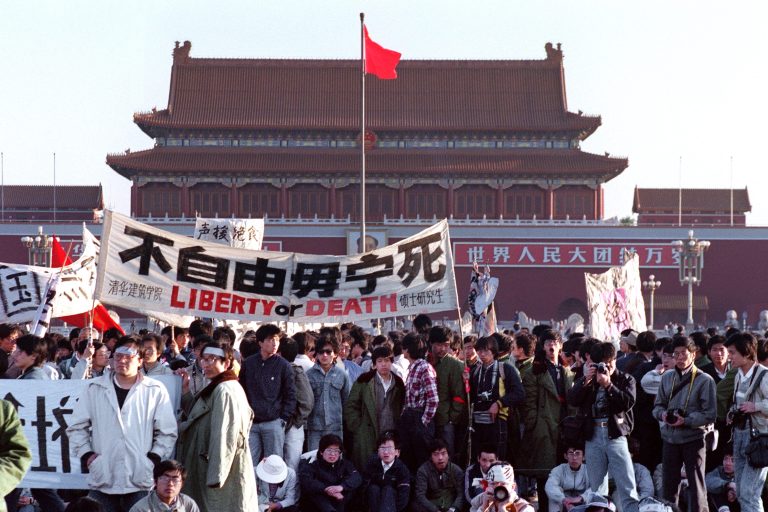
TORONTO, Ontario — Members of the overseas Chinese dissident community held a forum on May 27 to commemorate the 36th anniversary of the 1989 Tiananmen Square massacre, when the communist authorities brought a violent end to the democracy movement then spreading throughout China.
Wang Juntao, chairman of the China Democracy Party National Committee, attended the Toronto event, which was hosted by the CDP’s Canada Committee.
Participants who were directly involved in the events of Tiananmen include Liu Jianguo, a Chinese military veteran who served as the driver for People’s Liberation Army (PLA) commander Xu Qinxian, who famously refused verbal orders to deploy his 38th Group Army against the protesters. Another was Jiang Lin, then a journalist for the PLA Daily who opposed the armed crackdown.
Also present was a young Chinese influencer based in Canada, who is active under the handle “Toronto Fanglian.” The speakers painted a sobering yet hopeful picture of China’s past, present, and the struggle for a democratic future.
The moral imperative of June 4th
The 1989 Chinese democracy movement saw over a million people around the country come out to demand political reforms from the Chinese Communist Party (CCP) leadership after a decade of economic and social liberalization.
Success
You are now signed up for our newsletter
Success
Check your email to complete sign up
By late May that year, around 100,000 people were gathered in and around Tiananmen Square in Beijing, while the Party leadership decided how to handle the growing challenge to their authority. Though some in the regime hoped for a peaceful resolution to the protests, the CCP’s most powerful figure at the time, Deng Xiaoping, ultimately directed the PLA to impose martial law and clear Beijing by force.
The infamous Tiananmen Square massacre was carried out beginning in the night of June 3-June 4, and led to a period of repressions throughout China, while crushing any chances of political reform. Estimates of the death toll during the massacre range from the low thousands to over 10,000.
Opening the event, co-host Qiu Lan declared, “June 4 is not only a scar in history, but also a symbol of responsibility.” Her remarks set the tone for the evening’s emphasis on remembrance as an ethical obligation. Fellow host Liu Hongyan stressed, “Thirty-six years later, we are not just here to commemorate, but to consider how unfulfilled democratic ideals might be carried forward today.”
In a moving moment, attendees held up cellphone flashlights during a moment of silence for those who died in the crackdown, a gesture that symbolized light in the face of darkness.
Wang Juntao: The tragedy of June 4 and the challenge of democratic transition
As a student leader in 1989 and now a key figure in the overseas democracy movement, Wang Juntao offered a detailed reflection on the roots and lessons of Tiananmen. He explained that the protests were born from the contradictions between economic reforms and political repression. While market reforms in the 1980s brought growth, corruption and inequality fueled discontent, especially among students and intellectuals. “The movement wasn’t impulsive,” Wang said. “It was a response to the stagnation of political reform.”
Wang recalled how high-level factional struggles within the Communist Party sealed the fate of the protest. Reform-minded Party General Secretary Zhao Ziyang was sidelined by hardliners. “It was Deng Xiaoping’s single sentence: ‘Let the army handle it’ — that sealed the fate of those at Tiananmen,” he said.
Wang emphasized that no one has been held accountable for the massacre. “The tragedy is not just in the bloodshed,” he said, “but in the absence of responsibility. Without accountability, the public learns that justice has no reward and evil has no punishment.” He called this a deep national tragedy that undermines trust and morality.
Looking to the present, Wang argued that China’s economic downturn combined with high-tech surveillance creates both risks and openings. The CCP’s grip over media and public opinion, he noted, has fueled nationalism, which threatens to drown out democratic aspirations.
Yet, he added, “Tyranny is the greatest teacher. Repression and hardship awaken the people, just like in the White Paper Revolution.”
The “White Paper Revolution” occurred in November 2022, when tens of thousands of young Chinese took to the streets in Shanghai, Beijing, and other cities to protest the three years of overbearing “zero-COVID” pandemic lockdowns. The CCP soon lifted the policy, but many who took part in the demonstrations were arrested.
Wang concluded optimistically: “As long as the CCP keeps making mistakes, it will drive generation after generation to oppose it.” He drew hope from Taiwan’s democratization and stressed that success requires more than protest: it demands strategy, institutional design, and elite engagement. “Triggering a moment is easier than steering a transition. We must be ready to turn the next upsurge into a turning point for democracy.”
Former journalist: Bearing witness to violence in Beijing and Tibet
Former PLA journalist Jiang Lin provided a harrowing eyewitness account of both the March 1989 crackdown in Lhasa and the Tiananmen massacre. In Lhasa, the capital of China’s Tibet region, peaceful protests by Tibetan monks were met with brutal force as the army deployed an entire division to quell unrest in the city.
In Beijing, Jiang was on the ground on June 3, witnessing first-hand the military’s advance into the square. “I saw the troops open fire,” she said. “The hospital emergency rooms were packed with the wounded and the dead. It was horrifying.” Like Wang, she lamented the fact that no official has ever claimed responsibility, calling it a “headless case.”
Jiang identified the PLA’s nature as the root of the tragedy: “It is not a national army, it is a Party army. It has no independence.” She cited General Xu Qinxian’s refusal to act without a written order as a rare act of conscience, but one that ultimately had no impact on the final outcome.
Today, she warned, the surveillance state has only grown stronger, extending even overseas. “Even in Canada, we are not completely free,” she said, describing how church organizers cut contact after she shared her story publicly. Still, she expressed hope in the next generation: “The White Paper Movement shows young people are waking up. Tyranny remains the best teacher.”
PLA veteran: Describing the decision of a general who refused to fire on the people
Liu Jianguo, a former soldier and bodyguard to Gen. Xu Qinxian, provided a rare insider’s account of the military’s internal tensions in 1989. He recounted how Xu refused to enforce martial law without a written order, declaring: “I’d rather be executed than become a criminal in history.” Xu was later removed from command, placed under house arrest, and imprisoned. He died in 2021.
Liu described chaos and confusion in the army: “Most soldiers didn’t even know what they were being sent to do.” Xu’s principled stand contrasted starkly with the eventual deployment of the 38th Army, whose commanders led the crackdown while Xu became a scapegoat. Xu’s words stayed with Liu: “We’re soldiers to defend the country, not to suppress our own people.”
Liu himself experienced the danger when driving back into Beijing on June 3, navigating roadblocks and angry crowds. “It felt like a scene out of a World War II film,” he said. The fear was real, but so was the moral awakening. “At the time, all I wanted was to stay alive. But Xu’s actions showed me that a soldier can still have a conscience.”
Fleeing China in 2017 after prolonged political harassment, Liu now lives in the U.S. “If I don’t speak out, maybe no one will ever know the truth,” he said.
‘Toronto Fanglian’: A millennial’s view of June 4
Speaking from a younger generation’s perspective, Toronto-based content creator “Fanglian” said that learning about June 4 was his political awakening. Learning about the event through dissident videos, he came to see it as a “heroic but failed attempt that inspires future hope.”
He highlighted the decentralized nature of the 2022 White Paper protests, which responded to oppression without a central figurehead. The same internet tools used for surveillance, he argued, also enable activism. “Apps like Telegram lower the barrier to action,” he said.
Yet he cautioned against rising nationalism: “The CCP steers public anger at foreign enemies to distract from domestic issues. That’s a real danger.” Still, he believes in the power of small acts of resistance. “Even liking or reposting can make a difference. One person may go to jail—but when tens of thousands act together, the cost is nearly zero.”
‘What we do today creates the history of tomorrow’
Veteran political commentator Feng Zhiqiang emphasized that June 4 is part of a longer historical arc. “What we do today creates the history of tomorrow,” he said.
Criticizing the CCP’s prolonged rule, he said, “in this system, no one is clean, because you can’t get things done unless you play dirty,” he said.
Democracy, while imperfect, remains the best path forward. “Our current values are shaped by the CCP. We need forums like this to reset our thinking,” he said.
During the Q&A session, participants raised key questions, such as “Can Chinese people overcome their fear and push back against the CCP?” “Will populism lead to another disaster?” “How can China’s democratic transition succeed?”
Citing the example of the White Paper movement, which successfully resulted in the lifting of the pandemic restrictions, Wang Juntao said that the cost of protest is often overestimated, but collective action reduces individual risk. Populism, while risky, can also energize change. “It must be steered toward democratization,” he said. Transition to democracy, he emphasized, requires preparation, strategy, and elite cooperation.
Jiang Lin added that the PLA’s state as an army directly controlled by the CCP leaves little room for independent moral action by commanders, but young people’s awakening offers hope.
“One person can go to jail for going to the streets, but the cost of 10,000 people going to the streets is almost zero,” said Toronto Fanglian, citing the White Paper movement and online participation. “Future skirmishes will build courage. As long as people take to the streets, there is hope for democratization.”
With reporting by Xiao Ran.