To see the original video, please visit the Final War’s YouTube channel here.
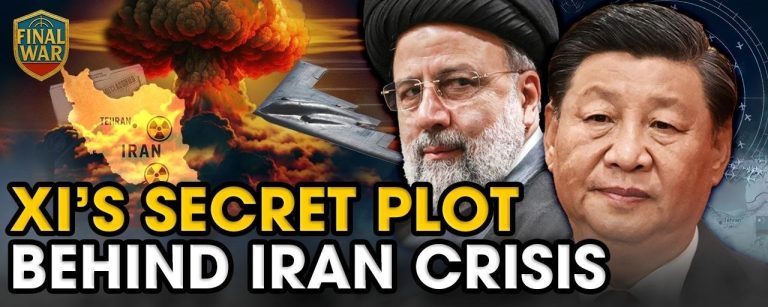
The Iran nuclear crisis has reached a boiling point, but the most unsettling revelation may be that the conflict doesn’t only involve Tehran and Tel Aviv. It’s not even just about Washington. Behind the escalating chaos, Chinese leader Xi Jinping is emerging as a silent yet central player — one whose actions may be accelerating the world toward global conflict.
As U.S. President Trump returns from an abruptly-shortened G7 summit and orders preparations for a potential strike on Iran, the region is bracing for what could become the most dangerous escalation in decades. Trump’s Situation Room meeting on the Iran-Israel war reportedly centered around deployment plans for the GBU-57 bunker buster bomb.
RELATED: Israel Braces for Prolonged Conflict as Iran Reels From Mounting Casualties
“President Trump has approved an attack plan on Iran,” host Katherine Hu explained in this week’s FinalWar episode. “He’s urging Tehran civilians to evacuate immediately.”
Success
You are now signed up for our newsletter
Success
Check your email to complete sign up
But why now? And what’s China’s stake in this?
A ticking time bomb
While many media outlets maintain that Iran is still years away from developing a nuclear bomb, the truth appears far more urgent. According to a leaked 2024 IAEA report, Iran had amassed over 360 pounds of uranium enriched to 60 percent — and the remaining jump to weapons-grade could take less than two weeks with current centrifuge capacity.
Back in February 2023, IAEA inspectors detected uranium particles enriched to 83.7 percent at the Fordow facility — just shy of the 90 percent needed for a bomb. Most chilling, Israeli sources claim Tehran may be preparing to transfer a nuclear device to the Houthi rebels.
“Iran isn’t years away from the bomb — it may be one technical decision away,” Hu warned.
Why Israel can’t go it alone
Since June 13, Israeli airstrikes have targeted Iranian nuclear facilities, yet one critical site remained intact: Fordow. Buried deep under a mountain and fortified with reinforced concrete, Fordow laid beyond the reach of Israel’s conventional bunker-busting arsenal.
Only one weapon in the world has the power to reach it: the U.S.-built GBU-57 Massive Ordnance Penetrator, a 30,000-pound bomb requiring a B-2 stealth bomber to deploy. Sources warned that Tel Aviv was even preparing to deploy a thermonuclear hydrogen bomb if the situation continued to escalate.
But after Israeli Prime Minister Netanyahu pressed Trump to act, the U.S. launched “Operation Midnight Hammer” on June 22. The mission saw the deployment of 14 GBU‑57 bunker‑buster bombs from B‑2 stealth bombers targeting Iran’s three key nuclear sites: Fordow, Natanz, and Isfahan. According to the Trump administration, the strike “completely obliterated” Fordow, leaving Iran with little recourse to continue its nuclear aspirations.
The very next day, on June 23, Trump announced on Truth Social that he had brokered a ceasefire that had been “fully agreed by and between Israel and Iran.” He continued, “On the assumption that everything works as it should, which it will, I would like to congratulate both Countries, Israel and Iran, on having the Stamina, Courage, and Intelligence to end, what should be called, “THE 12 DAY WAR.” This is a War that could have gone on for years, and destroyed the entire Middle East, but it didn’t, and never will!”
Though the tenuous ceasefire appears to be holding for now, it came only after a volatile 24 hours in which both sides continued exchanging fire.
Just hours after Trump’s announcement, Israel launched additional precision strikes on suspected missile storage sites near Shiraz and Mashhad, claiming that Iran had violated the agreement by repositioning short-range launchers. In response, Iran fired a fresh barrage of ballistic missiles toward Israeli military bases in the Negev desert, triggering multiple air raid sirens and brief panic across southern Israel.
China’s role in Iran’s nuclear rise
While much attention is focused on the U.S. and Israel’s response, one overlooked enabler of Iran’s nuclear program is China. From the early 1980s through the late 1990s, Beijing directly assisted Iran by supplying uranium hexafluoride (UF6), developing enrichment facilities, and training Iranian scientists.
“China also assisted with chemical separation processes, yellowcake processing, and the design of facilities to convert uranium into uranium hexafluoride (UF6), which is necessary for nuclear fuel production,” said scholar Farhad Rezaei.
But the relationship didn’t end there. In 1996, Chinese officials even invited Iranian military and nuclear experts to observe nuclear weapons tests — a move that would lay the groundwork for hands-on nuclear weapons training.
According to Brandon Weichert, author of “Shadow War: Iran’s Quest for Supremacy,” Beijing may still be involved — but through a proxy. “Since both Iran and North Korea act as proxies for Beijing, it’s entirely possible that North Korea is helping Iran develop its nuclear arsenal on China’s behalf,” he said.
In April 2024, a secret North Korean delegation visited Tehran, fueling speculation that Pyongyang is helping Iran overcome its final technical hurdle: Warhead miniaturization for ballistic missile delivery.
Strategic endgame
For China and Russia, an Iran in turmoil is more than just geopolitical noise — it’s strategic opportunity. Both countries have formed what Hu describes as an “Axis of Resistance” by actively working to counter U.S. influence in the Middle East.
On June 5, both China and Russia voted against an IAEA resolution to pressure Iran, underscoring their alignment with Tehran. And with China skirting U.S. oil sanctions and buying Iranian crude, the economic lifeline helps keep the Iranian regime afloat.
For Xi Jinping, a nuclear Iran could mean tying down U.S. forces in the Middle East — buying time and space for China to advance its goals elsewhere, including potential moves against Taiwan.
“Iran is a tool for Beijing to challenge American dominance,” Hu said. “If the U.S. is tied up in the Middle East, China has a freer hand in the Pacific.”
A preview of the CCP’s fate?
As Iranian citizens rise up — shouting “Death to dictators!” and tearing off hijabs in public protests — some see echoes of what could one day happen in China.
In a telling moment, Hu points out the recently-revealed satellite imagery of an underground complex near Beijing dubbed the “Beijing Military City” — ten times the size of the Pentagon.
“Does Xi Jinping truly believe he can stay safe, tucked away in a bunker, while the world burns above him?” she asks.
Regardless of how this conflict shakes out, this won’t be a regional rivalry anymore, Hu notes. The Iran nuclear crisis is becoming a proxy war between global powers, with China quietly fanning the flames. Now, as Israel prepares for a possible nuclear confrontation, the world is left asking: If Tehran falls, who will be next?
To see the original video, please visit the Final War’s YouTube channel here.