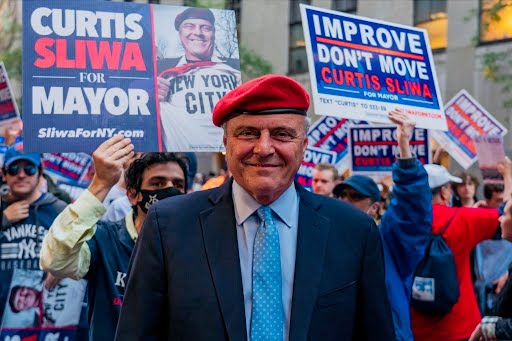
On Tuesday, Aug. 26, Vision Times sat down with New York City mayoral candidate and Republican nominee Curtis Sliwa, who outlined his campaign priorities. He cautioned about communist influences in the city and pledged to tackle both the rising cost of living and public safety concerns.
Sliwa is a longtime New York City activist, media personality, and founder of the Guardian Angels, a volunteer organization dedicated to crime prevention. He is the Republican nominee in the 2025 NYC mayoral race.
“The biggest danger to America, the biggest danger to the state of New York, the biggest danger to the city of New York is communism,” Sliwa told Vision Times. “Red China, mainland China is trying to influence our elections. Not just Democrats… they are trying to influence Republicans, too.”
“So, I am the only candidate who is warning everybody: Beware of CCP. Chinese Communist Party (CCP) influence, because they are trying to control who it is that becomes the mayor, or governor, or, in the future, even the President of the United States and we cannot have that. We cannot have that. We must all talk out about that, Democrats and Republicans.”
In this fall’s New York City mayoral election, slated for Tuesday, Nov. 4, voters will choose from among several candidates, including Republican nominee Curtis Sliwa, Democratic nominee Zohran Mamdani, former Governor Andrew Cuomo, and incumbent Mayor Eric Adams.
Success
You are now signed up for our newsletter
Success
Check your email to complete sign up
Speaking about his Democrat opponent, Zohran Mamdani, Sliwa said,”Look at Zohran Mamdani. People say, ‘Zohran, you’re a communist. You’re a socialist,’ [and] he doesn’t argue. He doesn’t say, ‘no, I’m a capitalist, you’re wrong.’ He agrees. He is a danger to our city, to our state and to our country. That’s why people must vote for me to be mayor.”
Chinese communist influences in the city are well documented, including the discovery of a secret Chinese police station in Manhattan and recent investigations revealed China-linked organizations making significant campaign contributions to New York politicians.
In addition, communist China has reportedly utilized networks of social clubs known as hometown associations to sway political outcomes in New York City.
READ MORE:
- New York Rally Celebrates 450 Million Cutting Ties With the Chinese Communist Party
- New York City Announces New Effort to Double Homes in Housing Lottery
Cost of living crisis
Sliwa believes that cutting taxes is one of the primary things the city’s administration can do to address the cost of living crisis.
“We have to cut taxes. That’s something the mayor can do. Cut taxes,” Sliwa said.
He is especially critical of the high property taxes that homeowners pay, with a particular concern for small landlords who have faced numerous challenges, especially since the COVID-19 pandemic.
“They are trying to get tenants to pay their rent. Ever since the lockdown and pandemic Governor Cuomo said, ‘You don’t have to pay rent.’”
“There are a lot of tenants refusing to pay rent. Landlords go to tenant/landlord court, and the courts are constantly supporting squatters—people who have been there four, five, six, or seven years and still aren’t paying rent,” Sliwa said, adding, “I will be there to support those landlords.”
Sliwa also contends that rent in the city is too high for both residential and commercial tenants, and he says that bringing an estimated 100,000 vacant apartments back onto the market could help ease the problem for residential renters.
Of these 100,000 vacant homes, Sliwa says 6,000 of them are directly under the City’s control.
“Why are they empty? We need those 6,000 — that is what the mayor controls. Eric Adams won’t answer that question,” Sliwa said, adding, “More apartments mean prices will stay the same or go down.”
Sliwa also hopes to make the American dream more accessible for all New Yorkers. “We have to make it easier for people, especially first generation immigrants, to live the American dream,” said Sliwa. “If I can do that, then I will help to stop all the people who are leaving New York City, and give them an opportunity to have the American dream, to have their own home, to have a car, to have a good school where their children and grandchildren can be educated.”
READ MORE:
- NYC Expands ‘Neighborhood Tech Help’ Pilot Program to Bronx and Upper Manhattan
- Run4Downtown 2025 Brings Middletown Community Together in a Celebration of Fitness and Fun
Cracking down on crime
Sliwa, a longtime advocate for public safety, has made reducing crime and making New York City safer a central focus of his mayoral campaign.
One of his primary campaign promises is to hire an additional 7,000 NYPD officers to “restore law and order across New York City.”
“When I’m mayor, Guardian Angels will continue, I will no longer wear the red beret. But, we will hire 7,000 more police. We are in desperate need of police. We don’t have enough police,” Sliwa said.
He also plans to reinstate the NYPD’s Anti-Crime Unit, expand the Gang Unit, strengthen proactive and aggressive policing strategies, and optimize the deployment of police resources.
According to Sliwa’s campaign website, if elected, he plans to reinstate the Homeless Outreach Unit in the city as well.
“This unit will work hand-in-hand with mental health professionals to build relationships with homeless individuals, distinguish between those in need of services and those who pose a danger, and connect people to shelters, treatment, and support.”
In addition, he plans to reform NYPD internal oversight and standards, create a long-term plan for crime reduction — which the city currently lacks — and end the cycle of repeat offenders among a number of other initiatives.
“That’s the mayor I am going to be. We are hiring 7,000 police. That’s the number one priority to make our streets safe and we are going to work with the president. If he wants to send in the National Guard, in crime areas, we are going to cooperate, we are not going to say, ‘no,’” Sliwa said.
Bolstering small business
If elected, Sliwa said one of his top priorities would be easing the financial burdens faced by small business owners across the city. He criticized the city’s reliance on fines and quotas, arguing that the practice often pushes entrepreneurs to the brink of closure rather than helping them succeed.
“A billion dollars worth of tickets a year. Why are we writing up all those tickets?” questioned Sliwa. “If you have a business, the sanitation police give you a ticket. The Department of Buildings comes, they give you a ticket. The Board of Health comes, they give you a ticket because they know you have to pay. And we put a quota in, which is very damaging. So I’m going to be saying no more tickets. Give them a warning so they can fix what the problem is. Because if you keep writing tickets, they’re going to be forced to close their business, or if they’re a landlord, they’re going to be forced to give up that building.”
Beyond small business fines, Sliwa also took aim at the city’s broader reliance on tickets and penalties that hit everyday New Yorkers. He argued that excessive fees — from traffic violations to infrastructure-related costs — create an environment where residents feel constantly squeezed.
“The roads are in disrepair, so you have to bring your car to a mechanic. Everywhere you look, you’re being asked to pay more money,” said Sliwa, adding, “New York City is the most expensive city in all of America. It doesn’t have to be that way. It is because the politicians just want to keep making you pay more and more.”
The New York City mayoral election is scheduled for Tuesday, Nov. 4, 2025. Early voting is available from Oct. 25 to Nov. 2, 2025, and mail-in ballots must be postmarked by Nov. 4, 2025. For more details, visit the NYC Board of Elections website.