At the end of August, Chinese leader Xi Jinping and other high-ranking Communist Party officials made a rare visit to Tibet, making him the first Chinese Communist Party (CCP) chief to travel to the nominally autonomous region since 1965.
The visit, coupled with the groundbreaking of a $165 billion mega-dam project on the Yarlung Tsangpo River just a month earlier, underscores Tibet’s elevated role in Beijing’s long-term political and strategic agenda.
Tibet was annexed by Communist China in 1950 and made an autonomous region in 1965. The Xi leadership’s recent moves in Tibet signal the CCP’s renewed interest in further developing the area’s natural resources, indoctrinate the Tibetan people into the Party’s broader narrative of Chinese national identity, and deepen its leverage over South and Southeast Asia through the control of the vast fresh water supply of the Himalaya mountain range.
‘Stabilizing and developing Tibet’
During his Wednesday, Aug. 20 speech in Lhasa to mark the 60th anniversary of Tibet becoming an autonomous region, Xi outlined the “four major tasks” for the region: stability, development, ecological protection, and strengthening border defense. He praised the “earth-shaking changes” in Tibet since 1965, attributing them to Party leadership and nationwide support. “Governing, stabilizing, and developing Tibet requires maintaining political security, social stability, ethnic unity, and religious harmony,” Xi said.
He also stressed the need to “strengthen the sense of community for the Chinese nation”, promote the national language, guide Tibetan Buddhism to adapt to socialism, and “build a national model zone for ethnic unity and progress.” Such rhetoric reflects Beijing’s ongoing efforts to assimilate Tibetans more deeply into China’s political and cultural framework.
Success
You are now signed up for our newsletter
Success
Check your email to complete sign up
On development, Xi called for investment in plateau-specific industries, expansion of clean energy and tourism, and advancing major infrastructure projects such as the Sichuan-Tibet railway and the colossal Yarlung Tsangpo dam.

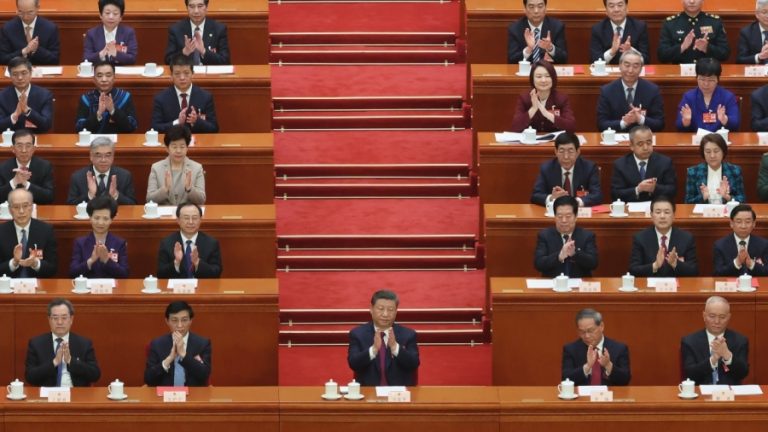
At a mass rally the following day, Chinese People’s Political Consultative Conference (CPPCC) chairman Wang Huning reinforced the message, hailing Tibet’s “historic accomplishments” under Xi’s leadership and urging adherence to Xi Jinping Thought. Tibet, Wang declared, must focus on “the four major tasks” to build a “socialist modernized new Tibet.”
Assimilation and stability
SinoInsider, a risk consultancy specializing in Chinese elite politics, argues that the rare attention given to Tibet by the Communist Party’s central leadership shows the regime’s prioritization of the region in its “long-term economic, geopolitical, and stability goals.”
By personally leading the delegation — which included senior figures such as Wang Huning, Cai Qi, Li Ganjie, He Lifeng, and Public Security Minister Wang Xiaohong — Xi demonstrated the Party’s full-spectrum approach to Tibet: ethnic policy, ideological control, economic planning, security, and military readiness, SinoInsider wrote in an Aug. 25 newsletter entry.
“Once a peripheral buffer zone, Tibet is now a ‘core asset’” for the CCP, the newsletter reads.
Demographic policies and cultural assimilation are core to Beijing’s Tibet policy. Authorities have encouraged Han migration, raised the urbanization rate to 57 percent, and aim to move an additional 15 million people to the Qinghai-Tibet Plateau.

At the same time, the Party is expanding its control over language, education, and religion to foster what Xi calls the “five identities”: identification with the motherland, the Chinese nation, Chinese culture, the CCP, and socialism.
In recent years, the Chinese authorities changed the official English name of Tibet to “Xizang,” the Chinese name for the region. Critics have panned the change as a further attempt by the CCP to erase Tibetans’ ethnic identity.
Surveillance technology also underpins the CCP’s efforts to “maintain stability.” The once-heavy reliance on military suppression has given way to a “gray zone” control network that blends high-tech monitoring with economic incentives to preempt unrest. Public Security Minister Wang Xiaohong’s presence in Lhasa highlights this priority.
Yarlung Tsangpo hydropower: A megaproject in the world’s deepest canyon
According to Chinese official data, Tibet’s GDP reached 276.5 billion yuan (US$38.4 billion) in 2024, with an average annual growth rate of 8.9 percent as the CCP pours money into infrastructure and resource extraction in the region.
The Medog power station, now under construction along the Yarlung Tsangpo, will be the world’s largest hydroelectric power station upon its completion. With an estimated cost of 1.2 trillion yuan, the project will build five cascading hydropower dams capable of generating 300 billion kilowatt-hours annually — three times the output of the Three Gorges Dam in Sichuan Province, which was also the largest hydropower station when it was completed in 2012.
Most of the electricity from Yarlung Tsangpo will be transmitted to other provinces, but the project will also enable local industrialization in Tibet.
Chinese state media frames the dam as a cornerstone of China’s “dual carbon” goals — peaking emissions by 2030 and achieving carbon neutrality by 2060. The project is also expected to provide massive economic stimulus, supporting infrastructure investment, creating up to 200,000 jobs, and generating about 20 billion yuan in annual fiscal revenue for Tibet.
Markets reacted quickly, with shares in cement, steel, and construction machinery surged following the announcement that construction had begun on July 19. According to SinoInsider, the project “appears to be one of the CCP’s solutions to mitigating the economic impact of the three COVID-19 pandemic years,” while also helping offset pressures from the property slump and U.S.-China trade tensions.
Geopolitical influence through water supply
The Yarlung Tsangpo river snakes across the Himalaya mountain range and through the Indian state of Arunachal Pradesh, ending at the Indian Ocean. It boasts the world’s deepest canyon, with an average depth of two to three times that of the mile-deep Grand Canyon in Arizona.
Tibet’s importance extends beyond China’s borders. With the plateau overlooking India and controlling the headwaters of major rivers, Beijing increasingly sees Tibet as a strategic gateway to South Asia. The Sichuan-Tibet railway doubles as both a development initiative and a military logistics corridor. The Yarlung Tsangpo dam, meanwhile, raises the stakes in Sino-Indian relations.
India and Bangladesh have already voiced concerns about water security and ecological risks for downstream communities. Analysts note that the dam could become a geopolitical flashpoint, giving Beijing leverage over river flows that are vital to India’s agriculture and population centers.
SinoInsider observes that China “could leverage its electricity supply to pressure South Asian nations into concessions on national interests. As economies grow reliant on cheap Chinese power, Beijing could disrupt energy supplies during critical periods to create destabilization.”
China has previously been accused of using dams on the Mekong to pressure Southeast Asian states. Extending this model to South Asia could complicate India’s already fraught relations with Beijing, particularly amid lingering border tensions.
Diplomatic overtures
Beijing is also hoping to deepen economic ties in the region. Foreign Minister Wang Yi visited New Delhi days before Xi’s Tibet trip, and both sides agreed to resume direct flights and boost trade. With India at odds with Washington over tariffs and its Russia ties, Beijing appears to sense an opportunity to draw New Delhi closer. Still, deep mistrust remains, and India is wary of the latent threat posed by China’s upstream projects, as well as the CCP’s military buildup along the disputed Sino-Indian border.
Despite its scale, the Yarlung Tsangpo dam faces serious challenges. The project site lies in a seismically active canyon, raising engineering and safety concerns. Construction delays, cost overruns, and corruption could undermine its potential.
“The CCP’s strategic ambitions are hampered by the serious deficiencies of its authoritarian system. Pervasive and persistent corruption could see the Yarlung Tsangpo hydropower project fail to deliver as expected upon completion or remain unfinished in the worst-case scenario,” SinoInsider wrote in its newsletter.
Even if completed on schedule in the 2030s, the dam will not erase the contradictions in China’s Tibet policy. Assimilation efforts may foster resentment, surveillance cannot fully eliminate dissent, and infrastructure-led growth risks creating environmental degradation. Moreover, weaponizing water and energy could further isolate China diplomatically.