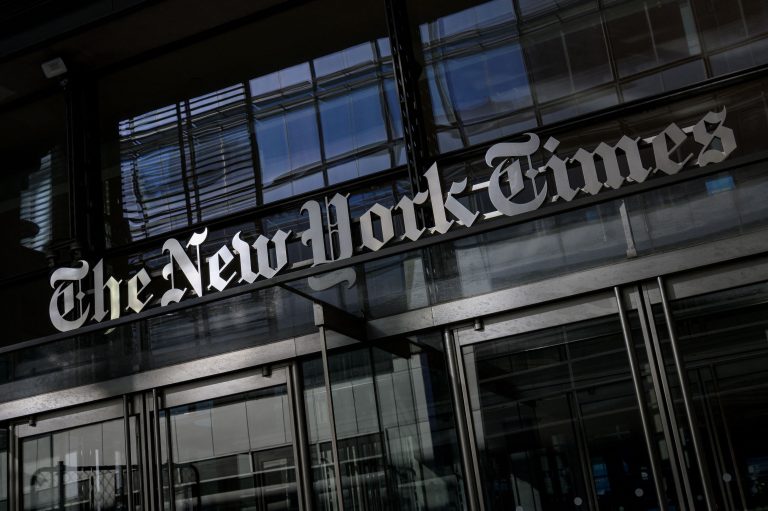
On Monday, Sept. 15 U.S. President Donald Trump announced that he has filed a $15 billion defamation and libel lawsuit against The New York Times.
“Today, I have the great honor of bringing a $15 billion defamation and libel lawsuit against The New York Times,” Trump wrote on his social media platform, Truth Social.
Trump alleges that the newspaper published false statements about him, his family, and his businesses.
According to The Guardian, the suit focuses on the publication of a set of news articles in the New York Times describing his time hosting the television show The Apprentice as well as stories from the book “Lucky Loser: How Donald Trump Squandered His Father’s Fortune and Created the Illusion of Success” by Times reporters Susanne Craig and Russ Buettner.
Among Trump’s key allegations is that the Times misrepresented the origins of his wealth and portrayed his business dealings in a misleading manner, and exaggerated aspects of his personality and personal history, including alleged remarks about Adolf Hitler, which Trump denies making.
Success
You are now signed up for our newsletter
Success
Check your email to complete sign up
Trump also accuses the Times of publishing content intended to influence the 2024 presidential election, including an editorial that labeled him unfit for office.
The lawsuit also asserts that these publications have caused significant harm to Trump’s personal and business reputation, leading to economic damages.
READ MORE:
- Vance: Trump Is Energetic — I Am Fully Capable of Assuming the Presidency if Needed
- Beijing Responds After Trump Says Xi Promised Not to Invade Taiwan
- Trump Calls for End to Mail-In Ballots and Voting Machines by 2026 Midterms
Legal considerations
To prevail in a defamation case, especially as a public figure, Trump must prove “actual malice,” that the Times knowingly published false information or acted with reckless disregard for the truth. Legal experts suggest that meeting this high standard may be challenging.
The Times has dismissed the lawsuit as meritless and an attempt to suppress critical journalism.
The newspaper has a history of having to defend itself against similar allegations.
In 2017, the Times published an editorial that incorrectly linked Sarah Palin’s political action committee to a 2011 mass shooting in Arizona. The editorial suggested that the map from Palin’s PAC, featuring crosshairs over several congressional districts, had incited the attack.
The courts found in favor of the New York Times, concluding that the paper was not liable for defamation. The jury determined that the editorial was an honest mistake made without malice.
In another case, Carlo M. Croce v. The New York Times, Carlo M. Croce, a prominent cancer researcher, filed a defamation lawsuit against the Times and several of its writers and editors, alleging that their reporting on scientific misconduct allegations was false and damaging to his reputation.
In Nov. 2018, U.S. District Judge James Graham dismissed virtually all of Croce’s lawsuit and Croce also lost a defamation lawsuit against critic David Sanders of Purdue University who was quoted in the Times article.
In May 2020, Croce lost the defamation lawsuit against Sanders, with the presiding judge writing that “discovery has proved the existence of about 30 instances of fabrication or duplication” in Croce’s research papers.