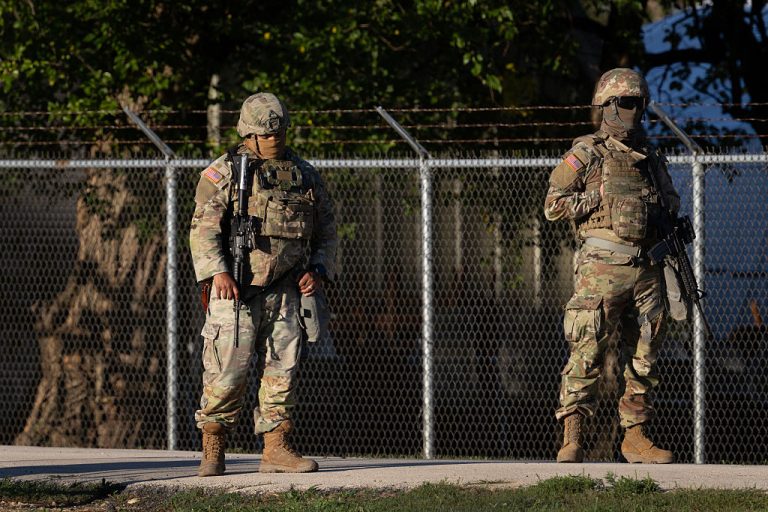
President Donald Trump has deployed National Guard troops and federal law enforcement personnel to several major U.S. cities, citing rising crime and immigration concerns. He is also signalling that he plans to deploy troops to a number of other cities, primarily ones led by Democratic administrations. The moves have sparked legal battles with state and local officials and prompted a judicial review over the limits of presidential authority.
In August, in Washington, D.C., Trump declared a “crime emergency” and placed the Metropolitan Police under federal control while activating the D.C. National Guard.
He invoked Section 740 of the District of Columbia Home Rule Act to assume control of the local Metropolitan Police Department (MPD) for the first time in American history. His executive action allowed the federal government to direct the MPD’s services for federal purposes, including maintaining law and order and protecting federal properties.
In response to the federalization, the District of Columbia’s Attorney General filed a lawsuit challenging the constitutionality of the takeover. The lawsuit contends that the federal government’s actions overstep its authority and infringe upon the rights of D.C. residents. The case is currently pending, with oral arguments scheduled for Oct. 24, 2025.
As of early October, approximately 550 individuals had been arrested under the federalized law enforcement operations, with a significant portion of those arrests categorized as “other” offenses, the Associated Press reported. The Trump administration reports that crime rates have declined since the deployment, but critics question the accuracy of these claims.
Success
You are now signed up for our newsletter
Success
Check your email to complete sign up
Also in early October, approximately 400 Texas National Guard troops were deployed to Illinois, with orders to protect federal immigration agents during operations in Chicago. This deployment occurred despite strong opposition from Illinois Governor JB Pritzker and Chicago Mayor Brandon Johnson, who filed a lawsuit claiming the deployment was unconstitutional.
A similar scene is unfolding in Portland, Oregon as ongoing protests against Immigration and Customs Enforcement (ICE) activities prompted the Trump administration to deploy the National Guard there.
However, a federal judge blocked the deployment, ruling it appeared unconstitutional. Despite this, the administration has indicated intentions to proceed with the deployment.
Federal forces arrive in Memphis
On Sept. 12, the Trump administration announced the deployment of National Guard troops to Memphis. Subsequently, on Sept. 15, he signed a presidential memorandum directing the deployment of federal law enforcement agencies in conjunction with Tennessee’s National Guard to form a task force aimed at addressing crime in the city.
The deployment has faced strong opposition from Memphis city officials and the Shelby County Board of Commissioners. Both have expressed concerns about the legality and necessity of the federal intervention. Notably, the Shelby County Board of Commissioners rejected resolutions either supporting a 90-day deployment or urging Tennessee Governor Bill Lee to oppose the deployment. Shelby County Mayor Lee Harris has also been vocal in his opposition, questioning the need for federal involvement.
Despite this, the “Memphis Safe Task Force,” incorporating at least 219 federally deputized officers, began operations on Oct. 1. Homeland Security Advisor, Stephen Miller, described the task force as “unleashed.”
As of Oct. 8, the situation in Memphis remains fluid, with ongoing legal challenges and public scrutiny surrounding the deployment.
Additional cities being considered
The Trump administration has also indicated that it is considering deploying National Guard troops to a number of other cities including New York, Baltimore, San Francisco and Oakland.
For New York, Trump says the National Guard needs to be deployed there to address concerns over crime and unrest. However, as of now, no formal orders have been issued, and the deployment remains a proposal.
The city’s administration, which is in the midst of an election, has not endorsed the plan but many suspect any deployment would likely face significant legal and political challenges.
In Baltimore, Trump has threatened to deploy federal forces in response to what he characterizes as escalating crime. Governor Wes Moore and Mayor Brandon Scott have strongly opposed the idea, viewing it as federal overreach. The city’s leadership has vowed to resist any federal intervention, emphasizing local control over law enforcement matters.
And in California, concerns revolving around crime and homelessness have prompted the Trump administration to consider deploying forces to San Francisco and Oakland.
San Francisco Mayor London Breed and other officials oppose the proposal, advocating for local solutions even as the city continues to grapple with these challenges.
Oakland Mayor Barbara Lee has publicly rejected the idea, arguing that her administration has made significant improvements in public safety, including a 30 percent year-over-year decline in overall crime.
While the Trump administration’s proposals have faced strong opposition, many argue they are justified and note that similar measures have been proposed multiple times before, though little action was taken.