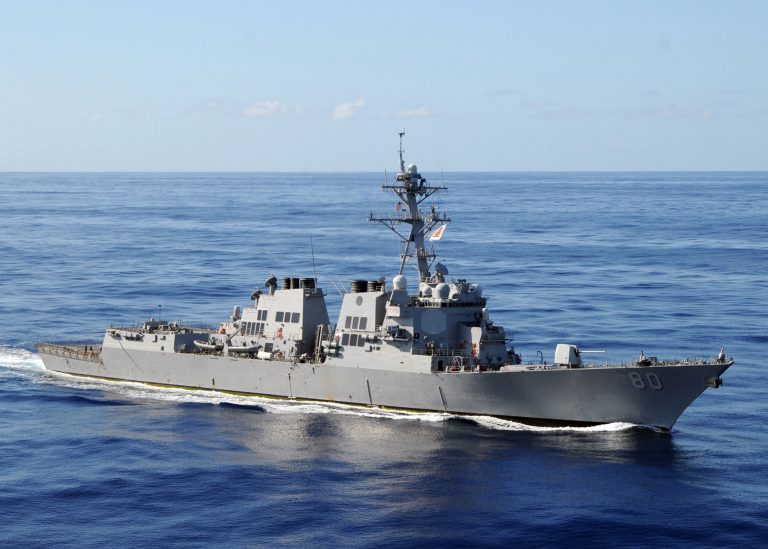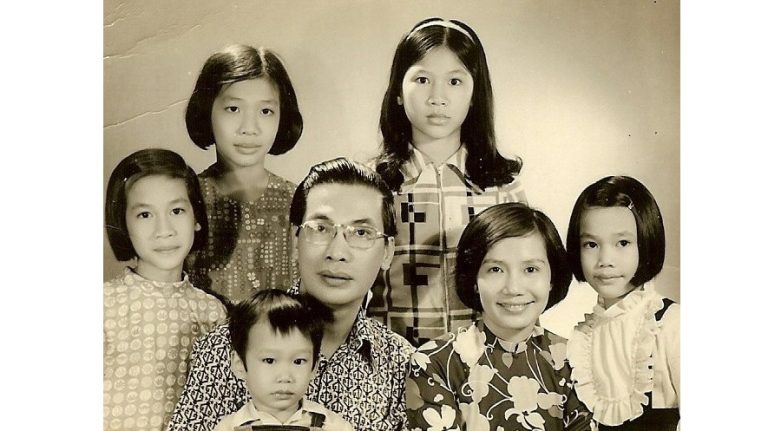
When the Pentagon abruptly forced out Navy Secretary John Phelan on April 22, 2026, the man who stepped into the job was a Vietnamese refugee who had escaped the fall of Saigon as a four-year-old child. Hung Cao, the Under Secretary of the Navy and a retired Navy captain decorated with the Bronze Star, became acting Secretary of the Navy that day. His predecessor’s removal came without public explanation from the Pentagon, though it followed months of tension between Phelan and Defense Secretary Pete Hegseth and landed while U.S. warships were enforcing a naval blockade against Iran.
Escaping the fall of Saigon in 1975
Hung Cao was born in 1971 in Saigon, the capital of South Vietnam, now renamed Ho Chi Minh City after the communist victory. His father belonged to the South Vietnamese governing elite and had studied in the United States in the 1960s, earning a doctorate in agricultural economics from Cornell University.
In April 1975, North Vietnamese tanks closed in on Saigon and the city fell into anarchy. The United States launched the largest helicopter evacuation in history, Operation Frequent Wind. Tens of thousands of Vietnamese who had worked for the South Vietnamese government or American forces crowded outside the U.S. embassy, scaling the razor-wire walls and begging the Marines above to pull them up. On the deck of the amphibious command ship USS Blue Ridge, so many South Vietnamese helicopters were landing that American crews shoved millions of dollars worth of aircraft into the sea to clear space for the next planes full of refugees.
Some South Vietnamese officers gathered their men, gave the order to disband, and then shot themselves at monuments or in their offices. Thousands of soldiers stripped off their uniforms and threw down their rifles in the streets to escape the North Vietnamese reckoning. Saigon’s roads were carpeted with a thick layer of discarded boots, uniforms, and medals.
The four-year-old Hung Cao was carried aboard one of the last evacuation flights amid the screaming and desperation. His family reached Guam and then the United States, escaping by air when most could not.
Success
You are now signed up for our newsletter
Success
Check your email to complete sign up
The new communist government sent roughly a million people to remote, brutal “reeducation camps,” where former South Vietnamese officials and intellectuals faced endless hard labor, indoctrination, and starvation. Tens of thousands died of disease, hunger, or torture. Many people branded “counterrevolutionaries” were marched to village edges or camp walls and shot in groups, never even reaching a trial.
The terror drove more than two million people onto flimsy wooden boats and out into the South China Sea, where they faced robbery and rape by pirates, storms that swallowed entire vessels, and hostile neighboring countries that turned them away. The United Nations estimates that between two hundred thousand and four hundred thousand of these “boat people” drowned at sea. Cao’s family, who had escaped by air in 1975, were among the rare few spared that crossing.
From a West African childhood to a decorated Navy career
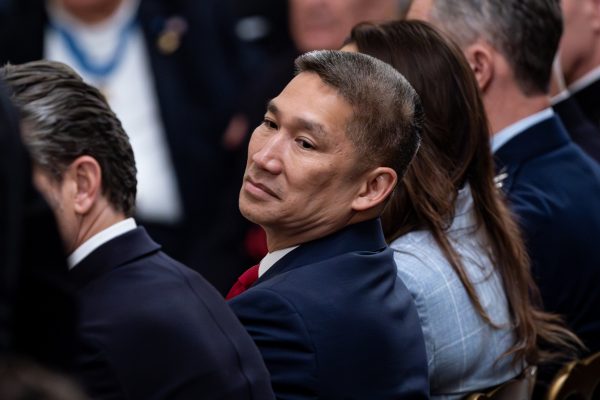
Cao’s father, a former South Vietnamese agricultural expert with a Cornell doctorate, was hired by the U.S. Agency for International Development and posted with his family to Niger in West Africa for an agricultural aid project. Cao spent the years from age five to twelve there, and speaks fluent French. At twelve, the family returned to the United States and settled in Virginia.
Cao tested into Thomas Jefferson High School for Science and Technology, consistently ranked the top public high school in the country, where he was among the first graduating class. He entered the U.S. Naval Academy in 1989 and earned a bachelor’s degree in ocean engineering, later training further at the Naval Postgraduate School in Monterey, California.
Cao served in the Navy from 1989 to 2021 as an explosive ordnance disposal specialist skilled in deep-sea diving and bomb disposal. His first brush with national attention came in July 1999, when John F. Kennedy Jr., the son of the assassinated president, crashed his single-engine private plane into the Atlantic off Martha’s Vineyard while flying his wife and her sister to a family wedding. All three died on impact, and the disappearance transfixed the country as the latest tragedy to strike the Kennedy family. By his own account, Cao served as the operations officer running the recovery, and he and another diver went down to rig the wreckage so the ship’s crane could raise it. He has said the plane was found within twelve hours and has described the mission as recovering, in his words, America’s son and laying him to rest.
Cao later deployed repeatedly to Iraq and Afghanistan, defusing roadside bombs, among the most dangerous work in the U.S. military. He has said his job was to move toward the blast site while everyone else pulled back. In East Africa, he took part in operations against the terrorist group al-Shabaab, commanding demolition work to clear militant strongholds.
Dismantling diversity programs inside the Navy
In his final years before retirement, Cao moved into the Pentagon’s budget machinery, managing roughly $140 billion in spending allocations in the Office of the Chief of Naval Operations, decisions that determined which nuclear submarines were built and which aging systems were cut. He then joined a Joint Terrorism Task Force with the FBI and the Department of Homeland Security. In February 2025, President Trump nominated him as Under Secretary of the Navy, and the Senate confirmed him that October.
After taking office, Cao cut off funding for every diversity, equity, and inclusion office inside the Navy and removed several civilian officials responsible for those policies, making him Hegseth’s enforcer in the administration’s campaign against such programs in the armed forces. As a Vietnamese refugee, a person of color, and a Bronze Star recipient, he is positioned to lead that effort without the political vulnerability a white official might face. He has argued that the Chinese military is not teaching its sailors gender theory but is practicing how to sink American warships, and that a military’s only defining trait should be lethality. While adversaries build hypersonic missiles, he warns, the U.S. military argues over pronoun usage, and has said this will cost American lives. He traces the danger to Vietnam: when the North Vietnamese took over, their first move was to redefine words like “the people” and “progress,” and accepting an enemy’s language, he argues, means accepting its shackles, followed by the reeducation camps and finally the executions against the wall.
Cao applied the same logic to the vaccine discharges. In late 2025 and early 2026, he led a review of service members removed for refusing the COVID-19 vaccine, arguing in an internal address at the Naval Academy that the military had lost its most experienced petty officers over an administrative order unrelated to combat effectiveness, and that this self-inflicted damage had to stop. He announced on social media that he had signed a letter of apology to service members he described as conscientious warriors unjustly removed by what he called an illegal vaccine mandate, and that the Navy was working to welcome them back.
Confronting Beijing across the Pacific
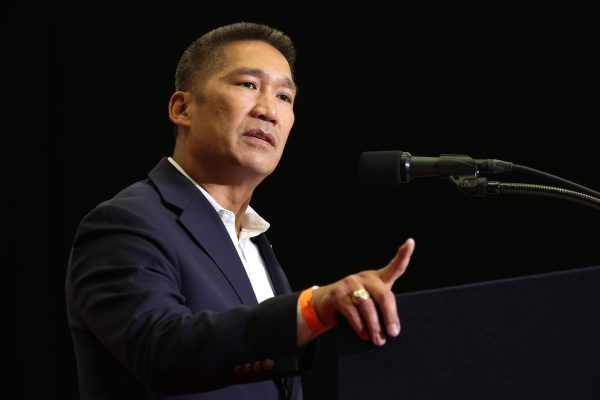
On the Indo-Pacific, Cao has discarded the traditional doctrine centered on large aircraft carriers in favor of turning Guam into a distributed combat hub for the Western Pacific, an “unsinkable aircraft carrier.” He has pushed to build dense missile-defense systems and dispersed supply depots across Guam and the surrounding Mariana Islands, on the logic that scattering assets defeats an adversary’s saturation strike.
Cao presses a hard line on Beijing across every front. When critics call his policies too aggressive, he holds up a photograph of himself as a four-year-old fleeing Saigon. The people of that era also believed compromise could buy peace, he argues, and what they got was execution. He has watched U.S. forces scramble out of Kabul in 2021, and told an interviewer the images of people falling from a C-17 transport plane put him back in Saigon in 1975. He says he re-entered public life so that Americans would never again go searching for the next boat out.
His other target is the supply chain. Cao spent four years managing next-generation equipment budgets at the Pentagon, and he blames fifteen years of stopgap funding for eroding the U.S. edge against China. Every American missile and microchip that still runs on an adversary’s raw materials, in his view, hands the enemy a knife. He has ordered a sweeping audit of the Navy’s defense contractors and set a deadline: zero dependence on foreign critical minerals and electronic components by 2028. He has told shipyard owners that building with an adversary’s steel puts American sailors at risk.
Cao and his wife have five children, all educated at home. Cao regards public schools as sites of ideological indoctrination and has said he chose home education to give his children a traditional patriotic upbringing and classical values. On April 30, 2025, the fiftieth anniversary of the fall of Saigon, he wrote a public message thanking the United States for saving his family half a century earlier.