
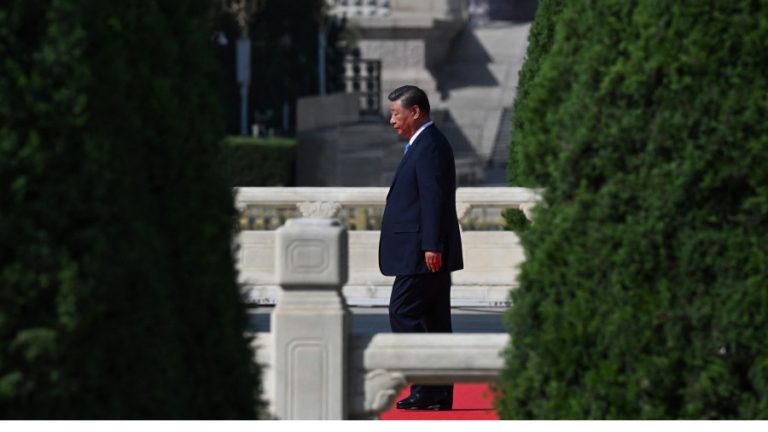
Since coming to power, Xi Jinping has consolidated control not only by purging high-ranking officials across the Party, government, and military under the banner of “anti-corruption,” but also by tightening his grip on the private sector.
According to a recent report by The Economist, Chinese entrepreneurs are mysteriously disappearing at an alarming rate — almost one every week.
On Oct. 11, The Economist noted on X (formerly Twitter) that China’s system of extrajudicial “detention” — initially used against Party and government officials — is now being applied to business leaders with increasing frequency.
By the end of September, 39 senior executives from publicly listed Chinese companies had vanished — roughly one per week, according to stock exchange filings. Many others, especially from non-listed firms, remain unreported.
The list of victims includes Wang Linpeng, once the richest man in Hubei Province. Wang, chairman of Beijing-based JuRan ZhiJia, died by suicide on July 27, just four days after his release from over four months of extrajudicial detention. His case is one of the few that became public; most others are still hidden.
Success
You are now signed up for our newsletter
Success
Check your email to complete sign up
Another notable case is Yu Faxin, a leading scientist and entrepreneur specializing in military-grade semiconductors. On Sept. 22, his company, Zhejiang Zhenlei Technology, announced that Yu had been placed under “detention.”
China’s “detention” mechanism — formally introduced in March 2018 — was designed to investigate CCP members under Xi’s anti-corruption campaign. But in recent years, it has expanded far beyond its original purpose, ensnaring private business figures in growing numbers.
The Economist describes these detentions as a major source of fear and uncertainty among China’s business elite. What was once a Party disciplinary tool has become a weapon of political control, reflecting Xi’s determination to rein in private enterprise and consolidate state dominance.
The numbers behind the crackdown
As of late September, China’s stock exchange disclosures confirmed 39 disappearances — already surpassing last year’s total. However, The Economist warned that these represent only “the tip of the iceberg.”
According to data from the Central Commission for Discipline Inspection (CCDI), total detentions — including both officials and businesspeople — surged nearly 50 percent in 2024, reaching about 38,000 cases. That same year, the CCDI reported disciplinary actions against more than 60,000 individuals in the pharmaceutical sector and 17,000 in finance, many involving extrajudicial detention.
Consulting firm Gavekal Dragonomics estimates that up to one million anti-corruption cases could be opened this year — a record high. Scholars such as Zhu Jiangnan of the University of Hong Kong note that sectors like computer hardware and green technology are now particularly vulnerable, as their close ties to local governments make them easy targets for investigation.
China’s slowing economy has made the situation worse.
Many local governments, burdened with debt and cash shortages, increasingly rely on aggressive detentions to force confessions or seize company assets. Executives are often pressured to admit wrongdoing or implicate others — providing political “results” that reinforce Xi’s narrative of anti-corruption success.
“When the economy falters, the easiest way to show loyalty is to find someone to punish,” one Chinese analyst said.
Business leaders also face punishment through China’s notorious “dishonest persons” blacklist, which includes some of the country’s wealthiest individuals. Once blacklisted, they are barred from flying, taking high-speed trains, or staying at luxury hotels.
According to China’s court database, nearly 200,000 new names were added to this blacklist as of September — ten times more than in 2019, before the pandemic. These restrictions further tighten the noose on private enterprise and stifle what remains of entrepreneurial freedom.
Adding to the grim picture are reports of entrepreneur suicides. Between April and July this year, at least five prominent executives reportedly jumped from high-rise buildings.
The Economist concludes that these tragedies represent only a fraction of the true picture — a glimpse into a climate of fear where business leaders vanish, die, or remain silent under the shadow of Xi Jinping’s tightening control.
By Wang Jun, Janet Huang