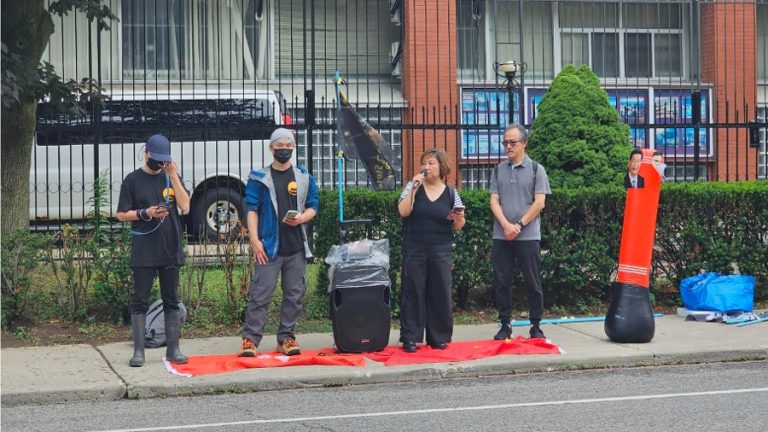

Chinese actor Yu Menglong’s death has shaken the public conscience. Those still alive can now perceive what he could not — the deceit and danger that surrounded him. His story is a reminder that goodness without discernment can be perilous. As an ancient Chinese proverb warns: “A wise man does not stand beneath a crumbling wall.”
Many in China, when confronted with the Chinese Communist Party’s (CCP) crimes, react with detachment: “What does that have to do with me?” But history shows that failing to recognize evil carries its own cost.
When the CCP seized power in 1949, those who fled and those who stayed behind embarked on drastically different paths. Many who remained were crippled, imprisoned, or driven mad in successive political campaigns. Those who escaped largely survived — their salvation owed to clear judgment and moral foresight. To see evil for what it is requires profound wisdom.
By late 1948, the Nationalists were losing China’s civil war. Chiang Kai-shek launched an emergency plan to evacuate prominent scholars to safety in Taiwan. He personally ordered planes to brave enemy fire and wait at Nanyuan Airport in Beijing. Yet, most seats remained empty. Only a few, including Hu Shi and Chen Yinke, chose to board.
Success
You are now signed up for our newsletter
Success
Check your email to complete sign up
The CCP sent emissaries to persuade Hu Shi to stay. His response was unequivocal:
“Don’t believe a word the Communists say.
In the Soviet Union, there is bread but no freedom.
In America, there is both bread and freedom.
When the Communists come, there will be neither.”
Hu’s warning went unheeded. Many intellectuals stayed, convinced that the Communists represented a “new dawn.” Chen Yuan, president of Fu Jen University, wrote that his students were “welcoming a new society.” Few imagined the nightmare to come.
Propaganda and Betrayal
Before taking power, the CCP publicly vowed democracy and freedom. Xinhua Daily declared in 1940 that claims of a “one-party dictatorship” were malicious lies, promising to “return power to the people.” In 1945, Mao Zedong assured Reuters that the new China would be “free, democratic, and governed by elections.”
These pledges seduced both Chinese intellectuals and foreign observers. Yet history unfolded as the opposite — a totalitarian regime built on deceit.
Those who trusted the regime paid dearly.
- Chen Yinke, the nation’s most erudite historian, was tormented by Red Guards until his death during the Cultural Revolution.
- Zeng Zhaolun and his wife Yu Dayin, both renowned academics, returned from Hong Kong to “serve the motherland.” Yu was stripped and beaten to death; Zeng died months later under torture.
- Hu Sidu, son of Hu Shi, stayed behind, denounced his father, and was later branded a “rightist.” He hanged himself in 1957.
- Dong Jiayi, a Harvard PhD, perished in the Jiabiangou labor camp during the Great Famine — his body mutilated by starvation.
Their fates stand as stark testimony to how the CCP devoured the very minds that once dreamed of rebuilding the nation.
The story of these scholars — and now, of Yu Menglong — carries a timeless message: goodness without wisdom can be fatal. Evil often disguises itself in the language of justice and progress. To resist it, one must see clearly, think independently, and refuse to be deceived by false promises.
The views expressed in this article are solely those of the author and do not necessarily reflect those of Vision Times.