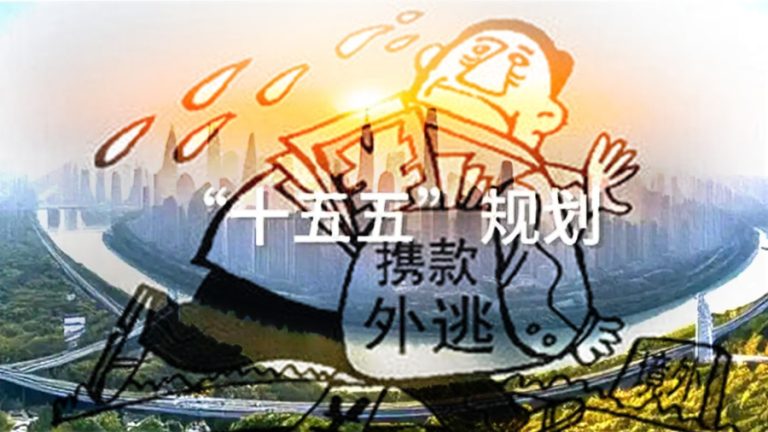
As the Chinese Communist Party’s (CCP) Fourth Plenum approaches, Beijing’s propaganda machine is shifting into overdrive. Beneath the global chatter about China’s future, one question lingers: how will the CCP once again hijack public perception?
At the end of September, the Politburo confirmed the plenum’s date and agenda. Soon after, the State Council Information Office staged a press conference titled “High-Quality Completion of the 14th Five-Year Plan.”
The event turned into a marathon of self-praise, boasting of supposed progress in housing, social welfare, ecology, culture, finance, science, tourism, and even disability employment.
But the spectacle masks an uncomfortable truth: the CCP’s “Five-Year Plan” has become a carefully scripted game. The Party writes the rules, plays the referee, and dictates the final report—a standardized template that filters out reality while amplifying illusion. Buzzwords such as “growth rate,” “completion ratio,” “new high,” and “breakthrough” fill the air, substituting metrics for meaning.
In practice, the so-called 14th Five-Year Plan bears the scars of three years of pandemic chaos. Many of its key targets have failed or been delayed, while statistical “successes” exist only on paper. As the CCP’s rule stretches into its eighth decade, its propaganda has evolved into a refined art of deception—its packaging glossier, its lies more elaborate.
Success
You are now signed up for our newsletter
Success
Check your email to complete sign up
A grim landscape
Behind that façade lies a grim landscape: shrinking global demand, post-pandemic stagnation, an aging population, technological isolation, external frictions, and a massive property-debt crisis—problems an authoritarian system cannot solve.
Even the Party’s most radiant blueprints are now smudged by the ink of reality.
Unless one is a state-approved economist, most analysts reach the same conclusion: China’s 14th Five-Year Plan has fallen badly behind on key structural and green-transition goals.
Its unmet promises are being hastily rolled into the upcoming “15th Five-Year Plan,” which the Fourth Plenum is expected to endorse with another round of hollow talk about “structural reform.”
To put it politely, the Chinese economy under the 14th Plan has struggled on multiple fronts—real estate, employment, foreign investment, and industrial overcapacity. Policy missteps, combined with one-man rule, have deepened uncertainty and fear across the market.
Meanwhile, rent-seeking and power-for-money exchanges have not diminished; they have thrived. Instead of being rooted out, corruption has been cultivated in fertile, well-tilled soil.
Under Xi Jinping’s economic doctrine, the 14th Five-Year Plan has proved powerless to manage structural change or restore investor confidence.
China’s demographic dividend
Looking deeper, China’s demographic landscape has undergone an irreversible shift: collapsing birth and marriage rates, a shrinking labor force, rapid aging, and a distorted job structure—where young people can’t find work while middle-aged workers are forced into early retirement. Economic growth has been successfully suppressed; social instability has surged.
Even official rhetoric now concedes the obvious: “China’s demographic dividend is fading,” and “low marriage and fertility rates will constrain long-term growth potential.”
The CCP tirelessly recites its mantras of “stabilizing real estate, stabilizing investment, stabilizing growth”—but never “stabilizing deaths.” From a more spiritual perspective, the accelerating wave of deaths during the 14th Five-Year period might well be seen as part of Heaven’s reckoning with the regime—its “year-on-year growth” tragically impressive.
The true death toll of the 14th-Plan era — long a matter of public suspicion — remains unreported in state media. Official figures claim that fewer than 54 million people were cremated between 2021 and 2025, including all “normal” deaths. Yet such numbers reflect underreporting and manipulation — a virtual reality built by deleting inconvenient statistics.
Independent AI-based analyses abroad, drawing on reports from January through September 2025, show thousands of sudden deaths (from strokes, cardiac arrest, and other causes) among public figures, officials, students, and professionals.
These figures — gleaned from open media, social networks, and WeChat screenshots — exclude ordinary citizens.
Even these limited online cases paint a chilling picture: the regime’s “best and brightest” are dying in record numbers. Within the system, the tally of “accidental deaths” has reached a grim new “breakthrough.”
Under Beijing’s command for “unified thinking,” China’s statistics agency now follows a single rule: unified storytelling. Any data hinting at a crisis—such as reports of mass deaths among younger generations—are swiftly branded as “rumors.” Yet even the official denials betray the truth: the dying is real; only the numbers are hidden.
The State Council boasts of “59 million new urban jobs” during the 14th Plan — a figure that quietly confirms how many positions had to be refilled.
Behind such slogans lies a society suffocating under pressure, weary of the Party’s endless plans and hollow promises of “stability.”
In preparation for the Fourth Plenum, the People’s Daily unleashed an eight-part political series titled “China’s Economy Under Xi Jinping Thought.”
It paints collapse as transformation and repression as progress, while the people who power the economy are reduced to expendable tools.
The essays even urge democracies to accept China as “a model of inclusive global development”— an Orwellian plea from an authoritarian state.
Absurd propaganda
The propaganda soon descends into absurdity. One article praises the AI model DeepSeek as a national triumph; in reality, its usage has plunged from 50 percent to just 3 percent because it cannot speak freely. Crippled by some 350,000 banned keywords, it freezes or produces nonsense whenever reality intrudes—a perfect metaphor for the CCP’s digital mind. Last year alone, China’s cyber-regulator deleted 1.34 billion accounts — meaning that, on average, each citizen was censored more than once.
Information itself has become the scarcest commodity. Chinese-language content makes up barely 1.3 percent of the world’s top web pages; English accounts for nearly 60 percent. As one saying goes, “A country that can’t even open the Nobel Prize website will never win a Nobel Prize.” Yet Beijing still proclaims “high-quality growth” and “enhanced confidence.”
In truth, Xi Jinping’s regime sustains miracles only on paper. Its realby-products—corruption, censorship, and fear — would set record highs if honestly counted. Every new slogan, every “success story,” serves one purpose: to pave the way for Xi’s indefinite rule.
What remains is not governance but performance — a dying system dressing its decay in triumphal songs while trampling morality beneath its feet.
The views expressed here are solely those of the author and do not necessarily reflect the views of Vision Times.