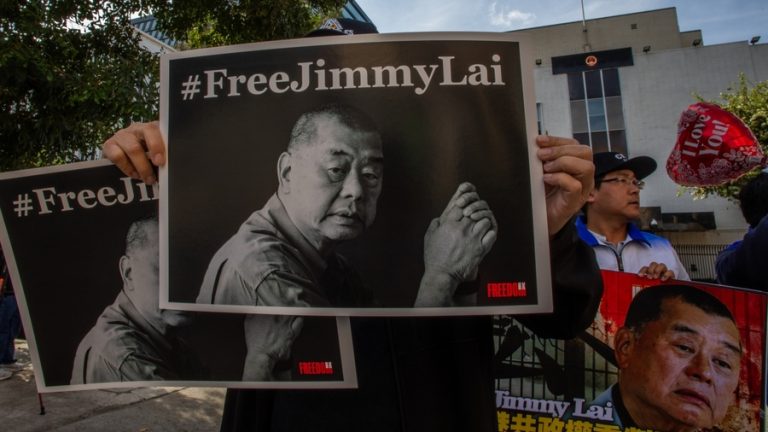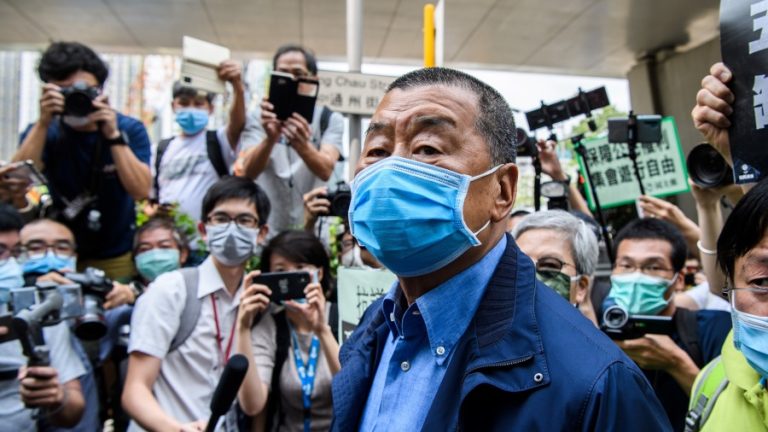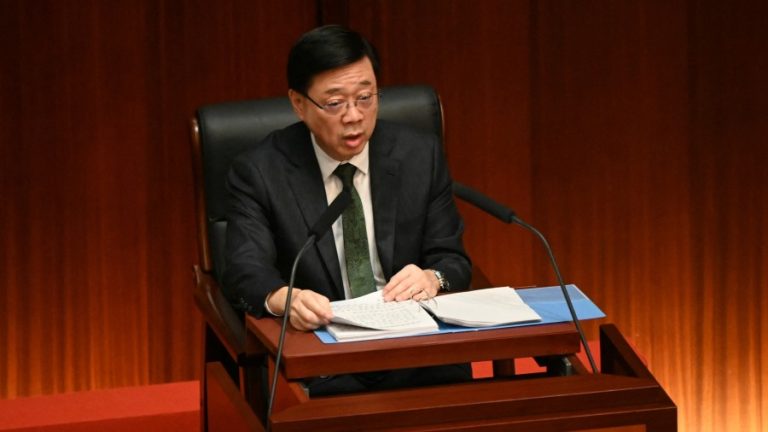
In July 2020, then-U.S. President Donald Trump signed an executive order declaring a national emergency with respect to Hong Kong and imposed economic sanctions on 48 Chinese and Hong Kong officials. This week the United States confirmed that it would not renew the national emergency and removed nine officials from the sanctions list, including Secretary for Justice Paul Lam Ting-kwok and two former Commissioners of Police, Stephen Lo Wai-chung and Raymond Siu Chak-yee, according to a statement by the Office of Foreign Assets Control on July 17.
The Committee for Freedom in Hong Kong Foundation (CFHK) expressed shock and strong opposition to the U.S. government’s decision, arguing that the ultimate beneficiary of the move would be the Chinese Communist Party (CCP). Megan Khoo, Policy Director of Hong Kong Watch, also voiced concern that the decision could pave the way for the restoration of Hong Kong’s preferential trade status.
Nine Chinese and Hong Kong officials removed from sanctions
The U.S. Department of the Treasury’s Office of Foreign Assets Control (OFAC) recently confirmed that the national emergency regarding Hong Kong, declared by President Trump through an executive order signed on July 14, 2020, has expired.
The U.S. Department of the Treasury stated that the expiration of the national emergency does not affect restrictions imposed under the 2019 Hong Kong Human Rights and Democracy Act or the 2020 Hong Kong Autonomy Act.
It further noted: “As stated in Executive Order 13936, Hong Kong does not enjoy a sufficient degree of autonomy. Therefore, under the specific U.S. laws and provisions cited in that Executive Order, Hong Kong should not receive treatment different from that accorded to the People’s Republic of China.”
Success
You are now signed up for our newsletter
Success
Check your email to complete sign up
A Treasury spokesperson added that the sanctions authorities under those two Acts substantially overlap with those established under the now-expired national emergency. As a result, the administration decided to streamline the sanctions framework by allowing the emergency declaration to lapse.
The United States announced that it would remove the following officials from its sanctions list: Paul Lam Ting-kwok, Hong Kong’s Secretary for Justice; Dong Jingwei; Raymond Siu Chak-yee, former Commissioner of Police; Sonny Au Chi-kwong, Secretary-General of Hong Kong’s Committee for Safeguarding National Security; Joe Chow Chung-pat, Assistant Commissioner of Police (National Security); Margaret Chiu Wing-lan, then Assistant Commissioner of Police (National Security).
These six officials had been sanctioned since March of last year. Also removed from the sanctions list were: Stephen Lo Wai-chung, former Commissioner of Police, who had been sanctioned since August 2020; and Qiu Hong and Yang Jianping, both former Deputy Directors of the Liaison Office of the Central People’s Government in the Hong Kong SAR, who had been sanctioned since July 2021.
READ MORE:
- Trump Accuses China of 2020 Election Interference; Expert Cites Prior Documentation of Beijing’s Cyber
- Trump Says China Stole 220 Million American Voter Files in the ‘Largest Compromise of Election Data in
Thirty-nine Chinese and Hong Kong officials remain under sanctions
An additional 39 Chinese mainland and Hong Kong officials remain subject to U.S. sanctions.
They include: Xia Baolong; John Lee Ka-chiu, who was Secretary for Security at the time and is now Hong Kong’s Chief Executive; Eric Chan Kwok-ki, who was then Director of the Chief Executive’s Office and Secretary-General of the Committee for Safeguarding National Security, and now serves as Chief Secretary for Administration; Chris Tang Ping-keung, who was then Commissioner of Police and is now Secretary for Security; Former Chief Executive Carrie Lam Cheng Yuet-ngor; Former Secretary for Justice Teresa Cheng Yeuk-wah; among others.
In response to the U.S. decision, both the Hong Kong Special Administrative Region (HKSAR) Government and China’s Ministry of Commerce welcomed and praised the move.
CFHK expresses shock and strong opposition
However, the overseas Hong Kong advocacy organization Committee for Freedom in Hong Kong Foundation (CFHK) said in a statement on Friday it was shocked by the U.S. decision and strongly opposed it.
Jonathan Stivers, the Foundation’s U.S. Director, questioned the move, arguing that the Chinese Communist Party (CCP) would ultimately be its greatest beneficiary.
Meanwhile, Megan Khoo, Policy Director of Hong Kong Watch, said the U.S. decision not only failed to hold the CCP accountable but also handed Beijing “a win it has not earned.” She warned that the move could pave the way for restoring Hong Kong’s preferential trade status and send the wrong signal internationally—that the United States’ commitment to human rights is negotiable.
Before the announcement, President Donald Trump delivered a nationally televised address on Thursday (July 16), in which he accused the Chinese Communist Party of interfering in the 2020 U.S. presidential election to benefit then-President Joe Biden.
The White House had previously indicated that Chinese President Xi Jinping could visit the United States in September. Meanwhile, the South China Morning Post recently reported that Ma Zhaoxu, China’s Vice Foreign Minister, is expected to travel to Washington in the near future, in what may be preparations for Xi’s visit to the United States.