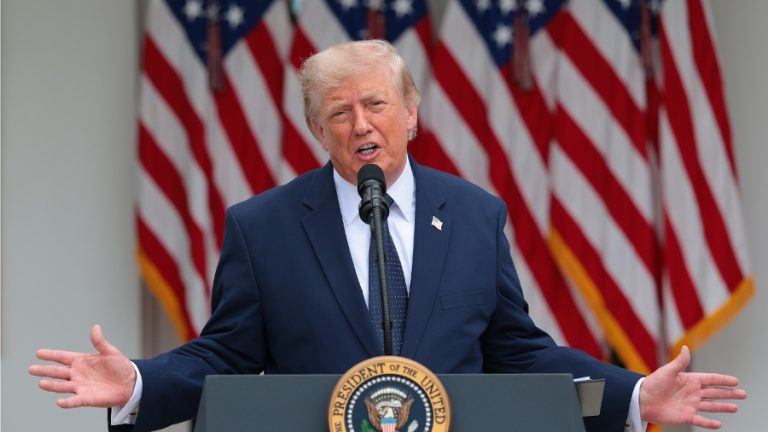
U.S. President Donald Trump fulfilled a previous pledge by releasing a series of newly declassified documents concerning foreign interference in U.S. elections on Thursday, July 16.
The documents not only describe what they characterize as the Chinese Communist Party’s (CCP) broad-based efforts to infiltrate the U.S. political system, but also allege that some officials within the U.S. intelligence community attempted to downplay or even conceal those threats.
All of the declassified materials have now been published on the White House’s newly established “Election Integrity” webpage. The site is divided into several sections covering topics such as the alleged theft of voter data, vulnerabilities in voting systems, an investigation into Michigan’s voter rolls, and the unlawful registration of non-citizens as voters.
Although many portions of the documents remain heavily redacted for national security reasons, the information that has been made public is sufficient enough to send shockwaves through Washington’s political establishment.
Success
You are now signed up for our newsletter
Success
Check your email to complete sign up
Personal data of 200 million Americans allegedly exposed: The CCP’s ‘big data’ hunt
According to the declassified documents, the Chinese Communist Party’s (CCP) alleged interference in U.S. elections was far more extensive than previously believed.
A CIA cable memorandum written in July 2020, incorporating intelligence from the Federal Bureau of Investigation (FBI) and the National Security Agency (NSA), states that Chinese intelligence services had identified the “senior leadership of the United States” as a priority target.
Targeting senior officials: The report alleges that the CCP sought to gain access to the personal email accounts of senior officials within the Executive Office of the President, multiple executive branch agencies, the U.S. Congress, and the federal judiciary.
Large-scale data collection: The documents further allege that cyber actors linked to the CCP obtained the personal data of more than 204 million Americans from major U.S. databases, polling firms, political organizations, and non-profit organizations. According to the intelligence assessment, while some of the information came from publicly available sources, Chinese authorities allegedly used big data integration and analysis to build models capable of precisely influencing public opinion.
A separate report by the National Intelligence Council (NIC) available inside the downloadable archive of the Election Integrity page similarly concluded that Beijing significantly expanded its cyber intelligence collection during 2020, carrying out what it described as “opportunistic intrusions” into U.S. private-sector organizations in an effort to obtain information on political donors, election campaigns, and voter preferences.
Alleged counterfeit driver’s licenses intended to influence voting
Among the disclosures, is a particularly significant raw intelligence report from the FBI. According to it, a confidential source told investigators that the CCP had allegedly produced tens of thousands of highly convincing counterfeit U.S. driver’s licenses and shipped them to the United States in multiple batches.
The intelligence assessment said that the alleged purpose of the operation was to enable Chinese students studying in the United States and certain immigrants who were considered sympathetic to Beijing to vote in the election despite lacking legal voting eligibility, by using the counterfeit identification documents.
The report further alleges that the objective of the scheme was to increase the number of votes cast for then-presidential candidate Joe Biden.
RELATED:
- Trump Accuses China of 2020 Election Interference; Expert Cites Prior Documentation of Beijing’s Cyber
- Trump Says China Stole 220 Million American Voter Files in the ‘Largest Compromise of Election Data in
- Trump Condemns Communism in Speech Celebrating America’s 250th Anniversary
An alleged ‘shadow game’ within the intelligence community: Trump orders investigation
In addition to allegations of interference by foreign adversaries, the declassified documents also direct scrutiny toward elements within the U.S. intelligence community. Several internal email exchanges indicate that some intelligence officials privately discussed ways to “minimize or downplay” reporting related to alleged CCP election interference.
Internal resistance: One unnamed intelligence official reportedly wrote in an email: “For various inconsequential reasons, the intelligence community deliberately avoided mentioning the connection to the election.”
The email was reportedly sent as evidence of alleged Chinese interference was beginning to emerge.
Alleged manipulation of intelligence briefings: In his Thursday address, Trump cited an internal email that he said showed intelligence analysts had admitted to “deliberately modifying the President’s Daily Brief (PDB)” by removing dozens of sensitive intelligence reports concerning Beijing’s alleged activities targeting U.S. elections. According to Trump, this prevented the president from receiving a complete intelligence picture.
Trump stated: “Concealing intelligence of this importance is, in essence, a betrayal of America’s national security.”
He said he had formally directed the Office of the Director of National Intelligence (ODNI), the Department of Justice (DOJ), and the Federal Bureau of Investigation (FBI) to launch an internal investigation. He also called for the dismissal of all personnel allegedly involved in “filtering” intelligence and for criminal charges to be pursued where violations of the law are found.

Alleged psychological warfare through racial tensions and social media
The declassified documents also describe what they characterize as psychological warfare exploiting divisions within American society.
Alleged incitement: According to a report by the National Intelligence Council (NIC), Chinese intelligence analysts viewed racial conflict as a vulnerability in U.S. society. The declassified documents allege that employees of Chinese technology companies with ties to the Chinese government assisted in covert operations using digital platforms to incite violent acts and anti-government protests in the United States.
Social media campaign: According to the documents, the alleged influence operations were conducted across platforms including TikTok, Facebook, Twitter (now X), and YouTube. While U.S. intelligence agencies acknowledged that direct evidence linking specific campaigns to official instructions was limited in some cases, they assessed that certain elements within the Chinese government were at least aware of and tacitly approved the online influence efforts aimed at fostering social division.
In addition to China, the reports also identify Iran, North Korea, Russia, and Venezuela as countries of concern.
The declassified documents warn that these foreign adversarial states are continually improving their capabilities to undermine the U.S. electoral system. According to the documents, they seek to weaken the foundations of the United States by exacerbating social tensions and fostering socio-economic divisions.